
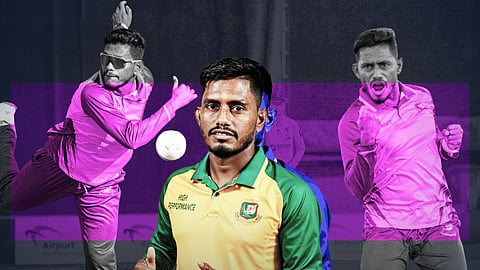
From conducting weddings in Chattogram to topping wicket charts in Australia, Rubel eyes the next step
AI generated summary, newsroom reviewed
For years, Md Rubel balanced life as a marriage registrar with a cricket career that seemed to be going nowhere fast, finishing his day job before heading straight to training or matches to keep both going.
That grind through Bangladesh's lower-tier leagues finally paid off at last season's NCL T20, where 10 wickets for Chattogram Division earned him the tournament's Promising Player award.
A BPL call-up and a third-place finish on the Dhaka Premier League wicket-takers' list (23 scalps) followed, but it was his first trip abroad that truly announced him: at the recently concluded Top End T20 Series in Australia, the 30-year-old topped the wicket charts with 23 dismissals in seven games, headlined by a five-for against NT Strike that carried Bangladesh's High Performance XI into the semi-finals, where they eventually fell to Victoria despite Rubel's own 3 for 18.
In an exclusive interview with Daily Waadaa, Rubel spoke about his standout tour of Australia, the deliberate three-month project that transformed him from an average off-spinner into a mystery spinner armed with a doosra and carrom ball, and his belief that a national call-up is still within reach.
Australia's conditions are completely different from Bangladesh's. What's the main reason behind your success there?
I've tried to stick to my strengths and bowl in good areas. At the end of the day, the results have come.
This was your first time playing abroad. Did you face any issues adjusting?
It felt good overall. Before this tour, I didn't even have a passport. The food took a little getting used to, though it wasn't a major issue. Being on a completely different circuit outside the country for the first time, I'm happy with how it's gone.
You used to be an off-spinner. Mystery spinners are a rare breed in Bangladesh. What drove this evolution? Did you feel off-spin wasn't going to work for you?
When I started out with off-spin, my performance was average. I played second division for many years and would get around 18 to 20 wickets a season, nothing more. I felt that if things continued that way, I wouldn't be able to play at a much higher level, so I decided to try something different. It's worked out.
Roughly when was this, and how long did it take?
It was around 2023-24. I started training about three months before the second-division league that season. I finished as the division’s leading wicket-taker with 37 wickets. The following season, in the first division, I topped the wicket-takers’ chart again with 43. I also performed well in the NCL T20 and, then, Alhamdulillah, I got the opportunity to play in the BPL.
Did you get help developing your variations, like the doosra?
I did a lot of net bowling for the national team, and that's when I started developing my different deliveries. Riyad bhai (Mahmudullah) noticed a problem with my follow-through and suggested my carrom ball could be more effective if I worked on it, so I did.
Unconventional spinners have traditionally been overlooked in Bangladesh's domestic cricket, unlike in Sri Lanka or India. But in the last DPL, Aliss Al Islam finished top of the wicket-takers and you finished third. How do you see this shift?
It's a good sign for mystery spinners and bowlers with unconventional actions. More bowlers are trying something different now, and it's paying off. I expect it to grow.
What do you think caused that neglect, and have you personally experienced it?
No, I haven't. Since I started with these variations, I've finished on top wherever I've played, so I haven't faced that.
Your performances in the tournament earned a lot of praise. While playing in Australia, did you have any memorable interaction with a former star or prominent cricket figure whose words particularly stayed with you?
I didn't meet anyone from Australia, but I spoke with South African legend Johan Botha, the Northern Territory Strikers coach. He praised me and said, 'I want to see you in the Big Bash.'
National team debuts after age 30 are rare in Bangladesh. How confident are you that you'll break that trend?
Whatever my age, I'm still very fit, and I'll play for many more years if I avoid injury. In the last NCL fitness test, I finished first in my division. The required time was six minutes 40 seconds; I clocked five minutes 58 seconds. I'll keep playing as long as I get the opportunity.

You have four variations now. Which is your main strength, and what do you see as your weakness to improve?
I don't think about it that way. I just try to bowl in good areas. Aside from that, sometimes I try to use my stock delivery repeatedly to set batsmen up before switching. That's it.
Bangladesh had just secured a historic Test win in Darwin before you arrived. What were your impressions of playing at the same venue, and how did you find the conditions there?
We went there on the final day of the Test. The matches were played on the same wicket. I wouldn’t say the pitch was bad, nor was it too extreme. You saw how Miraz took a five-wicket haul in the fourth innings, so there was certainly some help for the spinners on that Darwin wicket as well.
You were regularly trusted with the ball during the powerplay. What was your role in the team’s bowling plans, and how did you approach those overs?
The first powerplay is four overs in that tournament, and I usually bowled the second and fourth. After the 10th over, the batting side could take a two-over powerplay whenever they wanted, and I bowled during that phase as well. So in my four-over spell, three overs generally came during the powerplays, two in the opening four overs and another after the 10th, with one over outside the powerplay.
Where did your cricket journey really begin, and how did you find your way into the game?
It started simply. Growing up, I played tape-ball cricket with friends, and I was decent at it, which gave me real confidence early on. That led me into madrasa cricket, where I was studying at the time, and that environment really changed things for me, it's where my competitive streak actually developed. I had no idea about academies or formal trials back then. I got into practice properly in 2008, but stopped after about three months and drifted away from the game for a couple of years. I picked it back up in 2010, played my first qualifiers in Dhaka in 2011, and after another gap, settled into first and second division cricket from 2014-15 onward.
You mentioned madrasa cricket shaped your competitive edge. How important was that environment to your development, and how good was the standard there really?
It was hugely important. The standard of cricket at Kamil Madrasa was really high, with tournaments and real competition everywhere. I don't think people outside realise how much talent is sitting in that system. I've seen boys playing madrasa cricket who could comfortably compete at Premier League level or above. If the cricket authorities actually went looking there, they'd find some excellent players. I'm proof of what that pathway can produce.
You didn't come up through the traditional age-level system. Was that because you started in Chittagong?
No. When I began playing in 2011, I didn't have proof of age. I went for age-level trials once but was ruled over-age and never tried again. I just worked hard through domestic cricket instead.
Alongside cricket, you had another responsibility as a marriage registrar. What was life like trying to balance your job with your cricket career?
I worked as a marriage registrar for several years. I would finish my work during the day and then head straight to training or a match. It was tough, but I needed to support my family. I never let the job come in the way of cricket, and somehow I managed to keep both going. Sometimes I would finish a ceremony and go directly to a match. Those were difficult days, but they also pushed me to keep going.
Who has helped you most along the way?
Irfan bhai [Irfan Shukkur] has helped me enormously. I trained with him for 13 to 14 years, and he took care of everything for me.
How are you personally taking the news that this year's BPL isn't happening? How much will it affect you financially?
That's the board's decision to make. My job is just to play, wherever I get the opportunity. If not the BPL, there'll be another tournament, and I'll play that instead.
Who's your cricketing idol, one from Bangladesh and one from outside?
Shakib Al Hasan, both within the country and beyond, he's simply my favourite player in world cricket, and I don't rate anyone else as highly. I've bowled to him many times over the years, though it was always just casual conversation in the nets rather than any specific advice.