
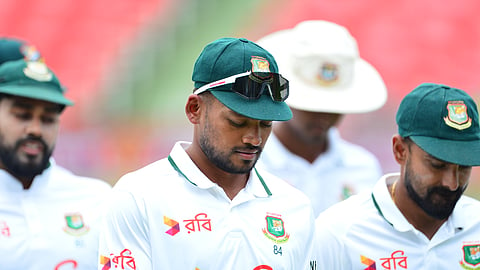
One step forward, 10 steps back: The story of Bangladesh’s rise and cries in Tests
“World Test Championship [smirks]… I can’t say whether Bangladesh will be making the World Test Championship final [smiles], but we are going to focus on the game in hand.”
October 28, 2026. The opening day’s play of the first Test between Bangladesh and West Indies had come to a close. It was time for the customary post-day press conferences.
After Bangladesh captain Najmul Hossain Shanto faced the press, it was the turn of West Indies’ off-spinner Jomel Warrican.
He fielded a couple of queries about the match, before came the question that broke through his professional poise.
He was asked about the pitch at the Sher-e-Bangla National Cricket Stadium offering turn from the onset, and how the visitors hoped to cope with this ploy, which, he claimed, was set to help Bangladesh earn valuable points in their bid to reach the final of the World Test Championship (WTC).
Warrican’s expression remained stoic for most of the question, right until the WTC part, when he couldn’t help but steal a glance at his team’s media manager sitting to his right.
He quickly regained his composure, though, began answering the question, but right as he came to the WTC final part, a faint smile broke through.
Now, it would be wrong to label his reaction as disrespect. From the looks of it, it stemmed mostly from disbelief; disbelief at Bangladesh’s belief that a berth at the WTC final is even possible.
The WTC final dream
At that press conference, only one journalist posed the question, but to be fair to him, he only said out loud what many had been thinking.
Ranked fourth in the WTC standings, with six matches in hand – two each against West Indies and England at home and two away against South Africa – Bangladesh were in the contest for a place in the final, at least, mathematically.
Out of their six matches in the cycle till then, they had drawn one, lost two and won three, one of which was the historic triumph over Australia in Darwin in August.
With a point percentage of 55.56, Bangladesh needed to win four off their remaining six to take their points percentage over 60, which historically has been enough to seal a place in the final.
It was not something that only the media and the fans were hyping up either.
In the buildup to the West Indies series, Bangladesh head coach Phil Simmons said that reaching the final was a ‘goal’ for his team. Captain Shanto also declared his side can ‘certainly achieve’ that goal.

The Bangladesh Cricket Board (BCB) was also eyeing the same goal, moving away from the sporting track that was prepared for the recent home Tests in Mirpur and preparing a turner.
The plan was set: clean-sweep the Caribbeans, try to pull off an upset in South Africa like in Australia. If that doesn’t happen, there are always the two home Tests against England, where the spin trap could be brought back to ensure another clean-sweep.
The media had worked out the permutations, the BCB had sketched the blueprint, and the players had set their sights on the final.
The only trouble, nobody bothered to analyse what had happened in the past.
Machine learning failure
They say ‘History repeats itself’ – whether anyone believes this statement or not, AI definitely does.
At the core of Artificial Intelligence is the method of machine learning – observing historical data to identify patterns and predict future outcomes.
Now, how exactly machine learning factors into how AI functions is not the point here. The point is that historical data matters, as humans tend to repeat their past patterns.
In the last five years, Bangladesh have followed a familiar pattern in Test cricket.
It started in New Zealand in 2022, when Bangladesh pulled off a historic win over the Kiwis in Mount Maunganui – arguably their biggest victory in the format till then.
That eight-wicket win, built on a brilliant six-wicket haul from pacer Ebadot Hossain, was even more significant as it came in the absence of Shakib Al Hasan and Tamim Iqbal.
It raised hopes that Bangladesh have finally evolved into a Test team that can win in overseas without their biggest names.
But the belief generated from that win was gradually beaten out of the team, as the Test side went winless in the next nine matches.
The team’s next notable win in the five-day format came in Pakistan in 2024, when they whitewashed the hosts 2-0 – their first Test series win over Pakistan – with Nahid Rana scorching the opponents with his raw pace.
That win was then followed by seven straight defeats. The winless run ended with an impressive 101-run victory over West Indies in the Caribbean, but in their very next Test, they suffered a three-wicket defeat to Zimbabwe in Sylhet.
Bangladesh again whitewashed Pakistan in 2025, this time at home. But in the very next month in Harare, they conceded their first innings defeat against Zimbabwe in almost a quarter of a century.
These defeats right on the back of big wins indicate that despite the recent upward tick in Test cricket overall, the Tigers still haven’t cracked the code to consistency in the format.
After Bangladesh pulled off their biggest triumph in red-ball cricket till date in Darwin in August, everyone should have seen the equally catastrophic dip coming.
Unfortunately, unlike AI, humans are yet to master the method of machine learning.
Glory followed by gloom
The miracle at the Marrara Oval, where Bangladesh beat Australia by nine wickets, was followed by an innings and 51-run drubbing at the hands of the hosts. However, the pummeling in the second Test could hardly dampen the hype of the Darwin Test win.
A draw with Afghanistan in the UAE followed in a non-WTC match, where Bangladesh failed to seal the win on the fifth day despite dominating the Test.
Spinners Taijul Islam, Mehidy Hasan Miraz and Nayeem Hasan failed to get the job done against an inexperienced Afghanistan side on the fifth day. Still, Bangladesh laid a spin trap for West Indies in Mirpur.
That trap snared the hosts instead of the tourists, with Warrican playing a leading role with a nine-wicket haul in the match.
A draw followed in the Sylhet Test, and with it the series went to West Indies.
Bangladesh's hopes of repeating their Darwin heroics in Johannesburg were dashed when, despite putting up 400 on the board in the first innings, courtesy of tons from Towhid Hridoy and Litton Das, they conceded a 157-run first-innings lead.
The hosts then bundled out the tourists for 168 and chased down the 12-run target with nine wickets to spare.
Despite the defeat, Bangladesh could take some pride out of the fight they had shown at the Wanderers.
But all that went out the window in Centurion.
A 91-run capitulation in the first innings decided the fate of the match on the first day.
South Africa then batted for three-and-a-half sessions, amassed a 403-run lead and took less than two sessions to roll over Bangladesh a second time and complete an innings and 219-run win inside two-and-a-half days.
Breaking the mirage
Warrican's smirk that October evening looked like disbelief. A month on, it reads more like foresight.
The WTC final, which seemed like an achievable dream just around a month ago, now looks like a mirage with the benefit of hindsight.
Mathematically, Bangladesh were in contention. But for a side that had previously never finished above seventh in a WTC cycle, aiming for the final is perhaps a few steps too far.
Rather than getting tangled up in talks of a WTC final, Bangladesh would have benefitted more had they focused on continuing to improve as a Test side, to try and figure out how to become more consistent.
The series loss against West Indies and getting whitewashed by South Africa doesn’t mean the win over Australia was a fluke. It just means that Bangladesh still have a long way to go in their development cycle, and there is nothing wrong with that, as long as they stay on track.
Before sketching out routes to the WTC final, Bangladesh need to figure out how to string together a few wins in the format.