
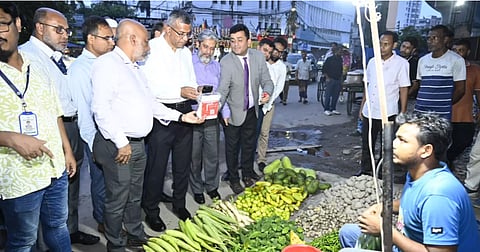
BB launches 'Bangla QR' nationwide to boost cashless payments
Bangladesh Bank Governor Md Mostaqur Rahman on Wednesday officially inaugurated transactions using Bangla QR, marking a major step towards a cashless society and a fully interoperable digital payment ecosystem.
The governor launched the initiative by completing a transaction using the unified QR code at a bKash merchant outlet in Motijheel, the capital's commercial hub.
From Wednesday, the central bank made the implementation of Bangla QR mandatory for all businesses across the country.
The unified system removes the existing complexity that required merchants to display multiple separate QR codes for different mobile financial services, including bKash, Nagad, Rocket and various commercial banks.
Under the new interoperable arrangement, a single QR code displayed at a merchant outlet will allow customers to scan and pay using any bank, mobile financial service or payment service provider application of their choice.
Bangladesh Bank officials described the move as the most significant milestone so far in achieving financial interoperability. They said the initiative is aimed particularly at bringing small and marginal traders — such as tea stall operators, grocery shop owners and kitchen market vendors — into the formal financial system without requiring expensive point-of-sale (POS) machines.
According to Bangladesh Bank, the maximum transaction charge under the new uniform setup has been capped at Tk11.50 per Tk1,000, making it highly competitive with existing digital payment channels.
Economists and central bank officials expect that expanding cashless transactions will significantly reduce the costs associated with printing, transporting and managing paper currency, which currently amount to an estimated Tk20,000 crore annually. The initiative is also expected to help curb tax evasion, formalise parts of the informal cash economy and reduce financial fraud by encouraging transactions through secure banking applications.
On 1 April, Bangladesh Bank issued a directive requiring all banks, mobile financial service providers and payment system operators to replace their individual merchant QR codes with Bangla QR by 30 June. The central bank warned that institutions failing to comply could face penalties of up to Tk30 lakh.
Although field-level implementation experienced a relatively slow start on the first day due to limited awareness and insufficient training among some retail merchants, Bangladesh Bank officials said digital payment adoption is expected to accelerate rapidly as awareness campaigns and regulatory monitoring are strengthened.