
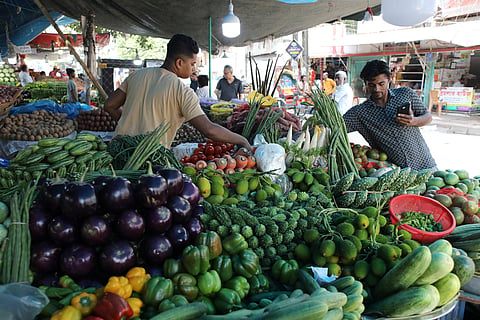
Inflation dips to 9.16% fuelled by falling food prices
Inflation fell to 9.16% in June from 9.42% a month earlier, owing partially to a fall in food prices.
According to the latest data from the Bangladesh Bureau of Statistics, food inflation fell to 8.60% from 9.06% in May, a 1.11 percentage point dip.
Non-food inflation, on the other hand, declined to 9.61% from 9.71% over the same period.
The latest numbers mean that overall inflation has remained above the 9% mark for the third consecutive month.
According to the BBS, the 12-month moving average inflation for the period from July 2025 to June 2026 stood at 8.68%, down from 10.03% recorded during the corresponding period a year earlier.
The government has set its targets on combatting inflation.
On June 30, the Bangladesh Bank (BB) kept its benchmark policy rate unchanged at 10% for the first half of fiscal year 2026-27, maintaining a tight monetary policy as inflation continues to remain well above the central bank's target.
Bangladesh Bank has pursued a contractionary monetary policy since the first half of FY2023-24, aiming to curb inflation by keeping borrowing costs high and containing excess liquidity.
Despite the prolonged tightening cycle, inflation remains elevated.
Official data showed overall inflation rose to 9.42% in May, the highest level since February 2025.
Both urban and rural areas recorded inflation above 9%, reflecting broad-based price pressures across the economy.
BB said it expects inflationary pressures to gradually ease in the coming months as its tight monetary stance has kept real interest rates positive, although subdued private investment and external uncertainties continue to weigh on economic growth.
The central bank has previously attributed persistent inflation to the Russia-Ukraine war, Middle East conflicts, sharp depreciation of the taka, volatile global commodity prices, fuel price hikes, heavy government borrowing and supply chain disruptions.
Speaking in Parliament on June 24, Finance Minister Amir Khosru Mahmud Chowdhury said the government had set a target of reducing inflation to 7.5% and raising economic growth to 6.5% in the 2026–27 fiscal year.
The finance minister said the government had identified controlling commodity prices, protecting the purchasing power of ordinary people and ensuring balanced regional development as the key priorities of the budget.
To achieve these objectives, the government plans to strengthen coordination between monetary and fiscal policies, build foreign exchange reserves, keep the budget deficit at a manageable level, prioritise public expenditure and boost production and investment to restore market stability, he said.
Economists remain cautious as the new fiscal year's expansionary budget and a stimulus package worth nearly Tk600 billion could boost economic activity but also increase demand and liquidity, potentially adding fresh inflationary pressure.