
Bangladesh may have to accept slower growth for now: Khosru
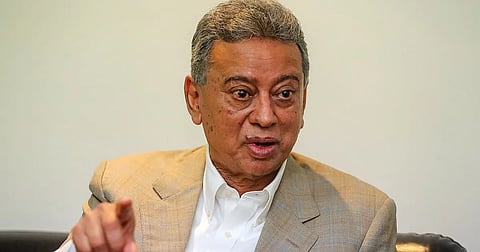
Finance and Planning Minister Amir Khosru Mahmud Chowdhury on Sunday said Bangladesh may have to accept slower economic growth for some time as the government had prioritised stabilisation and recovery of the economy.
“Growth will remain low for some more time. We are now at the recovery stage and engaged in firefighting every day. Our first priority at this moment is stability,” he said.
The minister was speaking, as the chief guest, at the inauguration of a training programme on the “Five-Year Strategic Framework for Reform and Development”, organised by the General Economics Division (GED) of the Planning Commission at the NEC-2 auditorium in the capital.
He said the government was facing significant financial pressure due to the high cost of importing fuel, gas, fertiliser and other essential commodities, which was contributing to imported inflation. “The government exchequer is bleeding absolutely,” he said.
Khosru said the government was having to purchase these commodities at prices two to three times higher than before, resulting in substantial pressure on the national exchequer.
He said the government had some control over domestic inflation and was taking measures, including tax reductions, to ease price pressures, noting that imported inflation remained largely beyond its control.
Referring to the inflation situation, the minister said food inflation had come down to around 6.4 percent, but the government needed to reduce it further.
He said the government believed in transparency and would not attempt to conceal economic difficulties or present misleading statistics to portray a better picture.
“If you try to explain things with wrong statistics, the government will be the first to suffer. Our responsibility is to present the actual situation before the people, explain why particular indicators are performing poorly and outline how we intend to correct them,” Khosru said.
He acknowledged that some economic indicators might remain weak during the recovery phase, but stressed that the government must ensure that corrective measures were moving in the right direction within specific timeframes.
The minister said the government was also working to restore confidence in the banking sector, which had accumulated huge liabilities over the years.
The immediate priority was to restore depositors’ confidence, he said, adding that the government had assured them that their deposits were safe and would be returned without any haircut.
Khosru said net deposits in banks had started increasing instead of witnessing the feared withdrawals, indicating a gradual improvement in public confidence.
Regarding the capital market, he said it had been turned into a casino under the previous system, discouraging good companies from getting listed and driving away genuine investors.
The minister said the present government had reformed the regulatory structure and appointed a new independent, non-political commission to restore confidence in the market.
He expressed optimism that the capital market would recover as investors returned and international fund managers began showing renewed interest in Bangladesh.
Referring to Prime Minister Tarique Rahman’s recent engagement with international investors on Wall Street, the United States, Khosru said 17 leading fund management companies, with combined assets worth around US$36 trillion, had attended a breakfast meeting with the Prime Minister.
He said several international investors had expressed interest in Bangladesh and made commitments, including investments of $500 billion and $700 billion in climate-related funds, as discussed at the meeting.
The minister said the government’s Five-Year Strategic Framework was the outcome of years of policy discussions and consultations, rather than an initiative conceived only after assuming office.
He traced its background to the BNP’s Vision 2030, prepared following the party’s Vision 2020 in 2016, and subsequent political programmes, including the 27-point and 31-point reform proposals.
Khosru said the framework had been aligned with the party’s political philosophy as well as the priorities of development partners, including the World Bank, Asian Development Bank, International Monetary Fund, Islamic Development Bank, Asian Infrastructure Investment Bank and Japan International Cooperation Agency.
However, he said the biggest challenge was to translate the framework into action within clearly defined deadlines.
Describing the document as a “live document”, the minister said the government would need to identify implementation gaps, institutional bottlenecks and coordination problems as work progressed.
He said the government’s aspiration was to create one crore jobs and that achieving the target would require coordinated investment from the private sector, the government and foreign investors.
Khosru said the government had set four criteria for public investment: value for money, economic returns, employment generation and environmental considerations.
Every public investment decision must be assessed against these criteria to ensure that public money generates economic benefits and creates employment, he said.
The minister also stressed the need for systematic evaluation of development projects after their completion to assess whether they had delivered the expected outputs and returns.
He said the Bangladesh Bureau of Statistics (BBS) had been asked to publish accurate statistics without government influence.
A research facility had also been established at the BBS to allow researchers to access information, with plans to make the facility available online, Khosru added.
He urged government officials to work beyond their institutional boundaries and involve private-sector representatives, NGOs, academics and professionals in implementing the framework.
“The government alone cannot deliver everything. We need to involve everyone according to their respective strengths,” the minister said.
He said the first year of the five-year framework would be particularly difficult as the government focused on recovery and stabilisation.
However, the fourth and fifth years must become a period of economic take-off, Khosru said, adding that the government could not continue to cite recovery as an explanation for weak performance in the later years.
State Minister for Planning Zonayed Abdur Rahim Saki attended the programme as a special guest, while GED Member Dr Monzur Hossain chaired the session.
Saki said the government was working to align development projects across ministries and divisions with its Five-Year Strategic Framework for Reform and Development to ensure coordinated planning and better implementation of its election manifesto.
He said the government had decided to move away from the conventional five-year planning approach and introduce a strategic framework that gave greater importance to implementation, coordination and measurable outcomes.
“Planning is not our biggest challenge; implementation is. We have many plans, but they are often not implemented properly,” Saki said.
He said the Planning Ministry had been tasked with translating the election manifesto, on the basis of which Prime Minister Tarique Rahman received the people’s mandate, into a realistic and actionable roadmap for the government’s five-year tenure.
The framework was developed after extensive discussions and consultations, including work over the past eight to nine months, the state minister said.
He said the Planning Ministry had held separate meetings with almost all ministries and divisions to ensure that development projects were not undertaken in isolation or in a fragmented manner.
Instead, projects would be organised into clusters under specific programmes derived from the strategic framework to achieve optimal outcomes, Saki said.
The government has also prepared sectoral plans to help ministries and divisions align their projects with the framework. These plans are expected to be made public shortly, he added.
The state minister said the government was working to translate the commitments in its election manifesto and the strategic framework into specific programmes that could be achieved within five years.
Several flagship programmes had already been identified, with implementation activities under way, he said.
Saki said the Planning Ministry expected to receive the complete set of programme-based and clustered project proposals from all ministries during the preparation of the Revised Annual Development Programme (RADP).
He said the next challenge was to ensure that officials and all stakeholders involved in implementation understood the framework and could apply it in their respective areas of work.
The workshops were part of the effort to share the framework with officials across ministries and divisions and build a common understanding of its objectives and implementation process.
Saki expressed hope that the initiative would help ensure coordinated implementation of the government’s development priorities throughout its five-year term.