
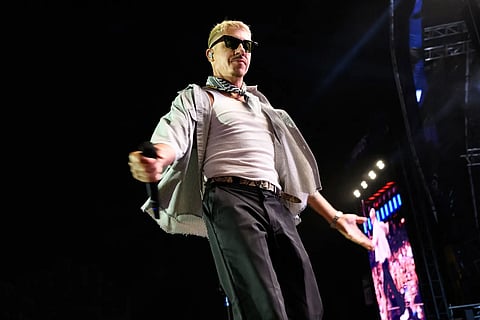
Macklemore speaks out after Ed Sheeran tour removal
Macklemore has been removed from Ed Sheeran’s US tour following his recent Free Palestine comments at MetLife Stadium in New Jersey, with the rapper alleging that pressure from stadium owners led to his departure and Gillette Stadium owner Robert Kraft defending the decision.
Macklemore had been opening for Sheeran on recent US dates when he used his set to speak about Palestinians in Gaza and the West Bank. At MetLife Stadium, he told the audience that those in Gaza and the West Bank “have not been forgotten” and that every person deserved “exactly the same freedom”.
“I say Free Palestine, free Cuba, Congo, Sudan and Iran and all the people of America who live in fear because of this terrorist organisation ICE,” he said before performing his pro-Palestine song “Hind’s Hall” with footage of Gaza shown on screen.
The Israeli-American Council subsequently called for Macklemore to be removed from the tour, accusing him of using his platform to “advance a one-sided political agenda”.
Messina Touring Group, promoter of the US leg of Sheeran’s Loop Tour, confirmed Macklemore’s removal in a statement shared with Rolling Stone.
“As the concert promoter for Ed Sheeran’s US Loop Tour, we have been notified by venues on the upcoming U.S. tour dates that they will not allow a concert to take place with Macklemore on the lineup, which would result in the cancellation of the tour and impact hundreds of thousands of fans,” the promoter said.
“After discussions with stakeholders, Macklemore will not be performing on the remaining support dates.”
Macklemore responded to the decision in a lengthy statement on Instagram, saying Sheeran and his team had decided to remove him from the tour.
He said he did not consider himself, Sheeran or P!NK, who had also faced controversy over the issue, to be victims.
“The victims are the Palestinian people,” Macklemore wrote. “The men, women and children who have been killed, starved, displaced and forced to live through unimaginable violence.”
Macklemore claimed that Sheeran told him Kraft had said he would not be allowed to perform at Gillette Stadium. He further alleged that Kraft had approached other stadium owners, who collectively told Sheeran that he would not be able to play their venues if Macklemore remained on the tour.
Kraft, who owns the New England Patriots and Gillette Stadium, later responded in a statement confirming Macklemore’s removal from the September 25 and 26 concerts.
“Gillette Stadium has a longstanding commitment to providing a welcoming environment for all guests and ensuring that events held at our venue do not provide a platform for hate speech,” Kraft said.
He cited Macklemore’s recent actions, material shared from the stage during Sheeran’s New Jersey shows and what he described as “a broader history of antisemitic rhetoric and imagery” that he said had been offensive and hurtful to the Jewish community.
Kraft said the decision was not intended to diminish the suffering of Palestinians or deny anyone the right to advocate for them.
“Their pain and loss are real,” he said, while arguing that such advocacy should not come at the expense of the Jewish community or obscure the responsibility of Hamas, which he described as a United States and globally designated terrorist organisation.
Kraft said he “agreed with Macklemore” that too many lives had been lost and there had been too much suffering, but argued that focusing selectively on the conflict and ignoring Hamas’ actions contributed to division and hate.
“Standing with the Palestinian people and standing against Hamas, antisemitism and hate should not be mutually exclusive,” he said.
Kraft also said he respected Sheeran and his ability to bring people together, adding that he would welcome an opportunity to meet Macklemore to discuss the issues.
“Ultimately our goal is the same: peace for all people, an end to suffering, and an end to all hate,” he said.
Macklemore described Sheeran as a “friend” and said the singer “was in a fucked up position” as his usual apolitical stance came under pressure.
According to Macklemore, Sheeran told him that the words “Free Palestine” and the Palestinian flag were hurtful to many people he had spoken with.
Macklemore said he told Sheeran that if those words were considered more offensive than the deaths of Palestinian children, there was a fundamental disconnect between their positions. He said Sheeran could not move beyond his public-facing stance of not taking sides.
Representatives for Sheeran were contacted for comment.
Macklemore also addressed the criticism surrounding his recent statements, which had drawn criticism from Boy George and P!NK.
“What I said at MetLife I have been saying on stages around the world for almost three years. So why is it an issue now?” he wrote.
“Because now I’m sharing a stage with one of the biggest artists in the world, in some of the biggest stadiums in America. At a certain level of exposure ‘Free Palestine’ becomes too much of a risk.”
He argued that continued performances in which audiences responded positively to calls for Palestinian liberation could encourage other artists to speak out.
“The stage becomes resistance. Maybe that’s why this time it became so important to silence me,” he wrote.
The decision has also drawn support for Macklemore from other musicians.
Garbage singer Shirley Manson called his removal from the tour “wildly unjust”, arguing that his comments were neither violent nor hateful.
“Can I just remind everyone that nothing Macklemore actually said was violent or hateful or remotely radical,” she wrote on Instagram.
Foo Fighters guitarist Chris Shiflett also defended Macklemore after calls for his removal emerged. Responding to a discussion about whether the rapper should have expressed his political views while opening for Sheeran, Shiflett wrote: “Maybe speaking out against genocide trumps etiquette.”
Macklemore has expressed longstanding views on the conflict through his music, including “Hind’s Hall”, released in 2024, and its sequel, which featured Palestinian-American artists Anees and Amer Zahr, Gaza-born rapper MC Abdul and vocals from the Los Angeles Palestinian Kids Choir.
The original song was named after Columbia University’s Hamilton Hall, which was renamed Hind’s Hall by pro-Palestine student activists in honour of Hind Rajab, a child killed by Israeli forces in Gaza.