
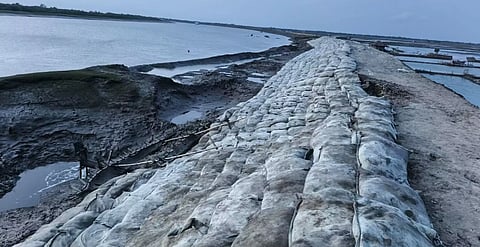
Coastal embankment sinks midway through repair in Khulna’s Koyra
A government-funded embankment repair project along the Kapotaksha River in Khulna’s Koyra upazila has begun showing signs of collapse even before completion, raising fresh concerns over the quality of work and the long-term effectiveness of flood protection in one of Bangladesh’s most climate-vulnerable coastal regions.
Residents and environmental campaigners alleged that the embankment is being repaired without removing saline water intake pipes used by nearby shrimp farms, an issue they say has repeatedly weakened the structure and caused breaches in the past.
They fear the latest project, worth Tk 26.80 lakh, may suffer the same fate unless the underlying problem is addressed.
The repair work covers a 240-metre stretch of the embankment along the Kapotaksha River from Dashhaliya towards Hogla under the Water Development Board’s (BWDB) Non-Development Revenue (NDR) programme.
Contractor Messrs Amin & Co began work on February 9, with completion scheduled for July 20.
However, a visit to the site on June 30 revealed that four large pipes, three within the first 100 metres of the repaired section and another farther along, remain embedded inside the embankment.
Instead of removing the pipes, workers have raised the embankment by piling earth over them.
Two sections near the pipes have already subsided, with one portion partially collapsing into the river.
Emergency protection work using geo-bags and bamboo piling was underway at the site.
No project signboard displaying construction details was found.
Large pits were also visible along the riverbank where soil had apparently been excavated for the repair work, while the embankment slope appeared unusually steep.
Local residents also alleged that some geo-bags were filled with muddy or insufficient sand instead of standard materials.
A recurring problem
Local residents Babu, Mostafiz and Abdul Hai said around 30 to 35 pipes have been installed along a two-kilometre stretch of the embankment to bring saline river water into shrimp enclosures.
They said tidal flows through these pipes gradually wash away the surrounding soil, weakening the embankment from within.
The embankment has failed several times before, flooding large areas, Babu said. “Repairing it without removing the pipes will only repeat the same cycle.”
Former union parishad member Didarul Islam said, “All pipes, including the four inside the new repair section, should be removed first. Otherwise, the embankment will become vulnerable again within days, wasting public money.”
Experts urge long-term solution
Environmentalists argue that the recurring repairs reflect a failure to tackle the root cause.
Tarikul Islam, president of the Coastal and Sundarbans Protection Movement, said the Dashhaliya embankment collapsed multiple times in recent years, causing losses worth crores of taka.
“Despite government restrictions on saline shrimp farming adjacent to embankments, enforcement remains weak. As a result, public funds are being spent year after year on repairing the same sections,” he said.
He suggested supplying water to shrimp farms through canals connected to the Shakbaria or Koikhali canals instead of installing pipes through embankments.
“That would eliminate the need to puncture the embankment and significantly improve its durability,” he said.
Palash, who supervises the work on behalf of the contractor, said the project was being implemented according to specifications.
“The subsidence occurred because of the pipes, not because of the repair work itself. The damaged sections are being repaired again,” he said.
BWDB Sub-Assistant Engineer Solaiman Hossain said the contractor has been instructed to restore the collapsed portions.
Koyra Upazila Nirbahi Officer Md Abdullah Al Baki said removing the pipes involves multiple stakeholders and cannot be done immediately.
“There are several challenges in removing the pipes. We will hold discussions with elected representatives, relevant government agencies, civil society members and shrimp farm owners before taking a decision,” he said.
For many residents, however, the latest collapse has reinforced an old concern: unless the embankment’s structural vulnerabilities are addressed rather than patched over, repeated repairs may continue to consume public funds while offering little lasting protection against coastal flooding.