
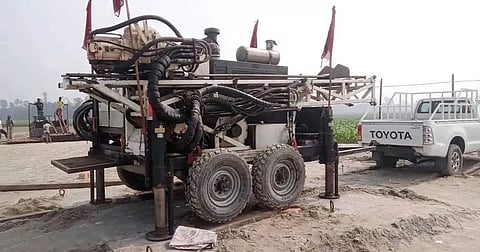
Exploration for iron ore deposit in Pirganj resumes after six decades
Exploration activities have officially resumed at the country's first potential iron ore deposit in Pirganj upazila of Rangpur, six decades after it was first identified.
Mohammad Saiful Islam, Secretary of the Ministry of Power, Energy and Mineral Resources, inaugurated the resumption activities at Velamari Pathar in Chhota Paharpur village under Sanerhat Union recently.
According to officials, the site was first identified in 1965 by the then Pakistan government's Mineral Resources Department. Four exploratory wells were drilled in the Velamari Pathar area, covering parts of Shanerhat and Mithipur unions, and the wellheads were sealed with concrete markers, some of which remain visible.
Officials said a team of geologists carried out an initial survey of the approximately six-square-kilometre area on September 6, 1965, shortly after the outbreak of the Indo-Pak war. Based on the survey, the area was identified as having iron ore potential, but no further exploration took place for decades.
Although mining plans were discussed on several occasions over the years, no significant work was undertaken until the Geological Survey of Bangladesh (GSB) launched the latest exploration programme at a new geological drilling well, designated GDH-79/25.
Secretary Saiful Islam described the initiative as an important step towards assessing the country's mineral resources.
"The government will provide all necessary support for the exploration and possible extraction of mineral resources found here. This is not an ordinary project; it represents a long-held national aspiration," he said.
The event was organised by the Geological Survey of Bangladesh.
GSB Director General Abdul Mannan and Deputy Director General Ali Akbar, among others, addressed the programme.
Ali Akbar said several exploratory surveys had already been conducted in the area over the years.
"The first well, EDS-15, was drilled before independence and provided preliminary geological information. After independence, another well, GDH-54, was drilled in 2000 to assess subsurface conditions. In 2023, drilling at well GDH-78/23 in Kashimpur village under Mithipur Union also identified indications of mineral resources," he said.
He added that the current programme aims to drill to a depth of 1,200 metres this year.
Responding to a question on the possibility of commercial extraction, Akbar said mining would depend on the results of the exploration.
"If the exploration confirms sufficient mineral reserves and extraction is economically viable, we will recommend that the government proceed with mining operations," he said.
On the types of minerals that may be present, he said the area's elevated basement geology suggests the possible presence of metallic minerals, including iron, copper, nickel and manganese, and potentially even gold.
"However, the exact nature and quantity of the mineral resources can only be confirmed after the exploration is completed," he added.