
Rajshahi city residents to get 200 million litres of drinking water next year
Rajshahi, the largest city in the country's drought-prone Barind region, is grappling with an acute drinking water crisis as rapid urbanisation and a soaring population continue to outpace the city's water supply infrastructure.
The city is currently facing a daily shortfall of nearly 37.5 million litres of drinking water, underscoring the severity of the growing water crisis.
To reduce pressure on the continuously declining groundwater level in the Barind region and ensure a sustainable water supply for city residents, the long-awaited Surface Water Treatment Plant Project is being implemented.
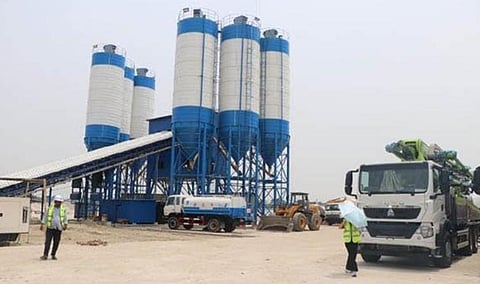
The physical work on this mega project, being built at a cost of about Taka 4,062.22 crore under joint funding from Bangladesh and China, has already reached 65 per cent completion.
Once the project is completed, it will be possible to supply 200 million litres of purified water daily by drawing water from the Padma River and treating it, which will easily meet the projected water demand through 2035.
Currently, the total daily water demand in the Rajshahi metropolitan area is about 11.32 lakh litres. To meet this demand, WASA mainly extracts 8.65 lakh litres of water per day from underground sources through deep tube wells.
This major undertaking is being carried out in three main phases. First, a modern intake point is being built at the confluence of the Padma and Mahananda rivers in Godagari to ensure the primary water supply. According to the survey, there will be an uninterrupted flow of water at a depth of at least 30 feet throughout the year.
Second, a central treatment plant with a daily capacity of 200 million litres is being built next to the intake point. In the third phase, a booster pumping station and a power substation are being set up in Haripur of Paba Upazila.
Of the 26.5 km transmission pipeline from the main plant to the city via Haripur, 21 km has already been completed. Rapid pipeline installation work is currently underway along the Godagari-Rajshahi highway.
In addition, 16 km of distribution pipeline has been installed across the city, while work on another 10 km is in its final stage.
The project uses world-renowned French water treatment technology and high-quality, long-lasting pipelines manufactured by China's Jingjian Company. The materials have been selected in accordance with international standards, taking into account a lifespan of at least 70 years.
WASA Chief Engineer Parvez Mamud said the plant has been designed with priority given to the city's projected demand in 2035 and future boundary expansion, adding that the completion of 21 km of the 26.5 km pipeline is a major achievement.
Under the project, water will be drawn from the Padma River, treated, and transported through pipelines to the booster pumping station in Haripur, Paba Upazila.
From there, purified water will be supplied to city residents. At the same time, residents of 30 wards in Katakhali, Nowhata and Godagari will also receive safe drinking water under the project.
Sanching, chief engineer of the Chinese contracting firm, told BSS that, following landfilling and levelling, structural piling at the main site and construction of the substation are in the final stage. He said the company is committed to completing the work on time while maintaining international standards.
Analysts see the mega project as an important step towards protecting Rajshahi's environment.
Prof. Abdul Wakil of the Department of Urban and Regional Planning at Rajshahi University of Engineering and Technology (RUET) told BSS that the groundwater level in the Barind region is declining at an alarming rate, making 100 per cent dependence on groundwater environmentally unsustainable.
He said the initiative to bring water from the Padma River to the city after treatment is a very positive step for Rajshahi.
Sufiuddin Ahmed, Rajshahi district president of the civic organisation SUJAN, said long-term and far-reaching planning is needed to fully utilise the potential of the Barind region.
Meanwhile, although the project's initial implementation period was set at four years, officials expressed strong optimism that, at the current pace of work, construction of the water treatment plant will be completed by 2027 and purified water will be supplied to city residents through the pipeline network.