
How the beauty parlours give Garo women a way out...and way up

Though she once aspired to be a doctor, the career path changed for Bani Rema as she moved to Dhaka twenty years ago as a member of a family struggling to manage its finances every month.
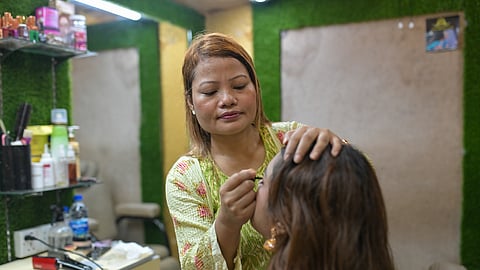
Today, the 38-year-old Garo woman from Dhobaura of Mymensingh runs a beauty parlour at Mohakhali in the capital, employing three staff and making around Tk1,00,000 every month.
Bani’s journey, from a rural high school student to an independent entrepreneur, reflects a much larger story of migration – of a community that gradually moved away from traditional livelihoods in search of survival and opportunity.
Driven by economic necessity and shaped by a matriarchal culture, generations of Garo women, like Bani, have turned beauty parlours into pathways of independence, creating an industry that now supports thousands of families across Bangladesh.
According to Alik Mree, former president of the Bangladesh Adivasi Chhatra Sangram Parishad, around 150,000 Garo people currently live in Bangladesh, based on their survey. Of them, around 20,000-25,000 are estimated to live in Dhaka, with most engaged in different occupations.
He said the migration of Garo people to Dhaka for employment began around the early 1980s, as economic pressures in rural areas pushed many towards the capital.
“The discontinuation of jhum cultivation, poverty in villages and a lack of employment opportunities pushed many Garo people towards the city. Many also came to Dhaka to work in order to repay debts,” Mree said.
For many migrants, Dhaka offered not only jobs but also a sense of security through community networks. The presence of relatives and other Garo families in the capital encouraged more people to make the move, creating clusters mainly based in Savar EPZ and Kalachandpur where newcomers could find support and adjust to urban life.
According to Arnika Chiran, president of the Bangladesh Garo Beauty Parlour Owners Association, roughly 250 Garo-owned salons now operate across Dhaka, providing an economic lifeline for thousands of women who have migrated from agrarian communities in search of opportunity.
How Garo women entered the trade
The origins of this transformation can be traced to the late twentieth century, when commercial beauty parlours began appearing in Dhaka under the ownership of expatriates and Chinese entrepreneurs.
The Chinese owners of Bangladesh’s early beauty parlours, including Mayfair and Hong Kong Beauty Parlour, chose Garo women to train and work in the salons.
What began as a hiring preference would eventually open a new economic pathway for ethnic women from the north, as they quickly found their footing in the trade.
Mree said several factors contributed to the popularity of the profession among Garo women. One of the biggest was the language barrier many faced after arriving in Dhaka.
“Before coming to the city, many Garo women could not speak Bengali fluently. The beauty parlour profession did not require them to speak highly polished Bengali, making it easier for them to enter the sector,” he said.
He added that beauty work was also relatively easy to learn, allowing many women to quickly develop skills, secure jobs and become financially independent.
Zarina Asghar, founder of Bangladesh’s first beauty salon ‘Living Doll’, said the Garo women were quick learners and had an advantage as many lived near the Indian border, where beauty work was already a well-established profession.
“You can’t imagine in words how their hands work like magic. They just learn and follow,” she said.
Zarina, who had already become a household name by the late nineties, believes the beauty industry’s growth owes much to the Garo women who came, saw and conquered.
She said some salon owners also took advantage of the physical resemblance of Garo women with Thai and Chinese beauticians to mislead customers about the origins of their staff.
Sarothi Nokrek and the first breakaway
For the Garo women, the shift from being employee to entrepreneur began taking shape by the mid-1990s.
Gandaria, one of Dhaka's once most decorated areas, saw the first Garo women-led beauty parlour ‘Sarorthi Beauty Parlour’ as it carries the name of its founder Sarothi Nokrek.
Now the 56 year old Sarothi, the pioneer of Garo beauticians’, too came from Mymensingh when she was just 12 years old and started working at Mayfair before starting her venture in 1995.
Sarothi’s migration was driven by seeing her mother’s suffering and one of her brother-in-law helped her to settle in Dhaka.
“I could think of little beyond my mother. But her hardship was what drove me to stay, work and build a future”, Sarothi said.
What followed was not merely personal advancement but the creation of opportunities for others. Over the years, Sarothi trained numerous women who later established salons of their own as her salon became part of an informal apprenticeship system that would help countless women move beyond low-paying labour and into skilled work and entrepreneurship.
A matriarchal path in a patriarchal world
Unlike the predominantly patriarchal culture of Bangladesh, Garo society is matriarchal, placing significant responsibility for family welfare on women.
“Our brothers don’t look after the family; the girls do. So girls are coming, and employment is growing”, explains Bani.
“After coming to Dhaka in 2007, I saw that there was a lot of potential in the salon business,” she added.
For many young women arriving in Dhaka from rural parishes, beauty parlours offered something equally important: safety.
“I noticed that for those working in salons, there is both safety and convenience,” says Arnika, the owner of Me & Mirror Beauty Parlour, who used to work at a private company office before working as a beautician.
“It’s a women-only environment; no men enter inside.”
You see, you learn, and earn
The beauty trade among Garo women has long relied on apprenticeship rather than formal education as they enter through relatives or friends already working in the industry. Skills are acquired gradually through observation and repetition, taking at least six months to learn the basics of the craft. The training itself remains largely informal and free.
“We don’t have separate formal courses; I train them myself when they join. It’s free, and there is good accommodation inside”, said Arnika.
The newcomers are usually aged between 10 to 15 years, as there are instances of leaving schools at sixth grade to work as a beautician.
“When they see a neighbour working as a beautician and being able to take care of parents and educate siblings, they get inspired and come to join,” Arnika added.
A senior beautician earns roughly Tk40,000 to 50,000 per month.
Throughout her career, Zarina trained thousands of women, often accommodating those who could not afford fees.
“When poor girls came and said, ‘We have very little, we have no money,’ I still did it,” she says. “I never turned anyone away.”
Against the odds, they stayed open
Despite its success, the profession has its own challenges. The general people used to speak ill of it.
The difficulties intensified in 2017 and 2018 when government crackdowns targeted commercial establishments operating in residential areas.
Arnika’s salon was closed for eight months. Then came the COVID-19 pandemic that proved even more disruptive.
Recognising the need for collective action, salon owners established the Bangladesh Garo Beauty Parlour Owners Association in 2021 and it now has 150 members.
During the pandemic, Arnika helped 14 Garo women secure government grants worth Tk100,000 each through Social Development programmes.
Bani also experienced significant losses during COVID-19, forcing her to shut down multiple outlets.
Yet she adapted, shifting to a leaner model based on online visibility and word-of-mouth referrals.
“I used to work through my page, but now I don’t need the page because I am known everywhere in Dhaka. I get work online automatically”, she said.
The next matrix
Today, the beauty industry is moving steadily away from its informal roots toward professional certification and technical education.
The industry received formal recognition in 2020 as the government declared beauty services as an industrial sector.
Meanwhile, the independent Garo salon network continues to play a major role in Dhaka’s beauty economy.
“For those who have built large industries – like Persona – they are hiring based on CVs now,” Bani says.
Twenty years into the business, Bani’s story is not only about economic success. Her ambitions have expanded beyond personal achievement, from building own career to creating opportunities for others.
“I want to open a large parlour industry or an institute or academy for Garo girls,” she says. “I haven’t found anything for our girls or Chakma girls who have financial problems.”