
In Old Dhaka’s Shankhari Bazar, Puja still tastes of ladoo, nostalgia and 54 years of history
The drums reach you before the pandals do. In Shankhari Bazar, Laxmibazar and Tatibazar the lanes narrow to a slow flow of people, and the air smells of incense and frying oil.
Bamboo frames rise over the doorways, and the lights hang so low that tall men duck. Families move in clumps, children held up by the wrist, grandmothers steered by the elbow.
Nobody is in a hurry, because nobody can be.
Near the mouth of Shankhari Bazar, a pandal put up by an organisation fifty-one years old fills the road. People stop in front of it, tilt their heads back, take photographs, and drift on. Past it the lane tightens again.
The crowd stops looking up at the lights and starts looking sideways, at the shopfronts, and the sweet shops are where it slows to a crawl.
Some of the people who come out of them are carrying white boxes, tied with string, held level in front of them. You follow the boxes back to their source.
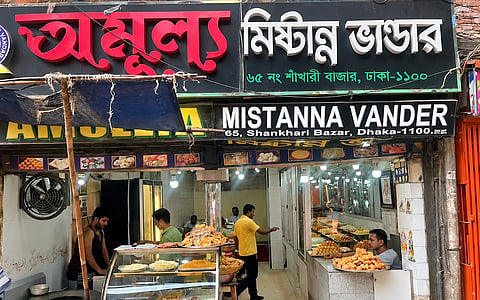
It leads to 65 Shankhari Bazar, and a shop so full that people stand in the doorway holding their place. Inside, a tray of kochuri sits on one side with amirti beside it.
On the side, three kinds of ladoo are selling faster than they can be weighed. The noise is of a market: orders called across heads, the scrape of a scoop, the clink of change.
At the cash counter sits Ratul Chandra Saha, and under the counter, on the bottom shelf, are two jars of ghee. He points to them while explaining the ladoo.

"Ghee ladoo doesn't mean it's fried entirely in ghee," he told Daily Waadaa, "We fry it in oil with ghee mixed in."
Ratul gives the sums. At the current price of ghee, he said, frying the whole batch in it would make the business impossible. The ladoo would have to sell at six hundred taka a kilo, not three hundred.
The signboard says the shop is fifty-four years old. Amulya Chandra Saha, who was born in Shankhari Bazar, started it, and his photograph hangs inside among the staff. He died in Shrabon of the Bengali year 1396.
His son Rajib Saha runs the shop now, though today Puja business has kept him elsewhere, so Rajib's son Ratul is at the till. "This shop isn't from today," he told Waadaa. "My grandfather started it. I don't sit here regularly. My father mostly does."
Across the room, Lakshman Kumar Saha knows where everything is. He has worked here twenty-five years, since 1997, and knew the place long before that, having grown up in the neighbourhood.
When it opened, he said, six or eight people could sit inside. Now it is twenty-four. The name used to hang on a plain board; today it is in red block letters.
Prices have moved too. In the seventies a luchi cost twenty-five paisa, and now it is six taka. Dal was one taka a plate, and so was the bhaji. A plate of dal, bhaji and halwa is now fifteen.
But it is the cooking Lakshman misses. The luchis were fried in ghee, he says, "and what a fragrance." The vegetables were done in pure mustard oil. "That taste was something else. Heavenly."
After the mid-eighties mustard oil became expensive and soybean oil came in. Soybean took the place of ghee for the luchis, and palm oil found its way into the vegetables later. Nobody announced any of it.
Each change was forced by cost, and together they make up most of what has happened to the shop's food since the seventies.
Some things have stayed. The jaggery sandesh was the original, and the sugar one came later. Both cost the same, though people prefer the jaggery.
"We didn't raise its price to match," Ratul said. "It sells well anyway." While I stood there an older couple, buying a kilo, looked over the display and picked the jaggery.
Chhanar polao used to be in almost every sweet shop in Old Dhaka, and now most have dropped it. Here it is still made, and the neighbourhood rates it.
The kochuri is the odd one out. It is common in West Bengal and rare in Bangladesh, though Old Dhaka ate plenty of it under the British and into the sixties and seventies. Amulya Babu put it on the counter at the start, and it is still made fresh each day with a mix of spices.
The three Puja ladoo are made only for the season: ghee at three hundred taka a kilo, Dalda at two hundred and eighty, plain at two hundred and forty. Each day's batch is sold that day, and this will go on until Dashami.
The shop opens at six in the morning and shuts at eleven at night, though in Puja it runs to half past midnight, sometimes one. Breakfast goes until ten or eleven: dal made of chickpeas, mixed vegetables cooked something like labra, semolina halwa with a little ghee. Luchi is also there in the evenings.
Lakshman has one worry, which he mentions quietly. When he joined, he said, the first craftsmen were still working and the raw materials were excellent. The suppliers today are younger and less experienced. He says nothing more about it.
Achintya Roy came from Mirpur with six friends, for the pandals and then the shop, which he had heard of. "Everyone around here knows it by one name," he told Waadaa. Each of them bought a ghee ladoo, an amirti and a kochuri. "It tasted good. The sweets are fresh."
Out in the lane the drums have not stopped, and the crowd is moving at the same pace, boxes held level. Fifty-four years on, the shop has changed its oil, its prices, its walls and its lettering.
The jars of ghee are on the bottom shelf, in plain view, and if you ask what is in the ladoo, someone will tell you.
—
Mahmud Newaz Joy is a freelance feature writer