
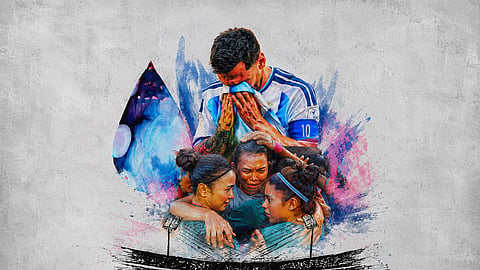
The tears that bind Messi and Sheuli
Tears are among the few things that remain stubbornly democratic, and on Tuesday evening, Lionel Messi was reminded of that.
The scene, at first glance, looked familiar. Argentina were opening their World Cup campaign against Algeria. Messi, making his 200th appearance for the national team, had already done what Messi so often does.
In the 18th minute, he received the ball outside the penalty area, shifted his weight and unleashed a left-footed strike that bent into the net with a sense of inevitability that has defined two decades of football greatness.
The crowd erupted. Teammates surrounded him. But as celebrations faded and players drifted back into position, something unusual happened.
Messi briefly lowered his head. He grabbed the bottom of his jersey and pressed it against his eyes. For a few seconds, it seemed insignificant. Perhaps sweat, perhaps dust, perhaps nothing at all.
Yet television cameras lingered. His eyes looked swollen. His expression seemed distant, burdened. The man who had just scored in a World Cup appeared less triumphant than troubled.
Soon, the images were everywhere.
The internet, as it invariably does, rushed to fill the silence with explanations. Many concluded that the tears were born of relief. Weeks earlier, Messi had suffered a hamstring injury that threatened his participation in the tournament.
At 38, every World Cup match carries the weight of finality. Recovering in time to lead Argentina onto the field and score in the opening game seemed reason enough for an emotional release.
It was a compelling theory. It was also wrong.
After Argentina's eventual 3-0 victory — a match in which Messi completed the first World Cup hat-trick of his career and matched Miroslav Klose's record of 16 World Cup goals — reporters asked him about the moment.
His answer surprised everyone.
"It was something completely unrelated to football," Messi said. He spoke of difficult days, thanked teammates and members of Argentina's delegation for supporting him through them but offered few details.

The mystery lasted less than a day.
Soon, reports emerged that Messi's father, Jorge Messi, had been hospitalised with an undisclosed illness. The family later confirmed that the 68-year-old was receiving treatment.
Suddenly, the images from Tuesday looked different. The fans thought they were witnessing one of the all-time greats putting on a classic performance, but what they were actually seeing was a son, worried about his ailing parent, soldiering on to fulfil his duty to his team, fans and country.
This is the price all athletes who represent their flags have to pay, whether they are a global icon like Messi or a young Bangladeshi footballer like Sheuli Azim.
On June 2, defender Sheuli lost her mother, Bashona Azim, to kidney-related complications. At the time, Sheuli was in Goa with the Bangladesh team for the SAFF Women's Championship.
Her mother's health had been deteriorating for months. But Sheuli could not be by her side as she had to spend long stretches away from home in training camps ahead of the tournament.
Then came the call every child fears. Her mother was no more.
The Bangladesh Football Federation attempted to arrange her return. But practical realities intervened as flight timings and other logistical issues made it impossible for Sheuli to reach Mymensingh before the funeral.
In the end, she remained in Goa. Through a video call, she watched her mother's final rites – a daughter said goodbye to her mother through a screen.
The next day, Bangladesh were playing Nepal in the semifinal and Sheuli was named among the substitutes.
She watched on from the bench as her teammates snatched a late winner and was surrounded by them afterwards, breaking down in tears.
The tears running down Sheuli’s cheeks were the same ones that Messi tried to hide on Tuesday; it was the price all professional sportspersons have to pay, the burden that connects them all.
The circumstances were different. The scale of their fame could not have been more unequal.
But grief has no hierarchy. Just like tears, it doesn’t discriminate.