
Bangladesh: The World Cup's most devoted outsiders
On July 4, 1990, Malaysian newspaper The Straits Times ran a 99-word agency story on its World Cup Special page about Bangladesh’s Banu Begum.
Banu lived in Khulna with her truck-driver husband.
Although she had no direct connection with the World Cup taking place in Italy, it consumed her life.
She was a fan overwhelmed with grief.
“A truck driver’s 30-year-old wife committed suicide in southern Bangladesh after Cameroon lost to England 3-2 in the World Cup quarter-final match in Italy, newspapers reported in Dhaka yesterday,” read the report titled Cameroon’s Defeat Leads to Suicide.
“‘I am also taking leave from the world as Cameroon leaves the World Cup,’ read the suicide note from Banu Begum, who hanged herself soon after the game ended,” the report said, quoting Khulna district police.

Questions can be raised about the authenticity of the report, given it cites no specific source.
But whether Banu’s story was real or not almost doesn’t matter, as it has since become part of football folklore.
Simon Kuper, in his acclaimed 1994 book Football Against the Enemy, also highlighted Banu’s death.
“When England knocked out the Lions [Cameroon], a Bangladeshi man died of a heart attack and a Bangladeshi woman hung herself. ‘The elimination of Cameroon also means the end of my life,’ said her suicide note,” he wrote.
This was just another instance.
Banu’s tale has been told and retold for more than three decades, pulling Bangladesh into a conversation it has never earned the right to join.
No Bangladeshi team has ever played at a World Cup.
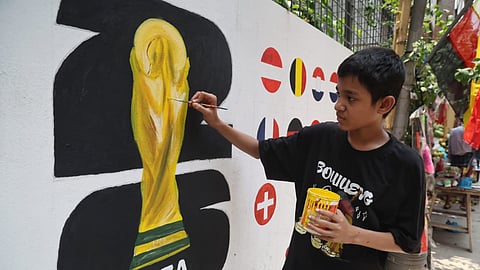
Yet Bangladesh keeps showing up through fans who every four years wave different flags, form parasocial connections with countries they would likely struggle to pinpoint on a map and, in their minds, become as much a stakeholder as any competing side.
The story of Bangladesh and the World Cup cannot be told through goals or trophies. It has to be told through grief, obsession and the stubborn insistence of a footballing non-entity that the tournament belongs to them as much as anyone else.
It is an unofficial World Cup journey three decades in the making, and it shows no sign of ending.
In the 1990s and 2000s, Bangladesh’s presence in the World Cup news cycle remained limited to over-the-top fan antics that became colourful footnotes in international media.
Fans across the country protested Diego Maradona’s expulsion from the 1994 World Cup in the United States over drug use, demanding — from the other side of the world — that FIFA reverse its decision.
International agencies also reported that in 1998, Dhaka power authorities received bomb threats warning against power cuts during World Cup broadcasts.
Deaths — through suicides, heart attacks and violent clashes across Bangladesh — continued to make headlines.
When the 2010s rolled around, social media arrived, creating a new avenue for Bangladeshis to showcase their World Cup obsession and for the world to watch.
Earlier, people elsewhere saw Bangladesh’s fandom through the lens of international media, which often portrayed the country as a distant place full of eccentric supporters obsessed with Argentina and Brazil in a tournament that had nothing to do with them.
Social media changed that perception by revealing another side of Bangladeshi fandom.
In 2014, three university students — Ashiqur Rahman, Faisal Ahmed and Shabbir Ahmed — frustrated by the country’s Brazil-Argentina obsession, created a Facebook group for unheralded Honduras and made international news.
We’re Crazy Fans of the Honduras Football Team from Bangladesh was the group’s name, and it quickly went viral.
The group even made headlines in Honduras, where locals were puzzled by their Bangladeshi supporters. Some responded with a similar fan group cheering Bangladesh in the 2015 ICC Cricket World Cup.
Social media worked its true magic during the 2022 World Cup in Qatar, when decades of devotion finally earned Bangladeshi Argentina supporters recognition from Argentine coach Lionel Scaloni.
“It fills us with pride that a country like Bangladesh supports Argentina like that. We thank you very much for the love, Bangladesh!” Scaloni said during a pre-match press conference before Argentina’s Round of 16 match against Australia.
After the Albiceleste added a third star, celebrations in Dhaka were as wild as those in Buenos Aires. Argentina’s official social media accounts reposted images from Bangladesh in an acknowledgement after the triumph.
With the 2026 World Cup in the United States, Mexico and Canada underway, familiar fan processions, online banter and clashes among support groups have returned.
For the first time, however, Bangladesh has made its presence felt in a different way, with Bangladeshi-born American DJ Sanjoy performing on an official World Cup song titled Siir, Siir.
He performed the anthem at the Canadian opening ceremony, proudly displaying the Bengal Tiger and the Bangladesh flag on his costume.
From getting 99 words in a single newspaper column to having a Bangladeshi voice woven into a World Cup anthem, Bangladesh continues to be present at the World Cup without ever qualifying.