
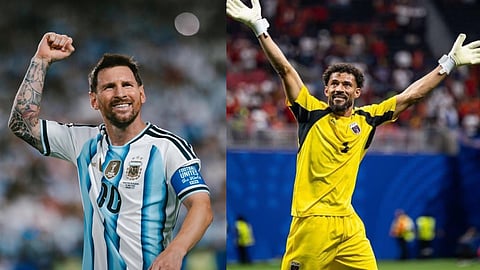
The 'little grandmother' guarding Cape Verde's dream against Messi
On the tiny island of Sao Vicente in the Atlantic Ocean, there once lived a puny boy with quick feet and a short fuse, who hated to lose.
He lived with his grandparents as his parents were away earning a living. He loved football, would regularly take on boys twice his size on the pitch and often get knocked down to the ground, with his face against the dirt.
He was quick to anger, but wasn’t big enough to put up a fight with the other kids. Hurt and furious, he would leave the pitch and walk back to his grandparents, while his playmates teased him by calling him a ‘little grandmother’.
They called him that so often that through repetition it became his nickname, much to his dislike.
He remained a relatively small kid till about the age of 17, when he hit a growth spurt, and in a matter of a few years, rose to over six feet in height.
Decades have passed since then; the angry little boy has now matured into a 40-year-old goalkeeper who has taken the world by storm in his country Cape Verde’s very first appearance in the World Cup.
His heroics in the 0-0 draw against Spain in the group stage turned him into an overnight star. His follower count on Instagram has shot up from around 45,000 before the World Cup to 17.4 million and rising.
He has been the star performer in Cape Verde’s historic qualification to the knockout stage – they are the smallest nation by population to make it this far in the World Cup.
The irony, however, is that even after achieving all of this, people hardly know his actual name, as the world knows him through his nickname, ‘little grandmother’, or in his native tongue of Portuguese, ‘Vozinha’.
His real name is Josimar Jose Evora Dias. His father Jose Pedro Dias, an avid football fan, named him after Brazilian striker Josimar, a cult figure from the 1986 World Cup – the year Vozinha was born.
However, Josimar wasn’t his father’s first choice.
He originally wanted to name his son Valdano, after Argentine striker Jorge Valdano, who was Diego Maradona’s attacking partner in the 1986 World Cup, when Argentina won their second World Cup trophy in Mexico.
Vozinha was born on June 3, 1986, 26 days before Maradona lifted the trophy at the Azteca Stadium. His father, clearly enthralled by Valdano in the World Cup, wanted to call his son by the same name.
However, he couldn’t as at that time, Cape Verde’s civil registry laws didn’t allow giving children foreign names.
As a compromise, his father chose Josimar, a Portuguese name.
His choosing an Argentine footballer’s name first and then a Brazilian footballer’s reflected how the island nation has been obsessed with the two South American sides in World Cups for decades, much like Bangladesh.
Historically, the people in Cape Verde have supported Brazil in huge numbers, feeling a kinship through sharing the same tongue. Gradually, that kinship has extended to the Spanish-speaking Argentinians as well.
It was perhaps fate that as Cape Verde reached the knockouts of a World Cup for the first time, they came across Argentina – a team many Cape Verdeans have supported in past World Cups as their own.
"We have a strong connection with Argentina,” said Cape Verde coach Bubista. “The chance to play against them is a reward for these players, this team and our people.”
In this David vs Goliath battle in Miami, Cape Verde’s hope of putting up a fight rests on Vozinha.
The goalkeeper who was supposed to be named after Maradona’s attacking partner Valdano, is charged with keeping out his successor, Lionel Messi.
However, the connections between Vozinha and Messi don’t end there.
Messi shared a special bond with his maternal grandmother Celia Cuccittini, who was the first person to spot his footballing talent and famously took him to the football pitch at the age of four for his first ever match.
She passed away when Messi was 11, unable to witness the incredible heights he went on to achieve.
Still, almost every time after scoring a goal, Messi points his index fingers upwards and looks towards the sky, dedicating it to his grandmother.

Vozinha also shared a deep bond with his grandmother Maria Senhorinha dos Santos, who looked after him from a young age and gave him the courage to carry on playing the game he loved, despite all the teasing.
After a career spent out of the global spotlight, his moment under the sun came in the drawn match against Spain, but his grandmother wasn’t there to see it.
She had passed away two years ago and emotional Vozinha dedicated the result to her and his grandfather’s memory.
“I lost my grandmother two years ago, and my grandfather as well. They raised me. If they were still alive today, they would be very proud of their grandson,” he had said after the match.
Cape Verde have already made history. What happens next in Saturday’s last 16 tie in Miami is almost secondary to how Vozinha got here — a boy once mocked for being small, raised by a grandmother who never lived to see him become the story of this World Cup.
The match will also be a meeting between two grandsons – one from Rosario and the other from Sao Vicente – both still playing, in their own way, for the grandmothers who believed in them first.