
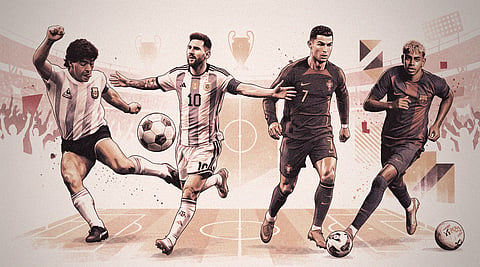
From Maradona to Yamal: Football's legacy of defiance
At the National Football Museum in Manchester, there is an entire floor dedicated to the figures who realised their playground was far larger than a green rectangle. It is a space reserved for those who understood that a ball is a megaphone and a stadium is a platform to confront the world’s injustices. Within this gallery of giants, you will find Diego Maradona, celebrated for his defiance against the systemic racism he faced in his native Argentina, the classism he battled while representing the impoverished south of Italy with Napoli, and his relentless crusades against the deep-seated corruption of FIFA.
Yet, even in this curated tribute, the museum pointedly omits his vocal, lifelong support for Palestine.
Nearby, the exhibits honour Carlos Caszely, the courageous Chilean forward who famously refused to shake the hand of the brutal military dictator General Augusto Pinochet before the 1974 World Cup. The display even transcends football entirely to honour Muhammad Ali, a man who stripped away his own prime, his titles, and his livelihood to refuse to fight in an unjust war.
Today, Ali is revered by millions who have never watched a single round of boxing because his legacy exists in a completely different atmosphere than mere athletic achievement.
While football purists will eternally debate whether Pelé or Johan Cruyff possessed superior technical genius to Maradona, neither commands the same cultural weight or profound affection because they lacked his raw, unwavering quest for justice.
For all their record-breaking statistics and glittering trophies, this is the exact threshold where Cristiano Ronaldo and Lionel Messi have stopped short, revealing the limits of their sporting supremacy.
For nearly two decades, Ronaldo and Messi have operated in a state of absolute dominance, achieving a level of wealth and global influence where they are essentially untouchable. No lost brand deal or social media backlash could ever truly diminish their empires.
Yet, when faced with the defining humanitarian crises of our era, both have chosen the path of comfortable neutrality. Online fanbases of both superstars have devolved into absurd, partisan arguments over which player is more aligned with one side or the other.
The reality away from the screen, however, is far more corporate, with both players having willingly participated in lucrative commercial deals in Israel, played matches there with glee, and protected their global marketability above all else.
There is a jarring irony to their current silence. In 2014, Lionel Messi used his platform as a UNICEF Goodwill Ambassador to release a statement expressing deep sadness over the loss of young lives in Gaza. In 2016, Cristiano Ronaldo released a heartfelt video message supporting the children of Syria, telling them not to lose hope because he was with them.
Their past actions prove they know the power of their voices, making their recent silence during years of unrelenting devastation all the more conspicuous.
If Pep Guardiola, despite working under the payroll of the UAE state-owned Manchester City, can find the courage to express his open disgust at the world’s indifference to human suffering, what truly keeps the two greatest players in history silent?
They have reached a pinnacle of fame where they have nothing left to fear, yet they have failed to turn up as children and fellow footballers have died.
This is why the quiet defiance of Lamine Yamal has already elevated him to a plane that Ronaldo and Messi have spent their entire careers avoiding.
During Barcelona’s trophy parade, the teenager held aloft a Palestinian flag - a simple, quiet act that reverberated across the globe. Predictably, Barcelona’s board and manager Hansi Flick scrambled to manage the political fallout and distance the club from the gesture.
Yet Yamal remained entirely unapologetic, refusing to let his identity or his convictions be manicured by public relations teams. And thus, Yamal has a mural dedicated to him in Gaza City, drawn amongst the rubble - a poignant tribute.
What makes Yamal’s stance so extraordinary compared to the veteran superstars is the sheer risk involved. Ronaldo and Messi are at the end of their careers, shielded by billions and lifetime contracts.
Yamal is at the absolute dawn of his professional life. He has major sponsorships to sign, boardrooms to please, and decades of media scrutiny ahead of him, meaning he had everything to lose by taking a stand. By choosing to show up for the marginalised when the stakes were highest for him personally, Yamal has proven he is unwilling to be a sanitised corporate asset.
Ronaldo and Messi may forever hold the records for Ballon d'Ors and Champions League trophies, but history eventually forgets the exact tally of goals. It never forgets those who had the courage to speak when the rest of the world chose silence.
One can hope Lamine Yamal will not be silenced in the decades to come. For now, his actions have brought a smile and some hope for the most marginalized people on Earth.
A deserving World Champion!
__ __
Raiiq Ridwan is an UK-based doctor and traveller.