
Dooley blames BFL's reliance on foreign number nines for Bangladesh's striker shortage
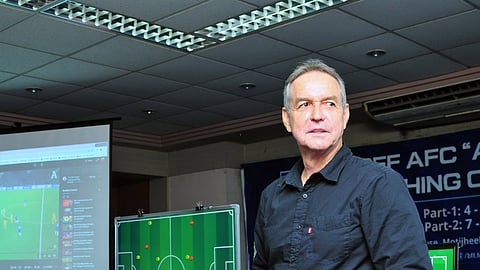
Bangladesh head coach Thomas Dooley has pointed to the dominance of foreign strikers in the Bangladesh Football League (BFL) as the root cause behind the national team's long standing shortage of a recognised centre forward, speaking to reporters on Tuesday ahead of their FIFA ASEAN Cup campaign in Indonesia.
Dooley's comments came after defender Bishwanath Ghosh, who had briefly emerged as a makeshift attacking option following his impressive display against San Marino, was ruled out of the tournament altogether with a hamstring injury.
"We don't have a typical number nine. The question is, why don't we have a number nine in the league here? Every club has a foreign player as a number nine, so we are not developing number nines," Dooley told reporters at Kings Arena.
Bishwanath had caught Dooley's eye during Bangladesh's 2-1 win over San Marino, setting up the winning goal while repeatedly troubling the opposition defence with his forward runs from a nominally defensive position.
"That's why Bishwanath, for me, is also a player I could put up front. When you look at the San Marino game, he provided the assist for the second goal, was twice in front of the goalkeeper and could have scored," Dooley said.

The coach admitted he had begun viewing Bishwanath primarily as an attacking option rather than a defender, partly due to concerns over the disciplinary risk his aggressive style carried inside his own penalty area.
"In my head, I actually had him as an offensive player rather than a defender because he goes in 100 per cent, and that can always be dangerous for free kicks and penalties in the box. He did an excellent job," Dooley said.
With that option now unavailable, Dooley is instead weighing up several wingers and attacking midfielders, including Rakib Hossain, Shekh Morsalin and Shahrear Emon, as possible solutions to the centre forward problem.
"We have to find somebody and put him in a position where he can help us the most as a centre forward. Who that will be, we don't know yet. Is it Rakib, Morsalin or maybe Emon? We need to find out who steps up," he said.
Beyond the injury to Bishwanath, Dooley also confirmed that Topu Barman, Jamal Bhuyan and Foysal Ahmed Fahim were carrying knocks of their own, though he remained hopeful all three would recover in time for the tournament.
The coach also offered insight into a demanding preparation period, revealing that most local based players had gone without organised training for close to two months following the San Marino fixture before the current camp began.
"Most of the players did nothing after the San Marino match. I am not saying they did absolutely nothing, but they trained individually on their own. The players we have abroad are playing with their clubs, doing pre season preparations. But the local players here had no training," Dooley explained.
To compensate for that gap, Dooley opted to load the squad with a heavy training schedule from the outset, a decision that inevitably brought its own physical toll on several members of the group.
"We started training sessions almost four weeks before the match. This gave us some time to get them fit. For that, we had to take on a significant workload from the beginning, which meant training twice a day," he said.
We don't have a typical number nine. The question is, why don't we have a number nine in the league here? Every club has a foreign player as a number nine, so we are not developing number nines.
Thomas Dooley, Bangladesh national team head coach
Looking ahead to the tournament itself, Dooley was candid about where Bangladesh stand relative to their group opponents, openly describing his side as clear underdogs against Malaysia, Indonesia and Singapore in Group A.
Bangladesh currently sit 181st in the FIFA rankings, well below Indonesia at 118th, Malaysia at 136th and Singapore at 148th, a gap Dooley believes leaves no margin for error once the tournament begins.
"You have to understand, we are the underdogs here. The opposition teams are far ahead of us in the rankings. So if we want to compete with them, every small decision on the field has to be perfect," he said.
Dooley was equally guarded about revealing tactical details publicly, arguing that secrecy remained one of the few genuine advantages available to a team facing stronger opposition across the board in this tournament.
"If what people are doing on social media, such as picking the best XI or how we are going to play, is revealed beforehand, the opposition teams will get an advantage. Keeping our tactics secret is our biggest weapon," he said.
Bangladesh's opening match against Malaysia comes a day after the tournament begins, before a meeting with Singapore on 28 September, a side they narrowly lost to during World Cup qualifying earlier this year.
"Last time, we came very close to winning but still lost. Although they are ahead of us in the rankings, it is possible to beat them on a good day," Dooley said, recalling that previous encounter.
On Malaysia, generally regarded as the strongest side in the group, Dooley struck a similarly pragmatic tone. "They are a strong opponent. Although they are generally difficult to beat, anything can happen in football. If we give our best and they make mistakes, opportunities will arise," he said.
Bangladesh close out their group campaign against hosts Indonesia on 1 October, a fixture Dooley believes could carry added psychological weight given the pressure on the home side to avoid an unexpected slip up.
"When Indonesia play against us, they will be under psychological pressure. They will not want to lose to a lower ranked team, just as we would not want to lose to Bhutan," he said.
Looking further ahead, Dooley confirmed the ASEAN Cup would also serve as valuable preparation for November's SAFF Championship on home soil, insisting the immediate priority remained gathering experience rather than chasing results.
"We cannot go there with the imaginary idea that we will finish first or in the top three. Our main objective is to gain experience. Even if we lose these matches, that is still good, because we can learn from those mistakes," he said.
Bangladesh are set to depart for Indonesia on 19 September.