
Hamza and Co. aren’t enough
When Hamza Choudhury first landed in Dhaka with a Bangladesh passport in hand, he brought with him something that was long missing in the country’s football.
Hope.
His arrival started a procession of expatriate footballers. The likes of Shamit Shome, Fahamedul Islam, Quazem Shah, Farhaan Ali Wahid and many more arrived, all eager to represent the country.
And with each new addition, that hope grew.
Emboldened by the overseas-based players, fans hoped Bangladesh could finally move beyond South Asia and make its mark in Asian football. The experience and skills of players raised in more advanced football systems abroad were seen as key to fulfilling that ambition.
The ongoing SAFF Championship 2026 was seen as a major test of those ambitions, a chance to end a 23-year wait and then set sights on greater accolades.
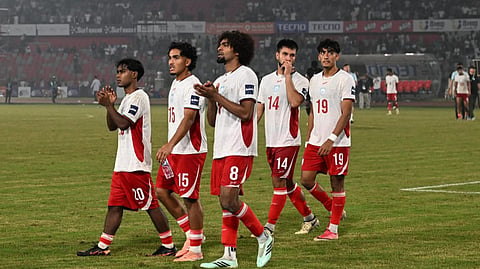
But those hopes were crushed on Saturday night when Bangladesh, with eight origin players in their XI, suffered a 1-0 defeat to Pakistan in the semifinal.
The heartbreak is fresh, and will take some time to heal. But even inside the grieving hearts of Bangladeshi fans, a question that they had overlooked for a long time has now become unavoidable.
Is recruiting expatriate footballers alone enough to establish supremacy in South Asia?
Much like Bangladesh, Pakistan, Sri Lanka and India are pursuing overseas-based players from all around the world to strengthen their national sides.
Pakistan's example at this SAFF Championship is particularly noteworthy.
The South Asians were without five expatriate players during the group stage because their clubs did not release them outside of the FIFA international window. The players joined the squad before the knockout stage and made a significant impact.
One of them, Abdul Arshad, scored the winner against Bangladesh, while Swedish league defender Abdullah Iqbal stood like a wall at the back.

Pakistan did more than simply bring its expatriate players back into the squad; it made effective use of their abilities. Bringing them in at a crucial stage strengthened the team and helped exploit Bangladesh's weaknesses.
Despite enjoying more possession, Bangladesh could not break down Pakistan's compact defence, while their opponents patiently waited for an opening and struck late.
Bangladesh assistant coach Hasan Al Mamun's assessment also highlighted Pakistan's tactical success.
"They studied our previous matches. They looked at our strengths as well as identified our weaknesses. Pakistan are a physical team, and they defended in a good block. Both teams had plans, but they executed theirs better," Mamun said.
Pakistan also appeared to have another advantage. Bangladesh had 72 hours of rest before the semifinal, while Pakistan had five days. Extra rest and the addition of five players meant their squad was fresher, which showed on the pitch.
"Our energy levels seemed to drop a little in the second half. Pakistan brought on five new players. They were fresh. I felt they were ahead of us in that regard," Mamun said.
Historically, Pakistan have never been a particularly strong force in South Asian football compared to Bangladesh.
They are yet to win a SAFF title. In fact, they are set to play their maiden final against India this Monday. Their top-tier league – Pakistan Premier League – has not completed a full season since 2019.
Yet, Pakistan used its expatriate players to compete on equal terms with Bangladesh and eventually snatched a victory. It is a warning that a strategy once considered one of Bangladesh's biggest advantages is no longer exclusive.
Sri Lanka, meanwhile, are pursuing a long-term plan involving expatriate footballers. Their football federation began identifying Sri Lankan-origin players overseas in 2023.
By December that year, it had 43 players under observation, eventually bringing several footballers raised in countries such as Germany, England and Australia into the national setup.
Sri Lanka had 19 diaspora footballers in their squad at this SAFF Championship. Although they failed to progress beyond the group stage, getting thrashed 4-0 by Bangladesh, their long-term planning warrants attention.
The island nation could very well emerge as a strong contender at the next SAFF Championship.
The Indian federation has also ramped up its search for diaspora footballers, creating a task force for identifying overseas-based talents and has reportedly established direct contact with 33 Indian origin players abroad.
The examples of Pakistan, Sri Lanka and India make one thing clear: recruiting quality expatriate footballers alone does not guarantee an advantage over rivals in South Asia anymore. On-field performances, team understanding, tactical preparation and the ability to stick to a plan under pressure will ultimately make the difference.
But Bangladesh's challenge extends beyond keeping pace with its rivals. The foundations of domestic football remain fragile, with the Bangladesh Football League (BFL) failing to provide the intensity, consistency and playing conditions required to develop international-standard footballers.
Since professional football began in 2007, the top-tier, which was renamed to Bangladesh Football League (BFL) this year, has largely followed a double round-robin format, with teams playing between 16 and 24 matches per season depending on the number of participating clubs. That is considerably fewer than in many established football leagues, leaving domestic players with limited opportunities to develop through regular, competitive football.
The quality gap between the strongest and weakest teams also produces one-sided contests, depriving players of the sustained intensity needed to sharpen their tactical awareness, decision-making and concentration under pressure.
The playing surfaces offer little encouragement either. Chandpur District Stadium, which was added as a venue for the ongoing BFL season, received heavy criticism earlier this year for its rough and uneven surface and large patches with no grass.
The pitch condition at the Chandpur venue is not the exception but the norm outside of Dhaka. And such conditions are not conducive to developing technically proficient players.
The league's instability off the pitch compounds the problem. Fixture disruptions, disagreements over scheduling and prolonged interruptions have repeatedly affected clubs' preparations and players' match rhythm across seasons.
A stronger domestic structure is essential to complement the experience brought by Hamza, Shamit and other expatriate players. Their inclusion can raise the national team's standard, but long-term progress requires a reliable grassroots system that consistently identifies and develops quality homegrown footballers.
The semifinal against Pakistan also exposed limitations in Bangladesh's team preparation and player management.
Assistant coach Hasan revealed that the plan had been to rest Hamza during the end of the Sri Lanka match, but they were ultimately unable to implement it due to the injuries of Saad Uddin and Tariq Kazi, while Farhaan Ali Wahid was also struggling to continue.
"Our plan was to rest Hamza towards the end of the Sri Lanka match. But because of some injuries, we could not implement it. Sometimes you go into a match with a plan, but injuries to players force you to move away from it," Mamun said.
The defeat to Pakistan also brought another longstanding weakness into focus: Bangladesh's tendency to concede decisive goals in the dying moments.
Last year, after coming back from 3-1 to make it 3-3 in stoppage time against Hong Kong in an Asian Cup qualifier match, Bangladesh conceded again and lost 4-3.
They also conceded a late goal to draw a friendly against Nepal that same year. Earlier, Bangladesh had suffered elimination from the SAFF Championship 2023 after conceding in the 113th minute of extra time against Kuwait in the semifinal.
The latest semifinal against Pakistan appeared to be another repeat of that familiar pattern. After battling throughout the match, Bangladesh conceded late and were eliminated. Repeated lapses raise questions about their game management, defensive concentration and ability to maintain focus until the final whistle.
Bangladesh's problem, however, cannot be solved through a week-long national-team camp alone. Concentration, tactical awareness and decision-making under pressure are developed over months of competitive football.
And the current domestic structure is insufficient to prepare the players for those challenges.
The arrival of players like Hamza has given Bangladeshi football the courage to dream again, brought supporters back to the stadiums and generated greater interest in the national team. But expatriate footballers are not a magic solution. Their experience and skills must be complemented by a stronger domestic structure and a consistent pathway for developing homegrown talent.
When rivals are following the same route, simply recruiting expatriate players will no longer be enough to stay ahead. To achieve supremacy in South Asia and establish a place in Asian football, Bangladesh needs a stronger football structure, a competitive and properly organised domestic league, a consistent supply of quality players and, ultimately, the ability to translate those improvements into performances on the pitch.