
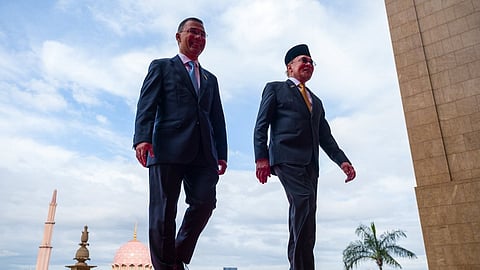
Tarique seeks reopening of Malaysia labour market
During his visit to Malaysia, Prime Minister Tarique Rahman called on the country to reopen its labour market to Bangladeshi workers at the earliest opportunity and recruit more workers from Bangladesh.
The two countries agreed to elevate their relationship through stronger cooperation in trade, investment, technology, education and regional affairs.
He made the call during bilateral talks with Malaysian Prime Minister Anwar Ibrahim at Perdana Putra in Putrajaya, followed by a joint press conference and the issuance of a joint statement.
During talks at Perdana Putra, Tarique and Malaysian Prime Minister Anwar Ibrahim pledged to deepen economic ties and work towards concluding a Bangladesh-Malaysia Free Trade Agreement (FTA) by 2027.
Speaking at a joint press conference after the bilateral meeting, Tarique said, “Bangladeshi workers, students, professionals, and entrepreneurs in Malaysia serve as an important bridge between the two countries. Their contributions benefit both our economies and societies. I requested His Excellency Prime Minister Anwar Ibrahim to consider recruiting more Bangladeshi workers, as well as to open the labour market as soon as possible,” he said.
He also raised the issues of regularising undocumented Bangladeshi workers and facilitating the return of detained Bangladeshis where possible.
Tarique said both governments agreed that worker recruitment must be transparent, fair and affordable, reducing the role of middlemen and lowering migration costs for workers.
The labour issue featured prominently in the discussions. According to a joint statement issued after the meeting, Malaysia noted that approvals for new foreign worker quotas are currently considered on a case-by-case basis based on verified employer demand and sector-specific requirements.
Both countries agreed to convene a Joint Working Group (JWG) to ensure the continued, safe and mutually beneficial migration of Bangladeshi workers to Malaysia.
The group will review the existing labour recruitment memorandum of understanding and begin work on a new and updated agreement reflecting the current needs of both countries.
The two sides reaffirmed that any future recruitment process should be transparent, non-discriminatory and competitive, involving only credible and qualified recruitment agencies.
Malaysia also acknowledged Bangladesh's proposal regarding the recruitment of workers and recognised the important contribution Bangladeshi workers make to Malaysia's economy and development.
A major outcome of the visit was the decision to advance negotiations on a Bangladesh-Malaysia Free Trade Agreement.
The two leaders welcomed progress towards the commencement of negotiations and expressed their commitment to concluding the agreement in 2027.
They described the proposed FTA as a mutually beneficial, comprehensive and forward-looking agreement that reflects modern global trading practices.
Both leaders noted that Bangladesh remains Malaysia's second-largest trading partner in South Asia and agreed to further strengthen two-way trade and investment.
The two prime ministers also welcomed progress towards establishing the Malaysia-Bangladesh Joint Business Council (JBC), which will serve as the principal platform for structured dialogue between the private sectors of the two countries.
The council is expected to facilitate greater business collaboration, investment partnerships and trade expansion.
The leaders stressed the importance of enhancing cooperation in telecommunications, energy, infrastructure, ports and logistics, halal industries, agro-processing, education, skills development, digital economy, semiconductors, smart manufacturing and other high-value industries.
They encouraged closer collaboration among government agencies, investment promotion bodies, businesses and industry leaders through investment facilitation, technology transfer, talent development, capacity building and strategic partnerships.
Tarique highlighted Bangladesh's improving investment climate and invited Malaysian companies to explore opportunities in the country.
Referring to the BNP government's election victory in February 2026, he said Bangladesh has restored political stability through democratic means and is focused on creating jobs, attracting foreign investment and accelerating economic growth.
Tarique identified infrastructure, energy, information technology, digital economy, semiconductors, halal industries and agro-processing as sectors with strong potential for Malaysian investment.
After the bilateral meeting, a Memorandum of Understanding (MoU) on cultural cooperation was signed in the presence of the prime ministers of the two countries.
In addition, a document on cooperation in research and capacity building in counter-terrorism and a bilateral investment-related document were exchanged. The foreign ministers of the two countries exchanged the documents.
Describing Malaysia as a trusted and longstanding partner of Bangladesh, Tarique said the outcomes of the visit would open a new chapter in bilateral relations.
"Our friendship is built on mutual trust, shared values and strong people-to-people ties," he said.
Anwar Ibrahim stressed that future cooperation should go beyond traditional trade and investment.
"We are looking at a comprehensive partnership in all fields, extending to research, science, technology, semiconductors and artificial intelligence," he said.
The Malaysian prime minister described Bangladesh as a country with enormous economic potential and said cooperation should expand into advanced manufacturing, energy and emerging technologies.
Recognising the growing importance of the global Islamic economy, both countries agreed to strengthen cooperation in the halal sector.
The two sides welcomed ongoing cooperation between Malaysia's Department of Islamic Development (JAKIM) and relevant Bangladeshi authorities and agreed to enhance collaboration in halal certification, regulatory frameworks, research, innovation, training and institutional capacity building.
The two leaders also agreed to strengthen educational cooperation.
Recognising the presence of around 11,000 Bangladeshi students in Malaysia, they agreed to expand university partnerships, joint research programmes and technical and vocational education and training (TVET).
Both sides emphasised mutual recognition of qualifications, joint degree programmes and flexible learning pathways aligned with labour market demands.
The two leaders also expressed optimism about expanding tourism cooperation, particularly under Malaysia's Visit Malaysia 2026 and Malaysia Year of Medical Tourism 2026 campaigns.
Malaysia welcomed more visitors from Bangladesh, and both countries agreed to promote tourism and cultural exchanges.
The two prime ministers discussed regional and international developments, including the Rohingya crisis, developments in the Middle East and cooperation at the United Nations.
Tarique thanked Malaysia for its continued support for the safe, voluntary and dignified repatriation of Rohingya refugees to Myanmar.
He also sought Malaysia's support for Bangladesh's aspiration to become an ASEAN Sectoral Dialogue Partner and join the Regional Comprehensive Economic Partnership (RCEP).
The prime minister expressed appreciation for Malaysia's support for Bangladesh's candidature for the presidency of the 81st session of the UN General Assembly.
Anwar said Malaysia would continue working with Bangladesh through ASEAN mechanisms to seek a sustainable solution to the Rohingya crisis.
The two leaders also reaffirmed their shared support for the Palestinian cause and their commitment to peace, justice and stability in conflict-affected regions.
Following the talks, the two countries signed a Memorandum of Understanding on cultural cooperation.
They also exchanged documents on cooperation in counter-terrorism research and capacity building, as well as an investment-related bilateral cooperation document.
Later in the day, Tarique met leading Malaysian business figures and corporate leaders, including representatives from Axiata, MMC Ports, Perodua, AirAsia and Petronas. Discussions focused on investment opportunities, port development, aviation links, infrastructure and energy cooperation.
Earlier in the day, Tarique and his wife, Dr Zubaida Rahman, were accorded a ceremonial red-carpet welcome at Perdana Putra by Anwar Ibrahim and his wife, Datuk Seri Dr Wan Azizah Wan Ismail.
A guard of honour presented by the Malaysian Armed Forces was followed by the playing of the national anthems of both countries.
Following the official engagements, Tarique attended a state luncheon hosted by Anwar Ibrahim at the Seri Perdana Complex before departing Kuala Lumpur for Dalian, China, on the next leg of his overseas tour.