
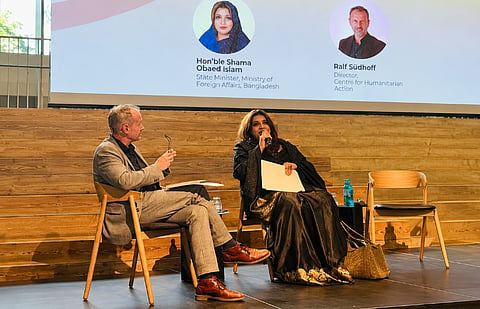
Bangladesh seeks strategic development partnership with Germany
Bangladesh wants to strengthen its development partnership with Germany through more strategic, targeted and mutually beneficial cooperation rather than relying on conventional aid, State Minister for Foreign Affairs Shama Obaed Islam has said.
She called for stronger partnerships with Germany and other development partners, particularly in the Global South, to address shared challenges such as climate change, disaster management and sustainable development.
The state minister made the remarks while attending the annual conference of the Center for Humanitarian Actions in Berlin, Germany, on Thursday (November 26) as chief guest.
Describing Germany as a longstanding and trusted development partner, she stressed the importance of cooperation in renewable energy, energy efficiency, skills development, vocational training, job creation, knowledge and technology sharing, and human and social development, including women's education and empowerment.
She said challenges such as climate change and the Rohingya crisis were not confined to individual countries but had regional and global implications, requiring collective action, a common voice and genuine political commitment from responsible countries and development partners.
Emphasising the need for more inclusive and collaborative approaches to humanitarian assistance and development financing, Shama said local expertise, resilience, international partnerships and technology sharing were essential to addressing emerging challenges.
Citing Bangladesh's initiatives, she said the government had undertaken a programme to excavate more than 20,000 kilometres of canals to address flooding and drought, alongside a plan to plant 250 million trees to tackle deforestation and climate change.
She also highlighted Bangladesh's recent achievements in disaster management as examples of the country's resilience.
The state minister said development in the Global South should be driven not merely by aid but by meaningful partnerships, development financing, innovation and technology transfer.
The conference brought together humanitarian practitioners, policymakers and experts to discuss the future of humanitarian action and development financing amid growing funding constraints.
Discussions focused on aid reform, local leadership, new funding models and the role of international partnerships in shaping more sustainable approaches to humanitarian assistance and development.