
Inquilab Zindabad: How a protest anthem transcended boundaries
The protests demanding the resignation of India’s education minister and reform to the exam systems intensified in New Delhi last Tuesday after police used force against demonstrators marching toward parliament.
Since then, the students have been staging a sit-in at Jantar Mantar, drawing support and appearances from activists and political figures like Sonam Wangchuk, Rahul Gandhi and Priyanka Gandhi.
Social media has been filled with images of the protesters feeding one another, tending to each other’s injuries, and chanting slogans in the face of Delhi Police.
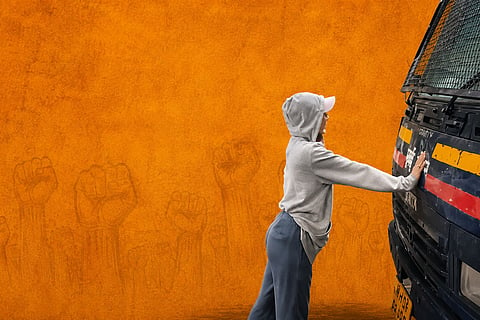
One video showed a woman standing, alone, in front of a police van to stop it from moving ahead as it advanced toward the protest site. As she stood her ground, she repeatedly shouted “Inquilab, Zindabad”.
The slogan has emerged as one of the uniting forces of this protest that grew into the biggest youth challenge to Prime Minister Narendra Modi in recent years. The protests began last month over the leak of medical school entrance exam papers that affected some two million students.
Yet, the slogan is not new.
All the legitimate protests in India over the past decade, including the Jawaharlal Nehru University protest in 2016, and the Anti-Citizenship Amendment Act (CAA) protest in 2019-20, borrowed their spirit from this slogan.
Its resonance is not confirmed to India only.
In Bangladesh, student protesters who forced the former prime minister Sheikh Hasina to flee to India, painted the slogan on the city walls with their blood during the deadly days of July Uprising.
Whenever their morale faltered, they turned to the chant.
“Inquilab Inquilab, Zindabad Zindabad.”
The phrase combines Arabic and Urdu words, and translates as “Long Live Revolution”.
The iconic phrase was coined by the celebrated Urdu poet of India, Hasrat Mohani, in 1921.
Mohani was a leftist activist and a freedom fighter who was one of the first political leaders to demand complete independence of India from British rule.
Over time, the slogan spread across South Asia, becoming the favourite catchword of freedom loving people.
Its enduring appeal has also made it politically contentious.
In 2022, the Delhi High Court questioned the use of the slogan while dealing with a case involving the speeches of Umar Khalid, the student activist who has remained in jail since 2020. Khalid, who faces more than 25 charges including sedition, was described by The New York Times as "a symbol of the wide-ranging suppression of dissent under Prime Minister Narendra Modi."
Today, "Inquilab Zindabad" continues to serve as a rallying cry for anti-colonial, labour, student and civil rights movements across South Asia.
For supporters, it represents resistance against injustice; for critics, it evokes political radicalism and challenges to the established order.
The slogan continues to provoke unease among some political leaders also.
In February, Bangladesh's minister for Power, Energy and Mineral Resources, Iqbal Hassan Mahmud, criticised the growing use of terms such as "Inquilab Zindabad”.
“We now hear new terms such as "Inquilab," "Inquilab Mancha," and "Azadi. Inquilab Zindabad and Inquilab Mancha have no connection to the Bangla language. These are words from the language of those who once tried to take away our mother tongue”, he said.
Yet, the slogan has transcended national boundaries and generations. More than a century after it was first coined, "Inquilab Zindabad" remains one of South Asia's most enduring expressions of political dissent and youthful defiance.