
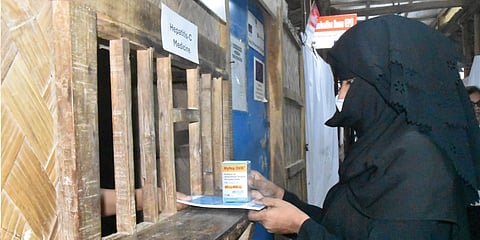
Hepatitis C silently spreads in Rohingya communities; treatment efforts ‘not enough’, RRRC says
The Rohingya community in Cox’s Bazar is silently and without awareness facing spiking hepatitis C infections, a recent study has found.
Around 17% of sampled Rohingya refugees in Cox’s Bazar tested positive for hepatitis C antibodies in the study by the International Centre for Diarrhoeal Disease Research, Bangladesh (icddr,b), stoking public risk fears.
In the survey, conducted between April 2021 and March 2022, of those sampled from the host communities, the rate stood at 1%, which is the average rate across Bangladesh.
Dr Shoeb Bin Islam, Assistant Scientist at icddr,b and lead author of the study, said, "Our findings reveal a hidden burden of hepatitis C among Rohingya refugees that could easily go undetected because the infection often remains asymptomatic until serious liver disease develops.”
The study, published on Thursday, also found hepatitis B rates to be similar in both groups, at about 1% to 2%.
Speaking to Daily Waadaa, Refugee Relief and Repatriation Commissioner (RRRC) Mizanur Rahman said the findings on hepatitis C reinforce a long-standing health concern in the camps.
“It has become a major public health risk,” he said.
Asked whether current treatment efforts were sufficient, the commissioner replied: “Certainly not.”
Hepatitis C often causes no symptoms in its early stages but can eventually lead to liver cirrhosis, liver failure and liver cancer if left untreated.
Meanwhile, researchers at icddr,b also assessed participants’ knowledge of hepatitis B and C and found low levels of awareness in both host and Rohingya communities.
None of the Rohingya participants surveyed knew about hepatitis B vaccination.
Numbers could be higher
Government data obtained by Waadaa shows hepatitis C prevalence among the Rohingya refugee population to be even higher at 22%.
About 64,327 refugees are believed to require treatment, while only 28,116 people have received it, according to the data.
In this regard, RRRC Rahman said the high prevalence of hepatitis C among Rohingyas was not a new discovery.
He said a Malaysian field hospital operating in Cox’s Bazar in 2017-18 had found a prevalence rate of around 13%, while a later survey by Doctors without Borders (MSF) estimated it at between 19% and 20%.
He said MSF later began providing hepatitis C treatment at one of its five health centres in the camps, with the World Health Organization subsequently becoming involved in the response.
Rahman said Bangladesh, WHO and humanitarian partners have expanded hepatitis C screening and treatment in recent years, but many Rohingyas still need access to care.
However, he said treatment remains expensive and existing services are insufficient to meet demand.
On possible solutions, Rahman said WHO had informally told him about a lower-cost hepatitis C medicine made in Egypt, but it has not yet been approved by the agency, limiting treatment options.
Egypt is widely regarded as a global leader in hepatitis C treatment after introducing low-cost generic medicines that enabled millions of patients to receive care.
Rahman said the issue would require discussions at the government level, adding that he planned to raise the matter with health authorities.