
'Completely abnormal': Measles deaths cross 1,000 as infections surge
AI generated summary, newsroom reviewed
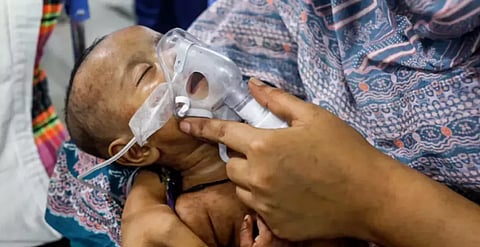
At Mugda Medical College Hospital in the capital, three-year-one-month-old Joya Moni is being given a nebuliser.
She has been suffering from measles for the past five days.
Before contracting the disease, Joya had been hospitalised for 11 days after being diagnosed with dengue.
Although she had recovered somewhat, she fell ill again. This time it was measles. Her family was deeply worried.
Speaking to Daily Waadaa on Monday, Joya's mother, Lata Begum, said, “My child has been sick for a month. She was first diagnosed with dengue and spent 11 days in hospital. Just as she started getting better, she developed measles. When your child is not well, the whole world feels dark.”
Amid growing concern over children like Joya across the country, the death toll from the measles outbreak that began in mid-March this year has now crossed 1,000.
According to data from the Directorate General of Health Services (DGHS), 1,002 people have died from measles or suspected measles as of Wednesday.

The numbers of infections and hospital admissions have also started rising again since July.
As of Wednesday, the total number of measles cases, including suspected and confirmed cases, stood at 187,484.
Worryingly, a recent study has found that 95% of children coming to hospitals with symptoms of measles tested positive for the disease.
One doctor Waadaa spoke to summed up the urgent requirement: “We cannot allow measles to spread any further.”
Meanwhile, ramped up campaigns have yet to yield results.
What monthly data shows
An analysis of monthly DGHS data shows that during March and April, an average of 887 people were infected with measles or suspected measles every day, while 535 were hospitalised daily.
In May, the average number of daily infections rose to a peak of 1,220.
The month also recorded the highest number of deaths, at 309.
In June, the average number of daily infections fell to 1,101, while daily hospital admissions dropped to 924.
In July, infections declined further to an average of 1,010 per day, with 850 hospital admissions.
However, both indicators increased again in August.
The average number of daily infections rose to 1,061, while daily hospital admissions increased to 886. Deaths also rose from 119 in July to 136 in August.
The situation has deteriorated further in the first nine days of September.
During this period, an average of 1,132 people per day were reported with measles or suspected measles—higher than the August average.
Daily hospital admissions also increased, reaching an average of 994 during the nine-day period.
'Never saw such high levels of transmission'
To contain the outbreak, the government launched an emergency measles-rubella vaccination campaign on April 5.
By the scheduled end of the first phase on May 20, around 18.4 million children aged between six and 59 months had been vaccinated, exceeding the target of 18 million.
According to DGHS data, infections, hospital admissions and deaths declined in June and July following the campaign. However, the decline was not as significant as expected.
A mop-up campaign was subsequently launched in late July to vaccinate children who had been missed during the earlier campaign.
By Tuesday, around 19.74 million children had been vaccinated under the programme.
Despite these efforts, all three indicators — infections, hospital admissions and deaths — rose again in August.
This has raised concerns among experts that the vaccination campaigns have failed to completely break the chain of transmission.
Professor Mahmudur Rahman, chairman of the National Measles and Rubella Elimination Verification Committee and former director of the Institute of Epidemiology, Disease Control and Research (IEDCR), described the current measles outbreak as “completely abnormal.”
He said he had never seen such a high level of measles transmission in Bangladesh before.
“In the past, measles cases would decline rapidly after vaccination campaigns. That is not happening this time,” he said.
According to him, children younger than six months are also becoming infected, although the routine immunisation programme administers the first measles-rubella vaccine at nine months of age.
At the same time, not all children older than nine months have been vaccinated, he added.
95% of suspected cases test positive
A recent study has found that 95% of children coming to hospitals with symptoms of measles tested positive for the disease, indicating that the overwhelming majority of children showing symptoms were actually infected.
The study was conducted jointly by Bangladesh Shishu Hospital and Institute and the International Centre for Diarrhoeal Disease Research, Bangladesh (icddr,b), among 354 children hospitalised with measles.
The study found that malnourished and younger children were at particularly high risk.
Of the 354 children with measles, 43% were aged between three and nine months, and 65% were suffering from malnutrition.
Thirty-eight percent had not received exclusive breastfeeding during the first six months after birth. Among children who died, the proportion was 82%.
An analysis of vaccination history and age data from 341 children showed that 97.3% of the 146 children younger than nine months tested positive for measles.
This means a significant proportion of infected children were below the age at which they would normally receive the first measles vaccine.
Among 126 children who were eligible for vaccination but had received no dose, 97% tested positive.
Among 48 children who had received one dose, 92% tested positive, while 76% of the 21 children who had received two doses tested positive.
However, the study was hospital-based and limited in scope.
Therefore, the findings involving children who had received two doses cannot be interpreted as evidence that vaccine effectiveness has declined or that the vaccine has failed.
The current outbreak has nevertheless highlighted a major concern over vaccination gaps.
A significant proportion of infected children were below the routine vaccination age, while another large group had not received vaccines.
At the same time, infections and deaths increased in August despite the DGHS mop-up campaign.
Although the government has launched emergency vaccination campaigns, brought millions of children under vaccination coverage and strengthened medical services, deaths have continued.
Public health experts and epidemiologists say several factors may be contributing to the situation.
These include long-standing gaps in vaccination coverage, limitations in disease detection and management, child malnutrition and inadequate awareness about measles.
The unprecedented outbreak therefore appears to be more than simply the spread of an infectious disease.
It has also exposed long-standing weaknesses in Bangladesh's vaccination and disease-management systems.
Professor Mahmudur Rahman said measles cases had declined rapidly following vaccination campaigns in the past, but that had not happened this time.
“Although the government has brought children up to five years of age under vaccination coverage, measles is also spreading among children younger than six months. At the same time, not all children older than six months have been vaccinated. As a result, the chain of transmission has not been completely broken,” he said.
The public health expert, who has worked in the sector for more than 40 years, stressed the need for extensive public awareness alongside vaccination.
“Measles is spreading widely among children who are too young to be eligible for routine vaccination. Therefore, raising awareness among their parents must receive significant attention,” he said.
He also stressed the importance of wearing masks and isolating infected children, as measles spreads rapidly.
“Authorities should scientifically analyse which areas and age groups are experiencing higher infection rates and conduct additional vaccination campaigns in those areas,” he added.
Dr Mohammad Mushtuq Husain, an epidemiologist and former principal scientific officer at IEDCR, said vaccinating only children under five years old would not be enough to control the current outbreak.
“At least 95% of children aged five to 15 should also be brought under vaccination coverage. Children who have been missed should be identified and vaccinated through door-to-door campaigns,” he told Daily Waadaa.
He also called for greater emphasis on community-based treatment to reduce deaths.
“Malnourished children with measles should be referred quickly to secondary-level hospitals. Medical services need to be expanded in areas inhabited by poor and floating populations, while arrangements must be made to promptly refer critically ill patients to advanced treatment centres,” he said.
Children infected with measles or showing symptoms should also be isolated, he added.
“We cannot allow measles to spread any further.”
Another vaccination campaign under consideration
Asked about the government's response, Professor Dr Md Halimur Rashid, director of the Disease and Control branch of the DGHS, told Waadaa that the authorities were also “very concerned” about the measles situation.
“We are considering conducting another campaign so that we can bring a large number of children under vaccination coverage,” he said.
Asked whether there was any plan to vaccinate children above the age of five, he said the initiative would be challenging.
“This would require us to procure a large quantity of vaccines from the international market. If sufficient vaccines are not available after we take the initiative, it will not be possible to implement the programme,” he said.
He added that no final decision had yet been made, but discussions were ongoing.