
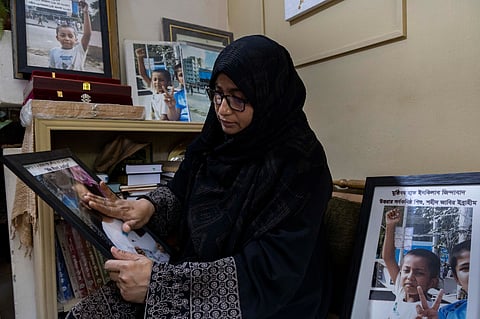
‘I am in Parliament for Shaheed Jabir’
Rokeya Begum never imagined she would one day sit in Bangladesh’s Parliament.
She says politics was never a part of her life, and she was never affiliated with any political party.
Now 49, Rokeya holds a reserved-seat MP position, but insists she is there for only one reason: her youngest son, Jabir Ibrahim, her beloved Jabir.
Following the February 12 National Election, the opposition Jamaat-e-Islami nominated Rokeya as an MP from the reserved women’s seats.
“I consider myself a representative of the martyrs’ families and of the July Warriors,” she says. “It is a heavy responsibility for me. There is no way to take it lightly as a representative of so many people.”
The six year old Jabir was shot dead on August 5, 2024, shortly after news broke that former prime minister Sheikh Hasina had been ousted.
He was with his parents at the victory rally marching from Uttara to Ganabhaban, the official residence of Hasina.
Gunfire erupted after 4:30 PM in front of the APBn Headquarters and RAB-1 in Uttara.
Rokeya and her husband tried to leave the area immediately, but their attempt failed.
“Suddenly I heard my Jabir say ‘Uh’ and fall to the ground, leaving my hand. His legs were covered in blood. I can’t forget the scene,” a weeping Rokeya recalled.
His father carried him on his lap and rushed him to Kuwait Bangladesh Friendship Hospital, but doctors could not stop the bleeding.
He was then taken to Crescent Hospital, but there was no ICU available.
By the time they reached Dhaka Specialized Hospital, the six-year-old had already left Rokeya forever.
'We wanted to do something'
Rokeya, once a teacher, left her job while she was expecting Jabir, a decision she did not make during her previous two pregnancies. Since then, she spent the next six years raising him, only to lose him to a bullet.
“I had to spend a lot of time feeding him. He loved eating while holding my hair, and I let him do so,” Rokeya said.
She says people often ask why a child like Jabir joined the protests. For her, the answer lies in what the family witnessed in the weeks leading up to August 5.

Whenever they watched videos of children disappearing, reports of mass graves, or the killings of protesters such as Abu Sayed and Mugdho, she says she would break down in tears.
“I couldn’t bear seeing babies being gunned down like birds. It pained me a lot. I used to talk to my children about these things. We wanted to do something.”
On the morning of August 5, Jabir put on his uncle’s motorcycle helmet and asked his father to take a photograph.
“He said he would become an army officer to protect his brothers from the police.”
His elder brother wrote “We want justice” on a placard and handed it to him.
Faith overcomes grief
Rokeya says the family still does not know who fired the fatal shot.
“It came from somewhere near APBn Headquarters and RAB-1. We don’t know who shot him. Because along with police, Awami League activists were also on the street at that time.”
Despite the unbearable loss, she says her faith has prevented her from being consumed by regret.
“Of course, I feel that if I had not gone there, then it would not have happened. But from an Islamic perspective, you cannot think this way. As Allah decided his death this way, I do not have the right to regret it.”
“It is a consolation that surely Allah knows best. I am pleased with His decision. Yes, I feel pain, but I have nothing to say against the will of Allah.”
For Rokeya, the responsibility of becoming an MP came unexpectedly. Until around noon on the day of her nomination, she had no idea she would enter Parliament.
“I couldn’t say no to the Opposition Chief, so I honoured his request,” she said.
Her experience in Parliament has not matched her expectations. After attending her first session, she came away disappointed by the limited opportunities given to opposition lawmakers.
“As a member of the opposition party, we usually get two to five minutes, which is not enough,” she says, adding that ruling party MPs receive considerably more speaking time.
'Not a politician'
For Rokeya, her parliamentary role is inseparable from her son’s memory. Her priorities, she says, are justice and recognition for every victim of the July Uprising.
“I did not go to Parliament because of my own capacity, as I am not a politician. I am there for Jabir. It is very painful.”
Rokeya noted that many protesters killed during the uprising have not been included in the official government list, which is nearly half the number mentioned in the United Nations report.
“Where are the rest?” she asks.
She believes some victims remain unidentified, saying some were allegedly thrown into rivers or buried in mass graves.
“I will try to bring all the martyrs under gazette notification. Then comes their rehabilitation. Justice is another core priority. The main demand of martyrs’ families is justice for the killing of their loved ones.”
'Want her today'
In separate interviews with NDTV and Reuters last month, Hasina vowed to return to Bangladesh this December, despite the death sentence handed down against her in absentia by the International Crimes Tribunal for crimes against humanity.
Rokeya’s reaction is immediate. She says she also wants the former prime minister to return, but only to face legal proceedings.
“I want her to return, not in December, but tomorrow, or today. I want her to be tried. On behalf of the martyrs’ families, I want her to return today, and we will take her to court.”
She dismissed discussions surrounding Hasina’s return to politics as “a futile attempt to create a political backdrop.”
“Whenever she returns to the country, she must go to jail, if the government does not let her get away.”
Rokeya said people will not simply sit and watch.
“I myself will go first. I won’t leave the killer of my child this easily. The 1,400 families will do the same. They won’t leave her. We are enough for her.”
She also questioned whether the Awami League should be allowed to return to politics without first acknowledging the deaths that occurred during the uprising.
“I don’t understand politics much. But this much I understand: the Awami League does not have even the minimum remorse for the killing of so many people.”
She said the party must first apologise and face legal accountability before seeking any political future.
For a mother who lost her youngest child, however, politics remains secondary.
Every issue ultimately returns to the same place, the pursuit of justice for Jabir and the hundreds of other families she now says she represents.
Her martyred son remains a constant presence in her life.
“I do not need to remember Jabir because I never forget him. He is always with me in my thoughts.”