
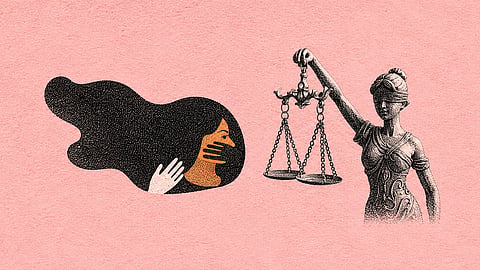
Bangladesh's rape laws leave married women unprotected: Report
Bangladesh remains among South Asian countries where marriage deprives women of full legal protection against rape, as international rights advocates renew calls for dismantling discriminatory provisions in sexual violence laws.
A report published on November 23 by the South Asian Movement for Accessing Justice (SAMAJ), with international women's rights organisation Equality Now as its secretariat, calls for the complete criminalisation of marital rape and the removal of legal exemptions protecting husbands from prosecution.
Titled Challenging the Marital Rape Exception in South Asia, the 24-page report examines legislation, judicial interventions and reform initiatives across Afghanistan, Bangladesh, Bhutan, India, the Maldives, Nepal, Pakistan and Sri Lanka.
The report recommends making freely given consent central to the legal definition of rape, irrespective of the relationship between the perpetrator and the victim.
It identifies the Maldives as the only South Asian country where marital rape is criminalised in all circumstances and carries the same penalties as rape outside marriage.
Bangladesh's legal problem is centering around Section 375 of the Penal Code of 1860, which excludes forced sexual intercourse by a husband from the definition of rape if his wife is not under 13.
The provision effectively denies adult married women the same criminal protection available to unmarried women. Bangladesh does not have a specific marital rape exception for spouses living separately either.
The Women and Children Repression Prevention Act 2000 also contains a definition of rape that excludes sexual intercourse within marriage.
In November 2020, the High Court sought an explanation from the government on why discriminatory legal provisions exempting marital rape should not be declared unconstitutional.
The challenge was initiated by Bangladesh Legal Aid and Services Trust (BLAST), BRAC, Naripokkho and Manusher Jonno Foundation.
Six years later, the exemption remained a concern in a joint submission made by Equality Now and five rights organisations to the UN Committee on the Elimination of Discrimination against Women in September 2026.
The organisations sought clarification on what steps Bangladesh had taken to repeal the exemption and resolve inconsistencies regarding the age of sexual consent across its criminal laws.
The legal gap persists despite extensive evidence of sexual violence within Bangladeshi marriages.
The 2024 Violence Against Women Survey, conducted by the Bangladesh Bureau of Statistics (BBS) and the United Nations Population Fund (UNFPA), found that 29% of ever-married women had experienced sexual violence perpetrated by their husbands.
Some 25.9% reported being forced into sexual intercourse against their wishes at some point in their lives, while 8.1% experienced it during the preceding year.
The prevalence of marital sexual violence was higher in urban areas, at 31.3%, compared with 28% in rural areas.
Barishal recorded the highest lifetime prevalence among divisions, at 35.7%, followed by Chattogram at 34.1%. Dhaka recorded 27.8%.
Among married girls aged 15–19, 16.1% experienced sexual violence during the preceding year.
The survey also found that 64% of women subjected to physical or sexual violence by their husbands had never disclosed their experiences to anyone.
The new regional report highlights how South Asian countries have pursued different approaches to criminalising marital rape.
The Maldives achieved full criminalisation in 2021, while Nepal and Bhutan recognise marital rape as an offence but prescribe lighter punishments than those applicable to rape outside marriage.
Equality Now recommends eliminating such disparities, strengthening domestic violence protections and improving institutional accountability.
The report also challenges objections to criminalisation based on religious beliefs, family values and difficulties in establishing evidence.
It recommends engaging religious and community leaders, alongside training police officers, prosecutors, judges and medical professionals to improve survivors' access to justice.
—