
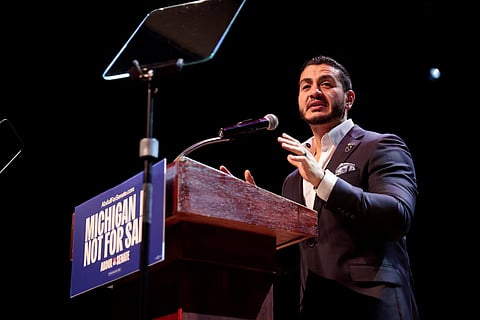
'I am running for the US Senate and happen to be Muslim': The remarkable journey of Abdul El-Sayed
“I'm not running to be a Muslim senator. I'm running for US Senate and happen to be Muslim.”
The answer was delivered by Abdul El-Sayed at a campaign gathering in Caro, Michigan. A man named Tommy had just asked him whether he would disavow the Muslim Brotherhood. It was a question that, on the surface, appeared straightforward. But El-Sayed understood what lay beneath it. He was being asked to establish his loyalty to America in a way that few candidates, particularly those from the country's religious majority, are ever required to do.
But Abdul answered in a different way, he took Tommy back into American political history.
Abdul reminded Tommy of John F. Kennedy, who, during his 1960 presidential campaign, had faced questions about whether his Catholic faith would make him more loyal to the Pope in the Vatican than to the American Constitution.
Kennedy had famously responded that he was not running to be the Catholic president. He was running to be president and happened to be Catholic.
El-Sayed borrowed that argument, making the comparison unmistakable. His religion, he suggested, should be no more relevant to his constitutional responsibilities than Kennedy's Catholicism had been to his.
It was a remarkable exchange. More than six decades after Kennedy confronted religious suspicion on his way to the White House, an American Muslim was having to answer a remarkably similar question on his journey to the Senate.
Now, following his victory in Michigan's fiercely contested Senate election, that exchange carries a significance beyond the campaign trail. Abdul El-Sayed is set to become the first Muslim ever elected to the United States Senate.
For him, the achievement is historic. For American politics, it is a moment that invites a much bigger conversation about religion, belonging, prejudice and the meaning of representation in a country that has long described itself as a “home for people of different faiths”.
But to understand the man behind the historic victory, we must look beyond the election, the campaign advertisements and the arguments (and of course the Islamophobic and racist remarks) about his religion. El-Sayed's journey began long before he became a familiar face in American political debates. In fact, he did not initially imagine himself becoming a politician at all.
The doctor who decided to treat the system
Abdul El-Sayed was born and raised in Southeast Michigan, in a family whose story mused the diversity of the state he would eventually represent.
His father was an Egyptian immigrant. His stepmother came from a family with roots in Michigan's Gratiot County dating back to the 1800s. El-Sayed grew up attending public schools, playing football, wrestling and lacrosse. At the University of Michigan, he graduated with highest distinction and played for the university's men's lacrosse team.

There was little in that early life to suggest that he would one day become a central figure in a national political debate about Muslim identity.
However, his academic journey was already taking him in an unusual direction. He earned a medical degree from Columbia University and a doctorate in public health from the University of Oxford as a Rhodes Scholar. He subsequently worked as an assistant professor of epidemiology at Columbia, building a reputation as a researcher interested in the relationship between social conditions and human health.
Medicine was supposed to be his profession. But somewhere along the way, he began to question whether treating individual patients was enough.
During his medical training, El-Sayed encountered a woman who was homeless and struggling with substance abuse. He recalled treating her in hospital and attempting to connect her with rehabilitation services. She declined and left. Not long afterwards, he saw her sleeping on the subway.
The experience stayed with him. It led him towards public health, and eventually towards public service.
He started looking at the government differently. To him, it was no longer just about making laws and collecting taxes. It was also about whether people had clean water to drink, safe neighbourhoods to live in, affordable healthcare when they needed it, and the basic things that allow them to lead a healthy life.
In other words, he began to believe that some of the most important work of a doctor happened outside the hospital.
That conviction would become the foundation of his political career.
His first major opportunity came in Detroit. The city had gone through a painful financial crisis, and its health department had been dismantled and privatised during the bankruptcy period. In 2015, El-Sayed returned to Michigan to lead the effort to rebuild it.
He was just 30 years old.
It was an enormous responsibility. Detroit was not an easy place to govern. Its residents were dealing with the consequences of economic decline, deteriorating infrastructure, environmental problems and deep inequalities in access to healthcare.
Rather than treating the health department as another bureaucratic office, El-Sayed set about rebuilding its capacity and reconnecting public services with the people they were supposed to serve.
Under his leadership, the department developed programmes that provided free eyeglasses to children who needed them, expanded environmental health initiatives and arranged for lead testing in schools and childcare facilities. His administration also worked on issues ranging from pollution to access to life-saving medication.
The work was not glamorous. It involved the difficult, often uncelebrated business of making public institutions function.
But it was precisely the kind of work that would later shape his argument for entering national politics that, government should be judged by whether it improves people's lives, not by the promises politicians make about it.
His work in Detroit earned him recognition as Public Official of the Year from the Michigan League of Conservation Voters and a place on Crain's Detroit Business 40 Under 40 list.
He subsequently took on another substantial public-sector responsibility. From 2022 to 2025, he led Wayne County's Department of Health, Human and Veterans Services, serving a county of approximately 1.8 million people.
It was another opportunity to work with the kind of problems that rarely feature in the grand language of political campaigns but shape people's daily lives.
Among his initiatives was a medical debt relief programme that aimed to cancel up to $700 million in medical debt for approximately 300,000 Michiganders over two years.
These experiences taught El-Sayed how the government works in real life. He saw how its decisions affect ordinary people every day.
But he was beginning to realise that the problems he wanted to solve could not always be addressed through a local health department.
The larger questions were political.
Who gets access to healthcare? Why should a medical emergency push a family into debt? Why do corporations enjoy so much influence over public policy? Why is it becoming increasingly difficult for ordinary Americans to afford a decent life?
For El-Sayed, these were not separate questions. They were connected symptoms of a political and economic system that, in his view, had stopped working for too many people.
And he wanted to change it.
So he ran for governor of Michigan in 2018, where he lost. It was his first appearance in electoral politics.
The Senate race that became a test of American identity
When El-Sayed entered the race for the US Senate in Michigan, he was not an established political heavyweight. He had never held elected office. He had lost a gubernatorial primary, and his progressive politics were hardly guaranteed to find a majority in a politically competitive state.
Interestingly though his campaign began to attract attention well beyond Michigan.
He was running for a seat being vacated by Democratic Senator Gary Peters. His Republican opponent was Mike Rogers, a former congressman and former FBI agent who had previously contested the Senate seat in 2024, narrowly losing to Democrat Elissa Slotkin.
The Democratic primary itself was a difficult contest. El-Sayed faced Congresswoman Haley Stevens, who enjoyed considerable establishment support, with money pouring from AIPAC giants, as well as state Senator Mallory McMorrow, who eventually withdrew from the race.
The odds were not particularly favourable to him. But El-Sayed prevailed.
On August 5, 2026, he secured the Democratic nomination, defeating Stevens by a narrow margin. According to the Associated Press results, he received approximately 48.5 per cent of the vote against Stevens's 47.5 per cent.
It was an important victory, but it was also the beginning of a much more difficult campaign.
The general election would become a contest over healthcare, economic inequality, the future of the Democratic Party and America's role in international affairs. Increasingly, however, it would become a contest over something that had little to do with his policy proposals – his religion.
For El-Sayed, being a Muslim was no secret and certainly nothing he intended to conceal. But as the campaign developed, his opponents increasingly made it a central feature of their political attacks.
And the attacks did not come only from ordinary political opponents.
President Donald Trump repeatedly targeted him. At a rally in Ohio, Trump referred to El-Sayed as a “jihadist”. On another occasion, the president suggested that El-Sayed would have to pass through a metal detector to enter the Senate.
Vice President JD Vance also used inflammatory language, describing El-Sayed as a “cancer” and portraying him as a threat to the state's stability.
Senator Ted Cruz went further, calling him a “theocratic zealot” and using the derogatory phrase “jihadist leprechaun”. Cruz also suggested that electing El-Sayed could endanger American service members because of an alleged risk that he might disclose sensitive information to terrorist groups.
Republican nominee Mike Rogers repeatedly questioned where El-Sayed's loyalties lay, attempting to associate him with the Muslim Brotherhood and suggesting that his political positions raised questions about whether he was truly acting in America's interests.
The attacks were not simply about whether voters agreed with his policies. They increasingly invited voters to view his Muslim identity itself as a reason for suspicion.
The Washington Post documented a sharp increase in anti-Muslim commentary following El-Sayed's primary victory. Reuters reported that a Michigan State University poll found 38 per cent of voters would be less likely to support a Muslim candidate.
The Intercept also reported on the increasingly hostile atmosphere surrounding his candidacy, including criticism from political figures and campaign material that allegedly placed his image alongside the World Trade Center's Twin Towers.
The irony was seriously difficult to miss.
'I'm Abdul, nice to meet you'
There was something particularly revealing about how El-Sayed approached these attacks.
He did not always respond with anger. Nor did he allow every provocation to dictate the direction of his campaign.
At times, he simply returned to the issues he had been talking about from the beginning.
When Trump attacked him in Ohio, El-Sayed told NBC News, “So he wants to point to my name and my faith, and he wants to distract people from paying attention to the issues.”
He added that Americans were bigger than the politics of division and that the president wanted people to become small in the way he was.
But El-Sayed was not entirely unwilling to return fire.
After Trump suggested that he would need to go through a metal detector to enter the Senate, El-Sayed responded at a campaign rally:
“Here's the deal, Donald, listen. I'll go through a metal detector if you'll sit for a lie detector. Simple. I got nothing to hide, you've got so much to hide.”
It was a sharp response, delivered with the kind of confidence that had become characteristic of his campaign.
Yet perhaps his most lovely remarks came in a rather different setting.
In an interview with Vanity Fair, El-Sayed was asked what he would say if an elderly woman approached him in a supermarket and asked who he was.
His answer was very simple.
“I usually just put out my hand and say, 'I'm Abdul, nice to meet you.'”
He then also said that having an uncommon name could actually be useful. It was not as though the woman would confuse him with one of the many Abduls she might already know.
This sort of communication method seemed ordinary but it worked.
He did not seem particularly interested in turning every encounter into a discussion about religion, identity or prejudice. He wanted to introduce himself, shake someone's hand and have a conversation.
That instinct also appeared in the way his campaign conducted public meetings.
Before one of his programmes, the audience was reminded that not everyone present would necessarily agree with El-Sayed or his political positions. Some might arrive with an open mind; others might already have made up their minds.
But everyone was welcome.
If disagreements arose, the organisers asked people to disagree respectfully. The campaign, the audience was told, was built on kindness and respect.
It was an important distinction in an election increasingly dominated by hostile rhetoric. El-Sayed wanted to argue about ideas without making hostility towards people the defining feature of his politics.
What does it mean to be too progressive?
Religion was not the only question El-Sayed had to confront. His political ideology was another source of criticism.
His opponents repeatedly described him as too progressive to win in Michigan. But El-Sayed seemed unconvinced by the label itself.
When Vanity Fair asked him what he would say to those who considered him too progressive, he responded with a question of his own: what exactly did progressive mean?
Was it a reference to the politics of the early twentieth century? A particular social media culture? Or a specific collection of economic policies?
He suggested that the label had become so frequently used in American political debate that it had lost much of its meaning.
Then he explained what he actually believed in.
He wanted the government to work for people. He wanted families to have access to healthcare, children to receive a good education and communities to have proper infrastructure.
He wanted an economy in which ordinary people could participate and prosper, rather than one in which billionaires could continue accumulating wealth while millions struggled to earn their first $100,000.
He wanted a democracy in which politicians listened to the people they represented rather than corporations financing their campaigns.
And he wanted America to stop fighting wars that did not serve its interests.
“Does that make me progressive? I don't know,” he said. “But that's what I'm about. And that's what I keep fighting for.”
It was perhaps the clearest explanation of his political philosophy.
For El-Sayed, progressive politics was not supposed to be a cultural identity or a badge of belonging to a particular political circle. It was about the practical question of whether the government could make life better for ordinary people.
He also argued that these ideas were not confined to traditionally Democratic communities. When he took his message to supposedly conservative parts of Michigan, he often found people who agreed with the basic principles.
They wanted affordable healthcare. They wanted better schools. They wanted good jobs and a fairer economy.
His argument was that these were not inherently left-wing demands. They were ordinary expectations of a government that was supposed to serve its citizens.
That message became central to his Senate campaign.
El-Sayed advocated Medicare for All, stronger protections for workers, action against corporate monopolies, higher taxes on billionaires and reforms to reduce the influence of wealthy donors in American politics.
He also made his opposition to continued American military support for Israel a major part of his foreign-policy position, particularly in the context of the war in Gaza.
This position attracted support among progressives but also generated considerable criticism, including from sections of the Democratic establishment.
It is important to distinguish those disagreements over policy from attacks directed at his religious identity. Not every criticism of El-Sayed was Islamophobic, and his positions on Israel were genuinely contentious within his own party.
But the campaign repeatedly blurred that distinction, allowing questions about his political views to become entangled with insinuations about his religious loyalties.
A campaign of course bigger than one man
The political significance of El-Sayed's candidacy extended beyond his personal ambitions.
Michigan is home to one of the largest Arab-American and Muslim communities in the United States. The Detroit metropolitan area, particularly Dearborn and its surrounding communities, has long been an important centre of Arab-American political and cultural life.
For many people in these communities, his candidacy meant a lot. They saw someone with a familiar name, a Muslim background and a real understanding of their lives running for one of the highest elected offices in America.
But his appeal was not limited to Muslim or Arab-American voters.
His campaign attempted to bring together working-class voters, young people, progressives, healthcare advocates, trade union members and those disillusioned with the influence of wealthy interests in Washington.
That coalition was never going to be straightforward to build.
His progressive economic positions created tensions with some traditional Democrats. His views on Israel generated disagreements within the party. His Muslim identity became a target for Republicans seeking to portray him as an outsider.
And the support of some prominent progressive figures, including Bernie Sanders, helped establish him as a candidate with national significance.
The campaign was therefore about more than whether Michigan would elect a Muslim senator. It was also about whether a candidate with a left-leaning economic programme could win in a competitive state while refusing to separate himself from the positions that had defined his political career.
The answer, in the end, was yes.
His victory over Mike Rogers was a political achievement in its own right. It also delivered a historic first for American Muslims.
But it would be a mistake to understand the result simply as a victory for one religious community.
El-Sayed had not campaigned on the promise of representing Muslims alone. He had campaigned on the promise of representing Michiganders, regardless of their religion, background or political affiliation.