
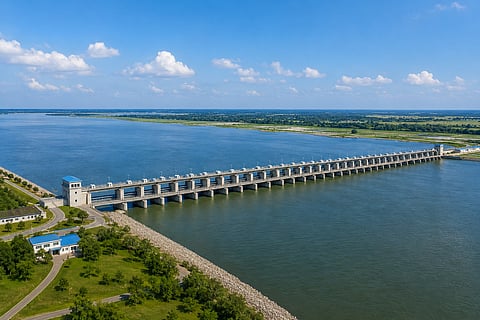
Padma Barrage bets on water security as Ganges Treaty uncertainty looms
The government has approved the Padma Barrage project, a Tk 34,497 crore mega initiative that officials describe as a strategic answer to Bangladesh’s worsening dry-season water crisis.
The Executive Committee of the National Economic Council (ECNEC), chaired by Prime Minister Tarique Rahman, cleared the first phase of the project on Wednesday, despite lingering uncertainty over the future of the 1996 Ganges Water Sharing Treaty with India, which expires in December 2026.
The project seeks to regulate and retain water from the Padma River during the monsoon so it can be released in the dry months to revive rivers in the southwest and northwest.
Officials say the barrage at Pangsha in Rajbari will hold around 2,900 million cubic metres of water and support irrigation, navigation, groundwater recharge, fisheries and salinity control across nearly one-third of the country.
But the approval has immediately triggered a deeper national debate on whether Bangladesh can truly solve its river crisis through a massive domestic engineering project when the core problem remains upstream water control by India through the Farakka Barrage?
That question is becoming more urgent because the Ganges treaty signed between Dhaka and New Delhi in 1996 is approaching expiration within the next eight months, while negotiations on a new framework have shown little visible progress.
The treaty governs dry-season water sharing at Farakka between January and May, the very months when Bangladesh faces acute shortages in the Padma and its distributaries.
Under the current treaty, Bangladesh is guaranteed specific water shares based on availability at Farakka, but Dhaka has long complained that actual dry-season flows remain inadequate for agriculture, river navigation and ecological balance.
The issue of Farakka Barrage
Bangladeshi experts argue that the diversion of water through the Farakka Barrage since the 1970s drastically altered the hydrology of southwest Bangladesh, accelerating salinity intrusion, river siltation and the degradation of distributaries such as the Gorai, Madhumati and Ichamati.
Government planners now present the Padma Barrage as a form of strategic adaptation. The underlying logic is if Bangladesh cannot ensure guaranteed upstream flow politically, it must maximise storage and management of whatever water enters the country during the monsoon.
Officials of the Water Management Ministry claim the project could restore flow in at least five major river systems, reduce salinity in Khulna, Satkhira and Bagerhat, and strengthen freshwater supply to the Sundarbans.
The Bangladesh Water Development Board believes the project could also increase irrigation coverage for nearly 28.8 lakh hectares of farmland and potentially raise annual rice production significantly. Project documents further estimate annual economic returns of around Tk 8,000 crore through gains in agriculture, fisheries and transport.
Yet many water experts warn that the barrage may struggle to deliver its promised benefits unless Bangladesh secures predictable upstream flow from India after 2026. Their concern is rooted in hydrological reality: a barrage cannot create water; it can only store and distribute available flow.
Sara Ferdousi, associate professor of Water Resource Engineering Department of BUET told Daily Waadaa that during severe dry months, the Ganges flow entering Bangladesh has at times dropped sharply due to upstream diversion and changing rainfall patterns linked to climate change.
If incoming dry-season flow continues to decline, the Padma Barrage may face operational limitations despite its enormous cost, Shahidul Islam said, adding that storing water in a heavily sediment-laden river like the Padma also poses major engineering and environmental challenges.
The sediment issue has emerged as one of the most critical technical concerns surrounding the project. Rivers connected to the Padma carry massive sediment loads from the Himalayan basin.
Critics argue that unless sediment management is integrated into the barrage design, silt accumulation could undermine river navigability and water retention goals within years. Environmental groups including Bangladesh Poribesh Andolon (BAPA) have questioned whether adequate feasibility studies and stakeholder consultations were completed before approval.
Water politics and diplomacy
There is also a political contradiction at the heart of the decision. Before returning to power, the BNP repeatedly criticised the previous Awami League government’s reliance on mega projects, arguing that such schemes became vehicles for corruption, inflated costs and debt dependency.
In 2023, BNP leaders publicly stated that if elected, they would prioritise investments in education and human resources instead of large infrastructure ventures associated with the Sheikh Hasina era. The Padma Barrage approval therefore marks a notable policy shift for the party now leading the government.
Officials argue the distinction lies in strategic necessity. Unlike some prestige infrastructure projects of the past decade, they say the barrage directly addresses existential concerns involving food security, climate resilience and water survival in southwestern Bangladesh.
The government also emphasises that the first phase will be financed entirely through domestic resources, avoiding immediate foreign debt exposure.
Still, scepticism persists because Bangladesh’s recent history of mega projects has been shadowed by allegations of inflated costs, procurement irregularities and weak accountability.
At more than Tk 34,000 crore for the first phase alone—with total projected expenditure potentially exceeding Tk 50,000 crore—the Padma Barrage instantly becomes one of the country’s largest public investments.
Zahid Hussain, former lead economist of the World Bank’s Dhaka office wrote in a local newspaper that without rigorous transparency and independent oversight, the “project risks becoming politically contentious long before completion.”
The geopolitical dimension also cannot be ignored. The barrage effectively signals that Bangladesh is preparing for a future in which water diplomacy with India may become more uncertain and contested.
A former diplomat who preferred to be unnamed told Daily Waadaa that while Dhaka officially continues to seek renewal of the Ganges treaty, the decision to move ahead with domestic water retention infrastructure reflects “declining confidence” that “upstream negotiations” alone can secure Bangladesh’s long-term water needs.
The diplomat said the project’s success ultimately hinges on “guaranteed transboundary flow from India” and without securing that, success will be hard to achieve.