
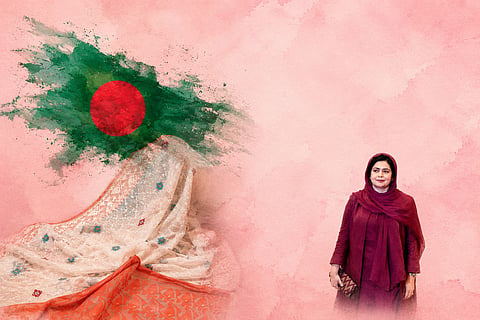
A nation woven in more than one cloth
Sartorial choices on the diplomatic stage are rarely innocent. For a first lady, a garment is essentially a tool of statecraft, projecting a nation's identity to the world.
When Bangladesh’s First Lady, Dr Zubaida Rahman, arrived in Kuala Lumpur this week alongside Prime Minister Tarique Rahman, the visual messaging was studied. The Prime Minister wore the standard armor of global governance—a crisp, dark suit.
Beside him, Zubaida opted for an elegant, collared salwar kameez in deep maroon—understated, contemporary and unmistakably Bangladeshi. Yet back home in Dhaka, this choice immediately ignited a fierce proxy war over cultural purity.
A vocal contingent of social media users, many aligned with the ousted Awami League establishment, took aim at the First Lady’s wardrobe. Their grievance was that by eschewing the saree, Zubaida had failed a crucial test of national representation.
In their eyes, the saree is the non-negotiable template of Bengali womanhood, the only garment worthy of the world stage. To choose the salwar kameez was deemed a dilution of the national brand.
To understand the visceral reactions, one must understand the unique position the saree occupies in the Bengali psyche. It is a repository of historical memory and economic pride.
The legacy stretches from the translucent muslins of Mughal Dhaka to the handlooms of Tangail and the UNESCO-recognized artistry of Jamdani motifs. The garment is intertwined with the country's struggle for cultural autonomy.
So fiercely protected is this inheritance that when India recently claimed the geographic origin of the Tangail saree, it triggered a genuine diplomatic and public outcry across Bangladesh. The saree is treated as a sovereign boundary.
The weight of the saree
How sensitive this territory can be was illustrated in 2019, when the eminent educator Abdullah Abu Sayeed published an article in a national daily celebrating the garment. What was intended as a romantic homage instead provoked a national reckoning.
Critics savaged the piece, arguing that his lyrical praise amounted to the patriarchal objectification of women wrapped in cultural nostalgia. The episode proved that the saree is a lightning rod, a vessel into which society pours its anxieties about gender, tradition, modernity and nationalism.
Yet while the saree remains culturally sacrosanct, a parallel reality has quietly rewritten the rules of daily life in Bangladesh. Contemporary Dhaka is not the Dhaka of the 1990s. For millions of modern Bangladeshi women, the salwar kameez has won the argument through sheer utility.
It is the undisputed uniform of the public sphere, worn across university campuses, corporate boardrooms, government ministries, hospital wards and garment factories. In a rapidly urbanizing, fast-paced society, the salwar kameez offers the mobility and convenience that the more restrictive saree often cannot match.
A casual stroll through any major Bangladeshi city reveals that the overwhelming majority of women have embraced this shift. The garment has long ceased to be an imported regional alternative; it has been thoroughly vernacularized.
The mistake of the First Lady’s critics lies in the assumption that a nation's identity must be static to be authentic. Global diplomatic history suggests the opposite. Fashion has always been a dynamic political tool.
Jacqueline Kennedy used her youthful chic to project a forward-looking American image during the Cold War. Michelle Obama deployed wardrobe choices to elevate emerging domestic designers while signaling egalitarianism and inclusivity. Jill Biden routinely uses color and local tailoring to communicate solidarity.
These women understood that diplomatic fashion is potent not when it rigidly adheres to an archaic template, but when it mirrors the living reality of the society it represents.
The Bangladesh of today
Zubaida Rahman’s choice was, in fact, an accurate reflection of the contemporary status quo. It spoke to the daily lived experience of the women who drive the country's economy and institutions.
This point was not lost on a younger generation of commentators who quickly mounted a counteroffensive. D Shamaruh Mirza, an Australia-based scientist and daughter of BNP Secretary General Mirza Fakhrul Islam Alamgir, diagnosed the criticism as a symptom of an identity crisis afflicting a Westernized elite establishment.
She noted that both garments are deeply woven into the fabric of the nation, suggesting that the obsession with dictating a singular standard of sophistication often betrays an underlying insecurity about one's own roots.
US-based geopolitical analyst Shafquat Rabbee made a related argument, framing the debate in terms of how Bangladesh presents itself internationally.
In a widely discussed social media post, he wrote that Bangladesh had "found someone who, even among foreigners, comes across as a person of genuine international stature."
Rabbee said he was "even happier" that Zubaida Rahman had chosen not to wear a saree during her trip abroad, arguing that it was "perfectly fair" to expect the spouse of Bangladesh's prime minister to project a distinct identity rather than resemble "Indian counterparts."
Equally sharp was the intervention from Fatima Tasnim Juma, a student leader from Dhaka University, who attacked the controversy from a civil liberties perspective. She characterized the critique as a form of "liberal moral policing."
In her view, attempts by self-styled progressives to enforce a specific cultural dress code are conceptually identical to conservative efforts to mandate religious attire. Both deny women autonomy. Juma argued for a pluralistic society where a woman wearing a saree, a salwar kameez, Western clothing or a burqa enjoys equal dignity.
This is the real insight buried beneath the social media noise. Bangladesh in 2026 is a complex tapestry of Jamdani and jeans, of rural heritage and hyper-modern global ambitions. Its cultural resilience does not depend on freezing itself in amber; it thrives through adaptation and plurality.
The image projected on the Malaysian tarmac was therefore more than a fashion statement. It was an acknowledgment of evolution. By wearing the salwar kameez, the First Lady looked exactly like millions of women who inhabit modern Bangladesh.
And that is why the image mattered.
Faisal Mahmud is the managing editor of Daily Waadaa.