
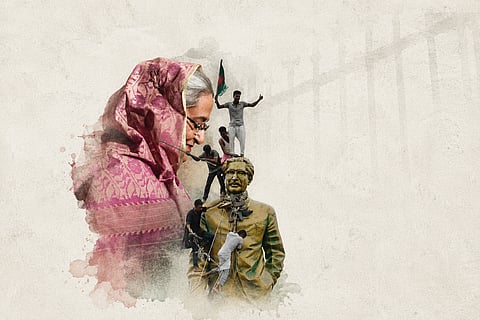
Hasina’s leftovers….a ‘grand old party’ confronts life on the scrapheap
As Bangladesh marks the founding anniversary of the Awami League today, the party finds itself celebrating in the sterile, disorienting wilderness of political exile.
For three quarters of a century, the Awami League was, in its own imagination and much of the national consciousness, the state itself. It carried the heavy, legitimizing mantle of the 1971 Liberation War and served as one of the twin planetary bodies around which post-independence politics revolved.
Yet, history is a fickle collateral. As the party surveys the wreckage left in the wake of the July Uprising, it faces an existential truth that its leadership spent fifteen years ignoring…past glory cannot indefinitely subsidize present tyranny.
The crisis currently suffocating the Awami League is unprecedented in its scope and severity. Following the dramatic collapse of Sheikh Hasina’s regime, the party has been systematically dismantled.
Its electoral registration is suspended, its top-tier leadership is either incarcerated, in hiding, or scattered across foreign capitals, and the ousted Prime Minister Hasina remains indefinitely sequestered in India.
To view this purely as a temporary reversal of electoral fortunes, however, is to profoundly misread the situation. Political parties routinely lose power, suffer electoral routs, and retreat to the opposition benches to lick their wounds, reform their platforms, and await the inevitable pendulum swing of public dissatisfaction.
The Awami League’s predicament is far more pathological. It has lost its moral friction with the Bangladeshi electorate.
At present, the ‘grand old party of secular nationalism’ has been reduced to a digital phantom. Its political presence is largely confined to the ethereal realms of social media—a disembodied entity operating via Facebook campaigns, combative WhatsApp networks, and video messages beamed from abroad.
Occasionally, this digital noise manifests physically in the form of sudden street demonstrations designed more for the lenses of smartphones than for actual political mobilization.
But a serious political movement cannot be resurrected through algorithms and hit-and-run optics. True reconstruction requires a coherent organizational skeleton, a transparent strategy for leadership transition, and a public program that resonates with an alienated populace.
Dismantled politics
Instead of undertaking this agonizing institutional repair, the party’s remnants have dissolved into an unseemly internal blame game. Activists and mid-level leaders trade accusations of cowardice and betrayal, yet none dare point the finger at the root cause of their collective ruin.
There is no visible reform agenda, no mechanism for truth-telling, and absolutely no willingness to separate the party’s historic contributions to Bangladesh from the autocratic excesses of its final decade in power.
This paralysis is directly linked to a calcified leadership structure. Sheikh Hasina remains the absolute, unquestioned center of gravity for the Awami League, even as she issues directives from New Delhi. But remote-control autocracy has strict operational limits.
A shattered party cannot be rebuilt via video calls, particularly when the leadership refuses to devolve power to a new, untainted generation of domestic politicians. The current hierarchy seems gripped by a paralyzing fear that opening the party to internal democracy will dilute their dynastic control.
Consequently, the Awami League remains trapped in its own past, incapable of producing leaders unburdened by the stink of corruption, electoral manipulation, and extrajudicial violence.
The central tragedy of the Awami League is its profound misreading of its own longevity. It mistook the silence of a suppressed population for genuine consent. The July Uprising was not a sudden, unpredictable black swan event, nor was it the product of a foreign conspiracy or opposition scheming.
It was the explosive release of fifteen years of accumulated civic resentment. Under the Awami League’s tenure, the institutional architecture of Bangladesh was thoroughly hollowed out.
Elections became farcical exercises in bureaucratic theater, the judiciary and law enforcement were weaponized into partisan cudgels, and dissent was treated as a form of treason. Journalists, students, opposition workers, and ordinary citizens lived under a continuous cloud of surveillance and intimidation.
The ongoing legal proceedings regarding the brutal crackdown during the uprising are bringing these systemic horrors into sharp focus. For the Awami League to expect a smooth re-entry into the political mainstream without answering for this legacy is an exercise in staggering delusion.
Catering to its own pipe dreams
This explains why the party's sporadic attempts to generate public sympathy have failed so spectacularly. When opposition figures were hunted down during the Awami League’s reign, ordinary citizens often offered them quiet solidarity, viewing them as fellow victims of an overbearing leviathan.
Today, when Awami League activists attempt to assemble, they are met not with public sympathy, but with active civic resistance. To chart a path forward, the party frequently invokes the historical parallel of 1975, when the assassination of Sheikh Mujibur Rahman plunged the Awami League into darkness.
Then, as now, the party was fractured and excluded. Yet, the comparison is fundamentally flawed. In the late 1970s and 1980s, the Awami League rebuilt itself through painstaking domestic negotiation, coalition-building, and institutional patience.
More importantly, contemporary Bangladesh is a vastly different country. The electorate is younger, highly connected, and fiercely intolerant of dynastic entitlement. Crucially, the crisis of 1975 was a tragedy imposed upon the party from the outside; the catastrophe of 2024 was entirely self-inflicted.
Even the party’s traditional external life-support systems are failing. For over a decade, New Delhi acted as the Awami League’s primary geopolitical guarantor, prioritizing regional stability and security over Bangladesh’s democratic health.
But international relations are governed by cold pragmatism, not sentimentality. While India may continue to provide sanctuary to Sheikh Hasina, policymakers in New Delhi must ultimately deal with the sovereign reality in Dhaka.
India is already quietly recalibrating its approach, recognizing that anchoring its bilateral policy to a deeply unpopular, fragmented, and sidelined political entity is a recipe for long-term strategic irrelevance. The Awami League can no longer rely on foreign patronage to bypass domestic legitimacy.
If the Awami League is to ever transition from a historical memory back into a viable political force, it must submit to a comprehensive moral and structural transformation. This requires absolute accountability, submitting unconditionally to credible, transparent legal processes for individuals accused of state excesses.
It necessitates an unqualified public apology, moving beyond vague expressions of regret to directly acknowledge the immense pain caused by a decade and a half of authoritarian misrule.
It demands comprehensive leadership renewal, purging the figures associated with the previous regime's kleptocracy and violence to make way for fresh faces. Finally, it requires a new democratic contract, embracing internal party democracy, financial transparency, and a structural commitment to institutional pluralism.
Ultimately, the party must learn the most fundamental lesson of democratic politics: the right to lose. Until the Awami League accepts that its survival depends not on reclaiming its lost empire, but on reforming its broken culture, it will remain stranded on the wrong side of Bangladesh’s history.
—
The writer is a political analyst. He can be reached at mwtanvir@gmail.com