
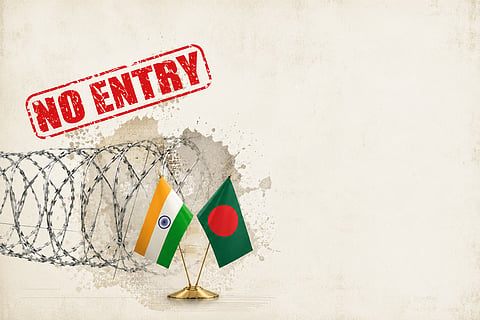
The price of diplomatic inertia in India-Bangladesh relations
In 2022, while traveling on official business through New Delhi’s immigration counter, I watched a Bangladeshi couple with red passports navigate entry. They were not merely being processed; they were being examined.
Every document invited another question; every answer generated a new request. They stood with a weary compliance, performing a familiar script, understanding that resistance would only prolong the interrogation.
Four years later, in June 2026, that memory returned with precise relevance.
Zahed Ur Rahman, the information adviser to Bangladesh’s Prime Minister Tarique Rahman, landed at New Delhi’s Indira Gandhi International Airport.
Leading an official delegation to the Indian Ocean Rim Association meeting—an event hosted by India’s Ministry of External Affairs—his arrival was not a surprise. Indian authorities had been notified more than sixty hours in advance, and Bangladesh’s High Commissioner was physically present at the airport.
Yet, Zahed’s name appeared on an immigration watchlist. For more than two hours, he was made to wait while officials attempted to resolve the discrepancy. Even after the High Commissioner personally identified him and cited an existing diplomatic notification, the bureaucratic gridlock remained.
While the rest of the Bangladeshi delegation was cleared, authorities eventually offered Zahed a "one-time exemption." He declined the compromise, refused entry, and boarded the next flight back to Dhaka.
New Delhi has since characterized the episode as an isolated administrative failure—a routine database synchronization error. While factually plausible, viewing this strictly as a technical glitch misinterprets how modern states communicate.
States communicate through their systems. The immigration officer was not executing foreign policy, nor was the clerk who flagged the name. Yet, their collective bureaucratic output delivered a diplomatic message far louder than any official communiqué.
This is the structural hazard of large bureaucracies: when they become sufficiently complex, they operate on internal logic. Procedure detaches from purpose, compliance replaces judgment, and the system grinds forward even when explicit context demands a halt.
Hostility can be negotiated and resolved. Indifference is far more difficult to counter because it lacks an explicit author. The insult to a senior Bangladeshi official was not engineered by a single decision-maker; it emerged from the cumulative operations of an unyielding system.
The timing of this incident is particularly damaging. In April 2026, Bangladesh’s Foreign Minister met Indian External Affairs Minister S. Jaishankar in New Delhi.
This meeting represented a tentative, critical attempt to stabilize bilateral ties following eighteen months of diplomatic frost after Bangladesh’s recent political transition and the conclusion of Sheikh Hasina’s tenure. Both nations had pledged to rebuild trust and maintain open channels.
Movement had finally begun, but the airport incident abruptly halted that momentum. Diplomatic relations regularly survive policy disagreements and electoral shifts; they rarely survive the steady erosion of confidence that the other party is paying attention.
The Zahed Ur Rahman episode is a symptom, not the source, of a deeper structural strain. The bilateral relationship faces critical, unresolved deadlines and long-standing grievances.
The landmark 1996 Ganges Water Sharing Treaty expires at the end of 2026, and Dhaka requires new allocations that reflect contemporary hydrological realities rather than data from three decades ago.
Meanwhile, the crucial Teesta River water-sharing pact remains frozen in political limbo despite twice approaching finalization. Along the border, fatalities continue despite repeated, high-level commitments to eliminate violence; human rights organizations documented dozens of Bangladeshi deaths along the border in 2025 alone.
Left unaddressed, these individual policy friction points coalesce into a potent national narrative. The prevailing perception taking root in Dhaka is not necessarily that India is an active adversary, but something more dismissive: that Bangladesh is treated as a regional problem to be managed rather than an equal partner.
This perception is reinforced daily by routine systemic friction felt by students facing protracted visa delays, professionals navigating unexplained administrative hurdles, and travelers subjected to disproportionate scrutiny.
Individually, these encounters appear trivial, but collectively they establish a pattern—and patterns become political facts. Zahed Ur Rahman’s decision to return home was a calculated statement regarding bilateral limits. Relationships depend on reciprocal recognition, and when that recognition degrades into cold procedure, unresolved grievances grow heavier.
None of the necessary solutions are inherently complex. They require synchronizing immigration watchlists for official state guests, establishing standardized notification protocols to exempt diplomatic delegations, implementing credible accountability mechanisms for border incidents, and approaching water-sharing negotiations with mutual validation of resource scarcity.
These are not technical limitations; they are matters of political priority. Respect in diplomacy is frequently dismissed as mere symbolism, but in reality, it operates as foundational infrastructure supporting treaties, trade, connectivity, and security cooperation.
The choice now facing New Delhi and Dhaka is straightforward: either steer the relationship with deliberate political purpose, or allow automated bureaucratic machinery to speak on their behalf.
—
Namia Akhtar is an anthropologist with expertise in South Asian affairs. She has previously served at the Embassy of the Netherlands in Dhaka, the United Nations Development Programme, and the European External Action Service. Her email address is namiaakhtar11@gmail.com