
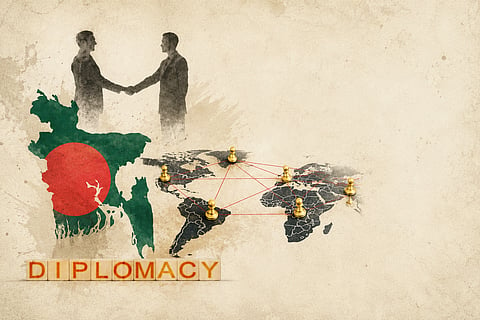
Bangladesh’s strategic recalibration in a multipolar world
In August 2005, while waiting at Singapore’s Changi Airport, I watched television screens repeatedly flash news that "synchronized bomb blasts had struck 63 of Bangladesh’s 64 districts." The attacks forced then-prime minister Khaleda Zia to cut short an official visit to China and rush back to a shaken capital.
The political fallout was severe, cementing a narrative of a state sliding into instability and casting a long shadow over Dhaka’s international standing. For nearly two decades that followed, the geopolitical consequence of that vulnerability was a domestic political landscape quietly but firmly chaperoned by a single neighbor: India.
Visits to Beijing have long carried a peculiar, almost deterministic weight in Bangladeshi political memory. If Khaleda Zia’s 2005 trip was aborted by terror, Sheikh Hasina’s July 2024 visit to the Chinese capital signaled the twilight of her own regime.
Arriving in the throes of an acute economic crisis, her hasty return with little more than token financial promises broadcasted a fatal vulnerability to her domestic rivals. Yet history offers a counter-narrative. In 1977, President Ziaur Rahman met Chairman Mao Zedong, a rendezvous that catalyzed the modernization of Chittagong Port and the upgrading of the vital Dhaka-Chittagong highway.
That early "Look East" pivot provided Dhaka with the crucial diplomatic ballast needed to preserve its sovereignty in a neighborhood prone to asymmetry. It is against this historical ledger that Tarique Rahman, the leader of the Bangladesh Nationalist Party (BNP), now navigates his own engagement with Beijing.
He does so in a fundamentally altered global landscape. The post-Cold War unipolar order is giving way to a fractious, multipolar reality shaped by European conflict, Middle Eastern volatility, the expansion of the BRICS bloc, and the economic muscle of the Global South.
Strategic leverage
For middle-tier states, this fragmentation creates strategic breathing room. The most notable shift is occurring in Washington. For decades, American statecraft viewed the smaller nations of South Asia—Bangladesh, Nepal, Sri Lanka, the Maldives—predominantly through the security lens of New Delhi.
That proxy view is expiring. Recent US-Bangladesh trade negotiations reveal a Washington acting on its own distinct calculations, aggressively pursuing export markets for American agricultural products, energy, and aviation, while treating Dhaka as an independent economic actor rather than an Indian dependency.
This shift is timely, because the ledger of Bangladesh’s bilateral relationship with India has grown unsustainably lopsided. Over the past two decades, Dhaka conceded significant strategic capital to New Delhi: seamless transit and transshipment corridors, deep market access for Indian corporate interests, and ironclad security cooperation along a volatile border.
In return, the dividends have been meager. The promised equitable sharing of the Teesta River waters remains frozen; the chronic trade deficit persists; and overland transit routes to Nepal and Bhutan remain choked by Indian bureaucracy.
Most galling to the Bangladeshi public is the continuous toll of lethal shootings of civilians by Indian border forces along the barbed-wire frontier. This deep asymmetry has exhausted Dhaka’s patience, forcing the new administration to seek fresh geopolitical leverage in infrastructure financing, industrial technology, and energy security.
Geography dictates that this leverage must be found in Beijing, though the exercise requires delicate balancing. Bangladesh’s geopolitical reality is stark: 180 million people enclosed on three sides by Indian territory and bounded on the fourth by the Bay of Bengal.
In such a geography, total alignment with any single superpower is a luxury Dhaka cannot afford; total alienation of one is an act of self-destruction. Bangladesh cannot become a Chinese satellite at the cost of its vital Western export markets, nor can it become a client state of New Delhi or Washington by turning its back on the world's manufacturing engine.
The remedy is a doctrine of cold, multidirectional transactionalism. Dhaka must treat the international system as a portfolio of specific national interests.
Balancing act
Western Europe and North America should remain the primary destinations for its garment exports; the Gulf states and East Asia serve as critical labor markets and sources of remittances; India remains the logistical partner for raw materials and overland trade; while China, Japan, and South Korea offer the capital and technical expertise required for digital transformation, high-speed infrastructure, and renewable energy.
Consequently, a renewed engagement with Beijing is less about securing immediate, high-interest loans for vanity projects and more about reshaping structural relationships. Dhaka requires Chinese technical commitment to reactivate comprehensive water-management and irrigation blueprints for the Teesta river basin, bypassing regional diplomatic inertia.
Furthermore, as the Sino-American trade war forces a realignment of global supply chains, Bangladesh must position itself to capture the manufacturing spillover.
This requires transforming the bilateral relationship from a simple buyer-seller arrangement into a partnership focused on genuine technology transfer, industrial diversification, and preferential market access for Bangladeshi goods into China.
However, the efficacy of this outward-facing strategy depends entirely on domestic renewal. The BNP’s governing mantra, "Bangladesh First," will not be validated in the diplomatic salons of Beijing or Washington, but in the institutional resilience of Dhaka.
History demonstrates that external interference thrives on domestic rot. When a state tolerates pervasive corruption, subverts the rule of law, fails to protect its minorities, and hollows out its democratic processes, it invites foreign leverage. Institutional integrity is a nation's primary defense against external coercion.
If Bangladesh’s current diplomatic recalibration is to match the strategic legacy of the late 1970s, it must avoid the pitfalls of the debt-trap and the illusions of easy capital.
The true measure of success will be whether Dhaka can secure the infrastructure and economic breathing room necessary to foster stable governance at home while maintaining its strategic independence abroad. In a fractured world, true sovereignty belongs to those who can balance the powers without becoming hostage to any of them.
—
Faiz Ahmad Taiyeb is a former Special Assistant to the Chief Adviser of Bangladesh and a writer on sustainable development.