
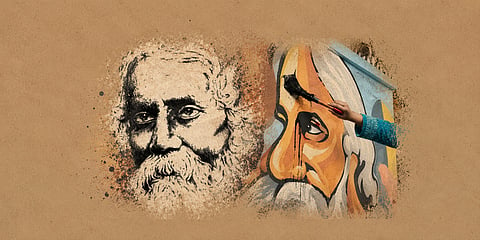
Can anti-India politics justify an attack on Rabindranath Tagore?
Four people were arrested in Dhaka on October 11 for smearing black ink on a mural of Rabindranath Tagore, the Nobel laureate whose song Amar Sonar Bangla is Bangladesh’s national anthem.
The mural, painted on the wall of Shilpakala Academy as part of an urban beautification initiative, became the target of a protest apparently motivated by opposition to Indian influence in Bangladesh.
Police identified the arrested individuals as members of Rashtra Sanglap Forum, a nationalist organisation critical of India. Reports indicate that sedition charges have been brought against them. The allegations, including the motives attributed to the suspects, remain subject to investigation and judicial scrutiny.
The incident comes amid heightened anti-India sentiment following the fall of Sheikh Hasina’s government in August 2024 and her subsequent refuge in India. Relations between Dhaka and New Delhi have remained strained, with disagreements over political interference, border security, water sharing and other bilateral issues.
Criticism of India’s policies is legitimate. Bangladesh has longstanding grievances that deserve serious political and diplomatic attention. But the defacement of Tagore’s portrait introduces a different question: why should opposition to the Indian state require hostility towards a poet whose work forms part of Bangladesh’s own cultural identity?
Tagore was born in Kolkata, but his literary and intellectual influence extends across the Bengali-speaking world. His poetry, songs, fiction and essays belong to a shared cultural tradition that predates the political boundaries separating Bangladesh and India.
Treating him exclusively as an Indian cultural figure ignores that history. It also overlooks the role his work played in the emergence of Bangladesh itself.
Tagore is not the Indian state
Tagore received the Nobel Prize in Literature in 1913, becoming the first Asian Nobel laureate in literature. His writing explored nationalism, individual freedom, social reform, education, human relationships and the relationship between humanity and nature.
His political ideas were neither identical to those of contemporary Indian nationalists nor reducible to the interests of the modern Indian state. He criticised aggressive nationalism and questioned the tendency of political movements to subordinate individual judgment to collective identity.
His relationship with Bengal was equally significant. Tagore spent considerable periods in areas that now form Bangladesh, particularly Shilaidaha, Shahzadpur and Patisar. His experiences there shaped important parts of his literary work.
His place in Bangladesh’s cultural history is therefore neither accidental nor dependent on India's political influence.
Amar Sonar Bangla, written in 1905 during the movement against the partition of Bengal, was adopted as Bangladesh’s national anthem after independence in 1971. Its imagery of Bengal’s landscape and emotional attachment to the homeland made it particularly relevant to the country's emerging national identity.
The song's significance comes from Bangladesh's own historical experience, not from the nationality subsequently assigned to its author.
Bangladesh's national identity developed through several interconnected historical processes: the Language Movement of 1952, resistance to cultural discrimination under Pakistani rule, the political struggle for autonomy and the Liberation War of 1971.
Bengali literature, music and artistic expression were central to those developments.
During the Pakistani period, Rabindra Sangeet became a subject of political controversy. In 1967, the Pakistani authorities moved to restrict the broadcasting of Tagore's songs on state radio and television, arguing that they were inconsistent with Pakistan's national ideology.
The restrictions prompted opposition from Bengali intellectuals and cultural activists. The dispute demonstrated how political authorities could use cultural identity to determine which artistic traditions were considered acceptable.
Bangladesh's independence emerged partly from resistance to such attempts to regulate Bengali cultural expression.
That history makes the present controversy particularly relevant. Political circumstances have changed, but the underlying question remains whether cultural figures should be judged primarily through the political interests of the moment.
There is also a distinction between questioning Tagore's legacy and seeking to remove his presence from public life.
His political views, social position, literary interpretations and intellectual limitations are legitimate subjects of criticism. Scholars have debated his understanding of nationalism, class, religion and colonial society for decades.
Such criticism contributes to a fuller understanding of his work. Defacing a portrait, however, offers no comparable argument. It communicates rejection without explaining the historical or intellectual grounds for that rejection.
The politics of cultural exclusion
The controversy also intersects with occasional demands to replace Bangladesh's national anthem.
Former army officer Abdullahil Aman Azmi, son of the late Jamaat-e-Islami leader Ghulam Azam, previously questioned the suitability of Amar Sonar Bangla as the national anthem and called for its replacement.
His remarks generated criticism and renewed debate over the place of Tagore in Bangladesh's national identity.
Such proposals can be discussed within the framework of constitutional procedures, historical scholarship and public debate. A national anthem is a state symbol, and citizens are entitled to express opinions about it.
But the argument for changing an anthem requires more than objections to the birthplace or perceived political associations of its composer.
Nor should those advocating a change automatically be equated with individuals accused of vandalism. Shared political preferences do not establish organisational connections or responsibility for particular actions.
The broader concern is the increasing tendency to interpret cultural heritage through contemporary political divisions.
Bangladesh's relationship with India is complex. The two countries share language, history, cultural traditions and extensive social connections, while maintaining distinct national interests. Cooperation in one area does not eliminate disagreements in another.
Bangladeshis can oppose Indian government policies, criticise New Delhi's relationship with the former Hasina administration and demand fairer bilateral arrangements without rejecting Bengali literary traditions shared across the border.
Indeed, treating Tagore as an instrument of Indian influence risks accepting the very premise that Bangladesh's cultural inheritance can be defined or claimed by another state.
It cannot.
Also damage to public artwork can warrant prosecution under applicable law. But reported sedition charges raise separate questions of proportionality, evidence and freedom of expression.
The authorities must establish what happened, who was responsible and whether the alleged conduct satisfies the legal requirements of each charge. Political disapproval of an act should not substitute for proof of a criminal offence.
The suspects are entitled to due process, just as the public is entitled to expect the protection of cultural property.
Bangladesh is undergoing a period of political change in which competing interpretations of history and national identity are increasingly visible. Debate over the place of secularism, religion, Bengali nationalism and cultural traditions is part of that process.
Those debates should remain open to competing arguments, including criticism of established cultural figures.
But rejecting a literary figure because of contemporary hostility towards a neighbouring government confuses political sovereignty with cultural exclusion.
–
The author is a PhD researcher in the Department of Political Science. He can be reached at siam33jamil@gmail.com.