
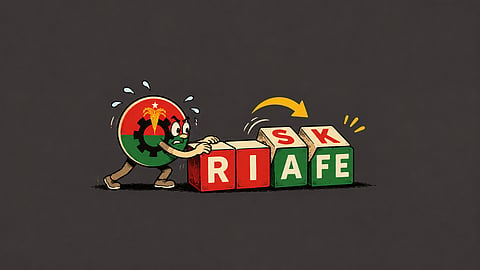
BNP is playing safe, and the public will keep paying

A few weeks ago, I was talking to a cousin in Dhaka. She said their electricity bill had gone up again, yet the power still went out almost every evening. I asked if anyone in the family had heard about the Adani deal. She laughed. “We only know the bills are getting higher. Nobody tells us why.”
That answer has stayed with me.
On November 14, Energy Minister Iqbal Hassan Mahmood Tuku explained why the government was reluctant to cancel the agreements with India and Adani. The sovereign guarantees attached to the contracts, he said, made withdrawal risky. It could damage Bangladesh's credit rating and undermine foreign investors' confidence. Instead, the government wants to negotiate a lower price.
There are risks in walking away from a major power agreement. Bangladesh needs electricity and cannot afford reckless financial decisions. But why is a government that once criticised this deal now reluctant to challenge its terms?
When BNP was in opposition, its leaders described the Adani agreement as one-sided and harmful to Bangladesh. They questioned how it was negotiated. Now that they are in power, the tone has changed. The same contract signed under Sheikh Hasina's government is being treated as something that can only be adjusted at the margins.
Signed in 2017 without an open competitive tender, the agreement commits Bangladesh to buying electricity from Adani's coal-fired plant in Godda, India, for 25 years. Bangladesh's National Review Committee examined the deal and submitted its findings in January 2026.
Reuters reported that Adani's electricity was costing Bangladesh 39.7% more than power from its nearest private-sector competitor. The committee also assessed the price as roughly 50% above a reasonable benchmark. It questioned the coal pricing formula, fuel costs and provisions that pass Indian corporate taxes on to Bangladesh.
Bangladeshi media reports put the estimated additional burden at $400 million to $500 million annually. Over the 25-year contract, the extra cost could reach around $10 billion. These are estimates, not money already lost, but the potential burden is substantial. Consumers and taxpayers bear the cost through electricity bills and public subsidies.
Other countries have shown that Adani agreements can be challenged. Sri Lanka questioned the tariff attached to Adani Green Energy's proposed wind projects in Mannar and Pooneryn, revoked an earlier Cabinet approval and moved towards renegotiation.
The government initially said the projects had not been cancelled. In February 2025, Adani Green announced its withdrawal. Kenya, meanwhile, moved to cancel Adani-linked agreements, including an airport expansion and a power transmission project, although the two followed different legal processes.
The US legal proceedings also attracted attention. In November 2024, prosecutors charged Gautam Adani and others over alleged bribery and securities fraud connected to solar contracts. Adani denied the allegations. In August 2026, a US judge dismissed three criminal counts against Adani, his nephew Sagar Adani and another executive.
This was not an acquittal or a finding that the allegations were false. Separately, Gautam and Sagar Adani agreed to SEC civil judgments involving penalties of $6 million and $12 million respectively, without admitting or denying the allegations.
These cases do not mean Bangladesh can walk away from its contract without consequences. But they show that agreements involving Adani are not beyond scrutiny.
Bangladesh has grounds for questioning the deal. Its review committee identified anomalies and possible irregularities and recommended considering international arbitration in Singapore. The government should use those findings rather than treating the sovereign guarantee as the end of the discussion.
A sovereign guarantee creates financial obligations, but it does not automatically make every commercial term immune from challenge. The government can push for changes to the tariff, coal pricing, tax provisions and capacity charges. It should make its demands clear, set a deadline for negotiations and prepare its legal case if those talks fail.
Bangladesh needs to reduce its dependence on expensive imported electricity. Investment in domestic gas, solar power and the national grid would strengthen its bargaining position. The less dependent the country is on one supplier, the more room it has to negotiate.
The public deserves answers. The government should publish the review committee's findings, explain what it wants Adani to change and tell people how much it expects to save. Electricity costs are not just a matter for ministers and foreign companies. They affect every household.
I keep thinking about my cousin's comment. She does not follow international arbitration or understand sovereign guarantees. She sees the bill when it arrives and notices when the lights go out. For her, the Adani agreement is not a debate about foreign investment or diplomatic relations. It is another expense becoming harder to manage.
BNP spent years criticising the previous government's agreements. It cannot expect people to forget those criticisms because it has inherited the responsibility of governing. Nobody is asking the government to take reckless decisions. But there is a difference between caution and accepting an expensive arrangement without using the leverage Bangladesh has.
The agreement may last 25 years. The ministers defending it may not remain in office for even a fraction of that time. Ordinary people, however, will keep paying the bills. That is what playing safe could mean for Bangladesh.
—
Sabina Ahmed is a Bangladeshi-American finance executive and strategic adviser who recently joined Bangladesh’s National Citizen Party (NCP) as an adviser. An MIT graduate, she has more than 25 years of experience in finance, technology and nonprofit organisations. She has held senior roles at Google, Vodafone AirTouch, Deloitte Consulting and Wells Fargo