
How Bangladesh can fight an information war it cannot outspend
In late November 2024, a young lawyer named Saiful Islam Alif was brutally killed outside a court in Chattogram. Several Indian media outlets identified him as the defence lawyer for the arrested Hindu monk Chinmoy Krishna Das.
Reuters reported a version of the same claim, attributing it to a police officer who, the Bangladesh government later confirmed, had never made the statement. Reuters corrected its report after the government disproved the claim using court records. By then, the original version had travelled around the world.
That episode was part of a much larger problem. Since August 5, 2024, Bangladesh has faced a sustained flow of disinformation, predominantly from India. AFP reported that there was no public evidence that the Indian government itself orchestrated the false narratives. However, over 90% of them came from India.
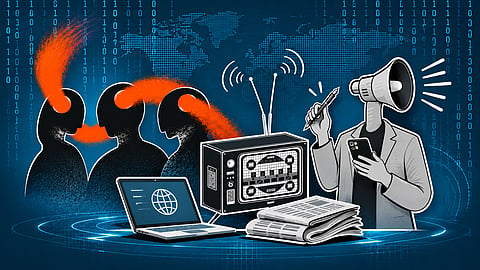
They spread through social media accounts, media personalities and mainstream Indian television channels, sometimes finding their way into international news agencies such as Reuters. A small state cannot match the scale and reach of such an information campaign. But it has several tools at its disposal to counter it.
How big is this campaign?
Barely two weeks after Sheikh Hasina fled Bangladesh, Rumor Scanner, a Bangladesh-based fact-checking organisation, traced communal misinformation and disinformation to 50 X accounts whose posts had been viewed more than 154 million times.
In 2025, it documented at least 155 cases of disinformation about Bangladesh originating from Indian media and social platforms. Of these, 126 originated on X and 91 concerned communal incidents.
The Center for the Study of Organized Hate, a Washington-based think tank, counted more than 700,000 posts from over 170,000 X accounts promoting the “Hindu genocide” narrative between August 2024 and January 2026.
The campaign persisted after the BNP replaced the Yunus-led interim government following the February 2026 national election. On November 21, several Indian news outlets reported that “300 Hindu houses” had been burnt in Narail and Pabna. Several pro-Awami League social media accounts circulated similar claims.
Investigations by local media found that at least 40 houses had been affected, with all the houses belonging to Muslims connected to the banned Awami League. The attacks followed the killing of two BNP leaders, allegedly by Awami League activists.
The campaign operates through three channels that form an information ecosystem.
First, social media. The number of new X accounts linked to disinformation about Bangladesh rose by 214% in late 2024. Media personalities, politicians and influencers amplify the claims.
Then comes mainstream Indian media, giving rumours the appearance of established news. In 2025, 73 Indian outlets published 140 false reports concerning 38 incidents. They included established outlets such as NDTV, Hindustan Times, News18, ABP, The Times of India, Zee News and India Today.
Finally, international news organisations can carry those claims to a global audience, as the Reuters episode demonstrated.
None of this negates the reality of communal violence in Bangladesh. Hindus have been attacked because of their religious identity. Such crimes demand investigation and justice. But the evidence presented does not establish genocide.
In 2025, police recorded 645 incidents involving minorities, classifying 12% as communal. It is the gap between documented communal violence and claims of genocide that the disinformation campaign exploits.
What are the consequences?
The consequences extend beyond social media. They affect people-to-people ties, diplomatic relations, trade and even sport.
In January 2026, following a public campaign in India, the Board of Control for Cricket in India (BCCI) ordered Kolkata Knight Riders to release Mustafizur Rahman. Bangladesh subsequently pulled out of the T20 World Cup hosted by India.
Days after the false report about Chinmoy Das’s lawyer, Indian protesters forced their way into Bangladesh’s Assistant High Commission in Agartala, vandalised the compound and pulled down the Bangladeshi national flag.
But arguably the greatest cost falls on Bangladeshi Hindus themselves. When Dipu Chandra Das, a young Hindu garment worker, was lynched and burnt in Mymensingh in December 2025, it was a real crime that demanded justice.
Yet it entered an information environment already saturated with fabricated atrocities. Genuine violence became harder to distinguish from invented incidents. Legitimate demands for minority protection risked being lost in competing political narratives.
When every communal incident is described as genocide, documenting actual crimes and establishing accountability become more difficult.
What does the evidence say works?
There is a persistent belief that debunking disinformation is futile, or worse, that repeating a falsehood only helps it spread. The evidence suggests otherwise.
Experiments in Argentina, Nigeria, South Africa and the UK found that fact-checking reduced false beliefs in every country. Most effects remained detectable two weeks later.
Bangladesh’s interim government launched CA Press Wing Facts in October 2024. The Press Institute Bangladesh established BanglaFact in early 2025.
Although CA Press Wing Facts often responded quickly, it ceased operating after February 2026. Independent fact-checking organisations such as Rumor Scanner, The Dissent and Dismislab have meanwhile built considerable followings.
The government should acknowledge their work, support independent fact-checking without compromising its editorial autonomy and give international journalists greater access to verifiable information. It should also strengthen its own presence on social media.
Bangladesh could learn from Taiwan. Facing sustained propaganda campaigns from China, Taiwan has adopted a “humour over rumour” approach. Its strategy is to answer false claims within 20 minutes, in 200 words, with two images, using humour to encourage people to share the rebuttal.
The principle is simple: make the correction as shareable as the lie. Taiwan also relies heavily on independent fact-checkers rather than government institutions alone.
Bangladesh could adopt a similar model. District police chiefs, district magistrates and the foreign ministry could establish a joint protocol requiring an evidence-backed preliminary statement on alleged communal attacks within two hours.
Preventing disinformation from taking hold in the first place can be cheaper than debunking it afterwards.
Known as pre-bunking, the approach teaches people to recognise manipulation techniques such as emotional appeals, scapegoating, clickbait and AI-generated deepfakes before encountering them.
In experiments involving nearly 30,000 people, researchers from the University of Cambridge and the University of Bristol, working with Google’s Jigsaw unit, found that a single 90-second video explaining manipulation techniques improved viewers’ ability to recognise them.
Ahead of the 2024 European elections, a pre-bunking campaign based on this research reached over 120 million YouTube users. Across 12 European countries, it improved people's ability to identify manipulation.
Finland, meanwhile, has taught media literacy in schools since the 1970s, adopted a national policy on the subject and topped the European Media Literacy Index every year since its inception in 2017.
Such institutional resilience takes years to build. Bangladesh cannot afford to postpone the process. Dhaka could begin with pre-bunking campaigns ahead of events that typically trigger surges in disinformation, including Durga Puja and national elections.
The government could also establish a small, professional agency dedicated to detecting and exposing foreign information manipulation, modelled on France’s VIGINUM.
In February 2024, VIGINUM exposed “Portal Kombat”, a network of at least 193 pro-Russian websites. It published the technical evidence, allowing independent researchers to examine its findings.
A Bangladeshi equivalent should employ data analysts, open-source investigators and multilingual specialists.
Its mandate should be narrow: identify the networks, establish how they operate, determine who is behind them where evidence permits, and publish findings that journalists, diplomats, researchers and technology platforms can independently verify.
Its credibility would depend on the quality of its evidence, not the authority of the government behind it.
Tell your own tale
The disinformation ecosystem has damaged relations between ordinary citizens on both sides of the border. Countering it need not further strain Bangladesh’s relationship with India.
Bangladesh should not attempt to win a propaganda war. A small state cannot match the media reach of a much larger neighbour. Nor should it answer fabricated narratives with counter-narratives of its own.
What it can do is establish credibility through rapid responses, transparent investigations and an honest accounting of its treatment of minorities. That means acknowledging genuine communal violence as readily as it exposes fabricated claims. A government that selectively acknowledges facts will struggle to persuade international audiences when it challenges falsehoods.
The objective should be to raise the cost of manufacturing disinformation and reduce the time it takes to expose it.
Bangladesh must tell its own story, backed by evidence. Otherwise, others will continue telling it on Bangladesh’s behalf.
—
The writer is a PhD researcher at a university in the US.