
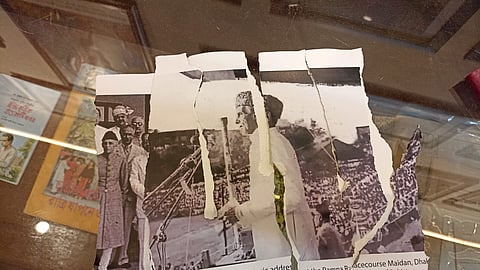
Jinnah photo paper cuttings at DUCSU museum: Torn down by Urdu student from 2001–02 session
Three photographs involving undivided Pakistan’s founding leader Muhammad Ali Jinnah displayed at the recently renovated museum of the Dhaka University Central Students’ Union (DUCSU) were torn down on Monday.
Abu Tayeb Habildar, a student of the Department of Urdu from the 2001–02 academic session and a former vice-president (VP) candidate in the 2025 DUCSU election, tore up the photographs around 2:30pm.
The incident has sparked fresh controversy and political tension on the university campus.
At the time, he said, “Displaying a photograph of Jinnah, who wanted to take away our mother tongue, at DUCSU is a gross insult to the blood-soaked history of the Language Movement and the Liberation War.”
Abu Tayeb was a student of the Department of Urdu at Dhaka University in the 2001–02 academic session. He came into the spotlight after contesting the VP post in the DUCSU election last year and was known as the oldest candidate among those who contested the election.
Jinnah, the founder of Pakistan and its first governor-general, died in 1948, more than two decades before Bangladesh’s Liberation War in 1971.
The DUCSU museum was reopened on Sunday (September 13) after a lengthy renovation. Three photographs and newspaper clippings involving Jinnah had been included in the exhibition.
The first was a newspaper clipping from 1970 featuring a photograph of Jinnah in a special report published by the then daily Dawn on the 1970 elections.
The second was a group photograph from the annual conference of the All-India Muslim League held in Lahore in March 1940, featuring figures including Sher-e-Bangla A K Fazlul Huq and Muhammad Ali Jinnah.
The third was a photograph of Jinnah delivering his historic speech on March 21, 1948, at the then Racecourse Maidan, now Suhrawardy Udyan, in which he declared Urdu to be the only state language of Pakistan, according to the caption.
Fatima Tasnim Zuma, DUCSU secretary for the Liberation War and Democratic Movements and in charge of the renovation work, said the photographs that were vandalised should not be viewed merely as images of Jinnah, but as historical records.
“The first one was a newspaper clipping from 1970, when Pakistan held its first general election. That news outlet published a report mentioning Jinnah,” she said.
Regarding the second photograph, she said it was taken in connection with the historic Lahore Resolution of 1940, introduced by A K Fazlul Huq, popularly known as Sher-e-Bangla.
“This is the Lahore Resolution in which the outline of the state of Bangladesh was drawn. Muhammad Ali Jinnah was standing alongside Sher-e-Bangla in that photograph,” she said.
Regarding the third photograph, Zuma said the person who vandalised it claimed that Jinnah had wanted Urdu to be made the sole state language and that this had led to the Language Movement.
“That is exactly what is written in the caption of the photograph. I do not know how ignorant someone has to be to call this glorification and demand its removal,” she said.
Earlier, the Bangladesh Jatiyatabadi Chhatra Dal (JCD) condemned and protested against the display of Jinnah’s photographs at the DUCSU museum.
In a statement issued on Monday morning, the organisation said the current DUCSU leadership had abandoned the aspirations of students and the university’s spirit of liberation.
It alleged that the inclusion of the photographs had revealed the DUCSU leadership’s “underlying sympathy for and affinity with Pakistan and the defeated forces of 1971.”
The Dhaka University proctor, Israfil Prang, said the university administration was taking the vandalism seriously. Legal advice was being sought on what legal action could be taken over the incident, he said.
He added that all related issues, including why and for what purpose the photographs were installed at the DUCSU building and the circumstances surrounding their removal, would be brought under a broader legal process.