
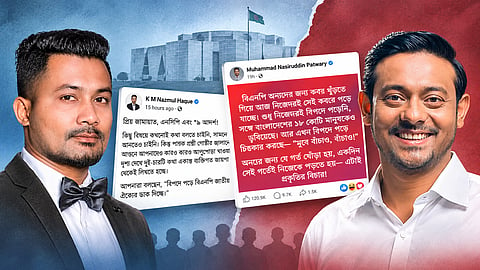
‘We will settle accounts’: PM aide rebukes Jamaat, NCP amid unity push
A member of Prime Minister Tarique Rahman's press team has sharply criticised Jamaat-e-Islami and the National Citizen Party (NCP), warning that their political conduct would be remembered, just a day after the prime minister reached out to the opposition in an effort to forge national unity.
K M Nazmul Haque, an assistant press secretary to the prime minister, made the remarks in a Facebook post on Thursday, addressing "Jamaat, NCP and others" while stressing that he was expressing his personal views.
“Your words, behaviour and position will stay in our memory. When the time comes, we will settle accounts: what we did for you in your hour of danger, and what you did when the country needed you,” he wrote.
The remarks came against the backdrop of Tarique Rahman's one-on-one meeting with Jamaat Ameer and Opposition Leader Shafiqur Rahman on Wednesday at the Prime Minister's Office in parliament for political unity against Awami Leage's recent violence.
The prime minister initiated the meeting, which lasted around 10 to 15 minutes, as political tensions intensified amid attacks and arson attributed to supporters of the Awami League.
The exchange on Facebook appears to have begun with NCP leader Muhammad Nasiruddin Patwary, who earlier criticised the BNP for seeking political unity after what he described as its own political miscalculations.
"BNP dug a hole for others and has now fallen into that very hole itself," Patwary wrote in a Facebook post.
He accused the party of having failed to recognise the dangers facing Bangladesh's 180 million people while pursuing its political interests.
"Now that it is in trouble, it is crying out, 'Save us, save us!'" he wrote.
Patwary added that those who dig holes for others eventually fall into them themselves, calling it a consequence of their own actions.
Hours later, Nazmul challenged what he described as opposition attempts to ridicule the BNP's appeal for national unity.
He accused Jamaat and the NCP of suggesting that the BNP was calling for unity only because it had found itself in trouble, while arguing that the same parties would have criticised the government had it not sought cooperation.
Nazmul also claimed that the BNP had stood beside the two parties during their previous 18 months in power, helping them navigate at least 18 major crises.
He challenged them to compare their efforts to dismantle Awami League networks during that period with what the BNP had accomplished over the past eight months.
Describing the Awami League as a national problem rather than one facing the BNP alone, he expressed confidence that the issue would be resolved soon.
Nazmul also warned against using the Awami League question as a political weapon and argued that being in opposition did not require rejecting every government initiative.
Although he explicitly described the post as personal, its confrontational language contrasted with the conciliatory message conveyed by the prime minister's meeting with the opposition leader.
Political analyst Mubashar Hasan, an adjunct researcher at Western Sydney University's Humanitarian and Development Research Initiative, welcomed the prime minister's initiative.
"The meeting was absolutely positive," he told Daily Waadaa, describing the meeting as an important step towards restoring political cooperation.
Hasan argued that the BNP had previously made a strategic mistake by focusing its political attacks on Jamaat and the NCP rather than addressing the Awami League question.
"It was a strategic mistake for BNP to focus on negative, focus on Jamaat and NCP bashing without addressing the Awami League question," he said.
"Through this, greater unity was disrupted."
He said the divisions had created political space for the Awami League.
"That gave Awami League a space to resurgence and return. So it was a good leadership move from the Prime Minister to invite and have a candid discussion with the Jamaat leader," he said.
Hasan also welcomed Jamaat's response, warning that relations between the former political allies had become increasingly strained.
However, he cautioned that resolving differences over political reforms would be difficult because of competing interests within the parties.
"You need strong leadership. You need unequivocal support to the leader within BNP," Hasan said.
The exchange comes as the NCP prepares to launch a 39-day nationwide protest programme on November 23, demanding, among other things, the trial of the Awami League as a terrorist organisation and implementation of the July Charter referendum verdict.
____