
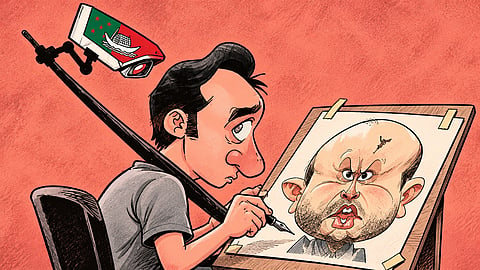
Barrister Fuad questions gun imagery in Mehedi Haque’s cartoon, raises concerns over threats
Barrister Asaduzzaman Fuad has criticised cartoonist Mehedi Haque over a cartoon depicting a gun aimed at his head, questioning whether the imagery crosses the boundary between political satire and the normalisation of violence.
In a Facebook post, Fuad questioned the message behind the cartoon, linking its imagery to death threats he said Awami League members were routinely making.
“Thank you for considering me a suitable subject for a cartoon. But what exactly is the message being conveyed by depicting a gun aimed at my head? That I deserve to be shot in the forehead and killed?” Fuad wrote.
“This is precisely the kind of threat that Awami League members are now making routinely.”
Fuad questioned whether creative expression was being turned into a vehicle for promoting violence.
“The question is whether creative art is being turned into a form of terrorism. We are well aware of the dangerous consequences of such portrayals throughout history, both at home and abroad,” he said.
“I hope the cartoonist will take the gravity of this into consideration.”
This is not the first time Haque’s political cartoons have drawn criticism over their underlying narratives.
In a Daily Waadaa opinion piece published on July 17, titled The pencil and the prison of ‘indoctrinated’ ideas, his recent works were criticised for reproducing political binaries cultivated during Sheikh Hasina’s 15-year rule.
The article argued that Mehedi’s depiction of an Islamist takeover in post-uprising Bangladesh reinforced a narrative long propagated by the Awami League and sections of the Indian media.
That narrative, the article argued, reduced Bangladesh’s diverse political landscape to a choice between “secular authoritarianism or the Taliban”, conflating opposition to the Awami League with religious extremism.
The piece also questioned Mehedi’s portrayal of post-uprising accountability, pointing to the UN investigation into the July killings and subsequent judicial proceedings.
--