
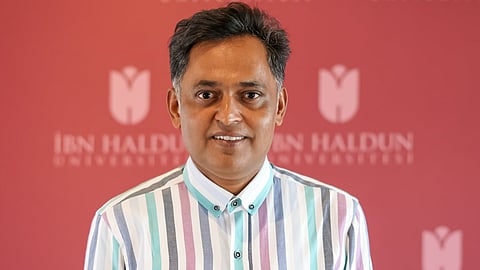
India’s stance on Bangladesh undermines its claim as 'Mother of Democracy,' Prof Irfan Ahmad tells Yeni Safak
Professor Irfan Ahmad, a distinguished academic in anthropology and sociology at Ibn Haldun University, questioned India's claims of being the world's largest democracy and the "Mother of Democracy," on Monday arguing that New Delhi’s stance toward Bangladesh directly contradicts these assertions.
In an interview with Yeni Şafak on the sidelines of the 2nd International Conference on Bangladesh Studies in Türkiye, Irfan raised concerns over human rights violations, enforced disappearances, and flawed elections under Bangladesh’s former regime. He questioned why a nation claiming democratic leadership would shelter a leader whose record stands at odds with core democratic principles.
The conference was organised by Istanbul University and the Center for Policy and Social Research (CPSR), bringing together participants from Bangladesh, Türkiye and other countries.
“If there is any truth to the claim that India is the 'mother of democracy,' the question arises: why would the world's largest democracy provide shelter to a person who has been anything but a friend of democracy?” Irfan said.
Reflecting on Bangladesh's political history, he noted that while elections were held, fundamental questions remained regarding their fairness and integrity.
“Democracy is not simply about holding elections,” he stressed, pointing out that opposition parties were either forced out of the process or subjected to conditions that rendered their participation meaningless, resulting in "token elections." He also highlighted widespread human rights abuses and the systematic use of extreme torture under the previous administration, citing high-profile cases documented by international media outlets like Al Jazeera.
Irfan sharply criticized New Delhi’s reaction to Bangladesh’s July 2024 mass uprising. He observed that instead of backing the Bangladeshi people's democratic aspirations, Indian political commentators and media outlets negatively characterized the popular movement, falsely labeling it as a "jihadi coup" or an "anti-India" plot.
“A country that considers itself a democratic leader should naturally support genuine democratic activism,” he said. “Instead, India opposed the 2024 uprising.”
He warned that New Delhi's regional approach risks alienating neighboring populations.
“If you position yourself as a hegemonic power and fail to respect the political aspirations and sovereign choices of people – whether in Bangladesh, Myanmar, or Sri Lanka – claims of being the world's largest or 'mother of' democracy become entirely empty, and no one will take them seriously,” Irfan concluded.
---