
How Bangladesh found a new Test identity post-Shakib
Bangladesh have been a Test nation for close to 26 years, and in almost 17 of them, the team’s identity was built around one player – Shakib Al Hasan.
His dual value as a world-class spinner and capable batter gave Bangladesh flexibility while choosing the playing XI. And for years, the management used it to field an extra specialist batter.
But this Shakib dependency came at a structural cost.
The Shakib era and its structural cost
Having Shakib in the Test side—an all-rounder with 4609 runs and 246 wickets in Tests—gave Bangladesh a genuine strategic advantage, but it also locked the team into a particular template.
Since 2016, when right-arm off-spinner Mehidy Hasan Miraz debuted, Bangladesh have had the option of fielding three capable spinners in Shakib, Taijul Islam, and Miraz in the red-ball format.
This spin-first composition naturally encouraged spin-friendly pitch preparation at home. Test surfaces at home became reliably low, slow, and awkward in bounce—conditions that unsettled visiting batters but also limited the development of Bangladesh's own players, who rarely had to learn to bat or bowl on sporting pitches.
The three-spinner system in home Tests was so ingrained that even when Shakib wasn’t available, Bangladesh still stuck with it.
As recently as 2023, Bangladesh fielded just one pacer – Shoriful Islam – in two home Tests against New Zealand.
Taijul and Miraz step up
When playing away, left-arm spinner Taijul—who has now taken over Shakib as Bangladesh’s highest wicket-taker in Tests—would often get sidelined as the management would prefer an extra pacer, and in Shakib, the side already had a very capable left-arm spinner.
Since Shakib became unavailable in Tests after the Kanpur Test against India in September 2024, Taijul has become a mainstay in the Test team, featuring in all 12 Tests since and claiming 67 wickets, which includes six five-wicket hauls.
Shakib’s absence also left a gap in the batting department, where Miraz stepped up.
The all-rounder has featured in 11 of the 12 post-Shakib Tests, accumulating 542 runs—the fifth highest in the team—with the help of a half-century and a century.
On April 30, 2025, Miraz also completed Test cricket's fastest-ever double of 2,000 runs and 200 wickets, achieving the milestone in his 53rd Test—one match quicker than Shakib.
The pace revolution
The potential of Bangladeshi pacers in the red-ball format first got attention after Ebadot Hossain’s lethal spell helped Bangladesh win the Mount Maunganui Test against New Zealand in 2021—their first-ever Test win over the Kiwis.
Interestingly, Shakib did not feature in that match.
The pace revolution was only just gaining momentum under the captaincy of Mominul Haque when Chandika Hathurusingha returned as the Bangladesh head coach, and with him returned the formula of producing rank turners for home Tests.
But in the last few years, especially since the 2-0 Test series win over Pakistan in 2024, pace has once again become the central part of Bangladesh’s Test bowling attack.
And a bulk of that credit goes to Nahid Rana—Bangladesh's first true-blue speedster.
All aboard the Rana express
Even before Rana, Bangladesh had a decent pace attack in Tests.
With the experienced Taskin Ahmed as the leader of the attack, a skilful left-arm seamer in Shoriful Islam, a reliable medium pacer in Hasan Mahmud, and handy backups like Tanzim Hasan Sakib, Kamrul Islam, and Ebadot, Bangladesh already had a solid pace attack in the red-ball format.
All that was missing was an X-factor—enter Rana.
In the second Test against Pakistan in 2024, he clocked 152 kph — the fastest delivery ever recorded by a Bangladeshi bowler.
Pakistan's senior batters, including Babar Azam and Mohammad Rizwan, were visibly late on their strokes against him. In the fourth innings, he took 4-44 to help Bangladesh bowl Pakistan out for 172—a collapse that set up a six-wicket win.
He then travelled to the Caribbean and claimed his maiden five-wicket haul in Tests to help Bangladesh register a 101-run win in Kingston.
His raw pace elevated Bangladesh’s bowling attack to the next level and gave them confidence to win on good surfaces even at home.
The structural changes that took place since Shakib’s unavailability ironically helped Bangladesh evolve into a more balanced Test unit.
This has been reflected in the results column as well, with Bangladesh winning six of the 12 Tests after Shakib’s exit, drawing one and losing five.
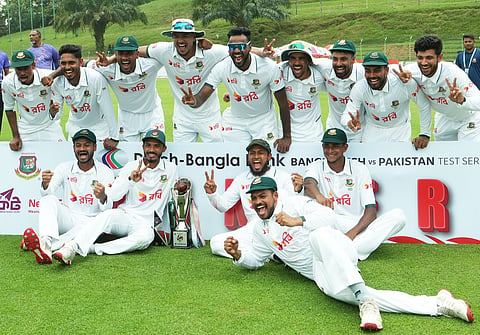
The latest two of the six wins came at home in the just-concluded series against Pakistan in matches that exhibited Bangladesh’s fresh approach in the five-day format.
A historic streak
Before August 2024, Bangladesh had failed to beat Pakistan in Tests after 13 attempts – a record that included a 0-2 series defeat as recently as 2021.
Then came the 2-0 series sweep in Rawalpindi in 2024, where Bangladesh ended this winless streak.
The Pakistan team landed in Dhaka in May with hopes of retribution. But their aspirations were crushed in the first Test in Mirpur, with Miraz and Rana claiming five-wicket hauls in the first and second innings, respectively, and skipper Najmul Hossain Shanto hitting a first innings ton to power the hosts to a 104-run win.
In the second Test in Sylhet, despite setting a mammoth 437-run target, Bangladesh were anxious late on Day 4, as Pakistan were 141 runs away from victory with five wickets in hand and two set batters in Rizwan and Salman Ali Agha in the middle.
Taijul then came to Bangladesh’s rescue, deceiving Salman with a ball that went on straight through the gap between bat and pad to clean bowl him.
He picked up another wicket late in the day to leave Pakistan 316-7 at the close of play.
On Wednesday, when the overnight pair of Rizwan and Sajid Khan had reduced the required runs to 79, Taijul had Sajid caught at slip to break their resistance and complete a well-deserved five-wicket haul.
Pakistan lost the next two wickets without adding another run, with Taijul rightfully claiming the last wicket to fall to finish with 6-120 as Bangladesh won the match by 78 runs and the series 2-0.
The bigger picture
This was Bangladesh's fourth consecutive Test win – something they have never before achieved.
This was also their fourth straight Test win over Pakistan, something they have only previously done against Zimbabwe.
More than the wins, however, what stands out is the conditions in which they were achieved.
The victories in Dhaka and Sylhet came on surfaces that offered a genuine contest between the bat and the ball, not on low, slow tracks Bangladesh once used to level the playing field artificially.
Bangladesh competed on merit and won, signalling a systemic shift in how Bangladesh play Tests in the post-Shakib era.
The biggest Test for the Shanto-led side awaits in August, when they will tour Australia for a two-Test series – Bangladesh’s first red-ball series Down Under since 2003.
The matches against Australia will be the biggest trial for this Bangladesh Test team – it will gauge how good they really are. But for now, they can take pride in what they have achieved and how far they have progressed in Tests in the post-Shakib era.