
BSEC eyes two-month IPO approvals, favours open-ended mutual funds
The Bangladesh Securities and Exchange Commission (BSEC) is targeting IPO approvals within two months and prioritising open-ended mutual funds as part of a broader reform drive to deepen the capital market and attract more investment.
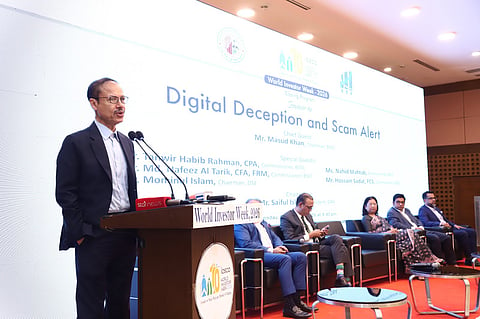
BSEC Chairman Masud Khan outlined the initiatives at a seminar titled “Digital Deception and Scam Alert”, jointly organised by the Dhaka Stock Exchange (DSE) and the DSE Brokers Association of Bangladesh (DBA) on Monday. The seminar marked the concluding session of World Investor Week 2026.
“Our main objective is to deepen the market. We must increase market capitalization; there is no other option,” he said, stressing the need to broaden the range of investment products and expand the market's capacity to mobilise capital.
He said as part of the IPO reform initiative, the commission has introduced checks aimed at completing approvals within two months. It is also allowing adjustments to accumulated-loss requirements for large infrastructure projects with long gestation periods, including power plants, hotels, cement factories and steel plants, according to the chairman's remarks.
The reforms are intended to make listing requirements more responsive to the financial realities of capital-intensive businesses while maintaining appropriate scrutiny of companies seeking to raise funds from the public.
Khan also expressed a strong preference for open-ended mutual funds as the future direction of the country's asset management industry.
“The only future for us is open-ended mutual funds—not closed-ended, full stop,” he said.
The commission is also working to introduce licensed mutual fund agents and financial advisers to widen retail participation and improve access to professional investment guidance.
On the broader market outlook, the chairman highlighted the relationship between interest rates and stock prices, saying lower interest rates generally support the market, while higher rates can put downward pressure on share prices.
“There is an inverse relationship between interest rates and the stock market. If interest rates fall, the stock market rises; if interest rates rise, the stock market falls,” he said.
He also raised concerns over the banking sector's asset quality, arguing that reported non-performing loan (NPL) figures did not fully capture the underlying stress.
“The official NPL figure is 32%, but figures do not hide reality—the actual number is far higher than 32%,” he said, adding that the impact approached 50% when rescheduled loans were included.
The chairman also said he had directly communicated with the Bangladesh Bank governor and its leadership about extending a special fund for supporting the stock market, which is due to expire on November 30.
“Regarding the bank special fund expiring on November 30: I communicated directly with the Bangladesh Bank Governor and leadership, emphasizing that we must extend it—and my request is to see if the amount can be increased,” he said.
Investor protection and financial transparency were also central themes of the seminar. Khan urged investors to look beyond reported profits when assessing a company's financial strength.
“Profit is a concept and cash is a fact,” he said.
He stressed that cash flow from operating activities provides a clearer picture of a company's underlying financial health than profit figures alone.
“A cash flow statement will give a real picture of what has the strongest company—the company whose cash flow from operations is very strong,” he said.
The chairman also called for more effective investor education, while acknowledging the limits of awareness campaigns if investors do not apply what they learn.
“We have been talking about investor education for so many years... but as the English saying goes: ‘You can take a horse to water, but you cannot make it drink,’” he said.
He urged the media to exercise responsibility in reporting on the capital market, calling for greater emphasis on fundamentals and verified information rather than sensational coverage.
“The press also has a responsibility... don't just output sensational news. Focus on the fundamentals and present positive developments for the market,” he said.
The seminar also addressed the growing threat of digital investment scams, including fake investment groups, phishing, identity theft and misleading promotions on social media.
DSE Chairman Mominul Islam said the exchange was working to modernise its surveillance and monitoring systems and strengthen coordination with the BSEC to combat fraudulent activities and protect investors.
BSEC Commissioner Nahid Mahtab, meanwhile, said market manipulation should be identified by analysing patterns of transactions, the relationships between parties, possible motives and the overall impact on the market, rather than assessing individual trades in isolation.
DBA President Saiful Islam, in his concluding remarks, called for an increase in the allocation intended to support the stock market from Tk 200 crore to Tk 300 crore. He also proposed extending the validity of financial statements used in IPO applications from 120 days to 180 days to give companies more time to complete special audits and comply with the forthcoming IPO rules.
---