
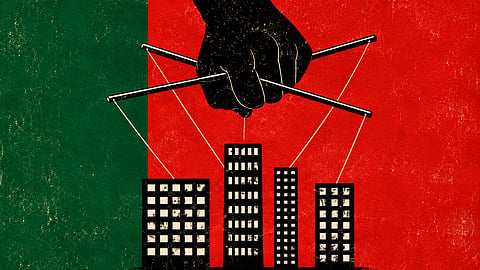
BNP's economic choices come with a political price
Every political government has choices to make. When deciding on economic policies and economic governance, they have to weigh the demands of voters, political allies, leaders, their grassroots, donors, foreign counterparts and diplomatic ties. These actors often do not align and pull the strings in different directions.
The government thus faces the challenge of sailing its boat to the shore it wants to dock. The storm comes from every direction. And this BNP government has inherited and continues to attract storms from too many directions. It has found itself in an economic crisis and it looks impossible for the government to achieve the promises it made in its election manifesto.
Moving forward, the government's success will depend on trade-offs which will get harder with time.
To understand the trade-offs, let us first take note of the government's immediate priorities. The government needs to stimulate private sector credit growth to achieve its vision for employment. It has to tackle RMG labour unrest to sustain RMG exports. It has to prepare for the post-LDC graduation challenges in sustaining exports.
The government has to tackle the energy crisis and the banking sector crisis to gain investor confidence. The energy crisis also reaches agriculture and food security. The government does not want to put further strain on farmers, as diesel prices have already risen twice this year. People in Bangladesh are struggling with inflation and they do not want added costs while income has stalled.
On the flip side, devaluation of the taka against the dollar remains a possibility. Given the struggle with jobs, the government has to weigh how far to push informal businesses and how to address the growing crisis involving battery rickshaws. The persistence of informality will further cost the government its ambition for export diversification.
Beyond the border, the government is desperate to find allies. Japan is showing interest in our ports, economic zones and skilled labour migration. China is also in the race to capture the market for infrastructure, water and our corridors that connect the region.
The US wants its own cut in the Bangladesh market for cotton, energy and more. BNP's future rests on the choices it makes, as each choice will come with a sacrifice.
Credit for private sector growth vs a stable taka
The first trade-off is between cheaper money and a stable taka. Private sector credit grew 4.17% in September against the central bank's projection of 6.8% for December. The bank cut the policy rate on July 30 for the first time in six years. If it cuts again to stimulate credit, the taka will fall further.
A weaker taka raises the taka price of the fuel, cotton and wheat we import, and non-food inflation is already at 9.89% nationally and 10.21% in the villages. If the bank holds the rate instead, it protects the price level and leaves credit growth where it is.
It has chosen the second so far, selling $122 million in late October to hold the rate near 125 taka. That choice costs employment.
The worker's wage vs the buyer's order
The second trade-off is between the wage and the order. The wage board met on November 9 and the workers proposed 32,000 taka against the 12,500 taka fixed three years ago, while the owners asked for four working days to answer. In the meantime, more than 40 factories in Savar and Ashulia have closed under Section 13(1), which withholds wages from workers who stopped work.
If the board sets a wage the factory must absorb, the order might move to cheaper suppliers. If it sets a wage the worker cannot live on, the workers will settle the matter on the street. The government might lean towards a middle ground between the workers and their employers.
But whatever choice the government makes, it will also be under pressure to find more products and markets to export. The government is running out of time to reduce its dependence on RMG and cheap labour.
The factory's gas vs the farmer's diesel
The third trade-off is between the factory's gas and the farmer's diesel. The Power Division expects to need about 90,000 crore taka this year for electricity and gas against 42,000 crore taka allocated, and nearly half of that allocation went out in the first three months.
The government can fund that gap in two ways, either by borrowing or by raising gas and electricity tariffs. Since the borrowing will come from the same banks, it will take from the credit that the private sector is waiting for. The government has already raised tariffs once this year.
The government has raised the price of diesel from 100 taka to 135 taka in seven months. Since about 71% of our irrigation pumps run on diesel, the Boro season that begins now will cost the farmer more for every hour of water he pumps.
If the government wants to hold that cost down through the season, it will have to pay for it either by borrowing more or by charging the factory a higher gas tariff.
Jobs in the informal economy vs tax revenue
The fourth trade-off is between the jobs that exist and the revenue the government needs. About 84% of our workers are informally employed and that share has barely moved in two years. The budget lowered the value-added tax threshold from 30 lakh taka to 20 lakh taka and tied a business identification number to bank accounts and utility connections.
The government gazetted rules for battery rickshaws on October 29. The drivers blocked roads across Dhaka on November 9 against the licence fee and the limit of five vehicles to an owner. Revenue collection is already more than 50,000 crore taka behind the four-month target.
Registering the smallest traders and the rickshaws will raise little of that, and it comes from the people with the least to give. On the other hand, if most of our small firms remain informal, our export potential will remain thin, as an informal firm cannot show the quality control, traceability and labour standards a foreign buyer asks for.
Exports to America vs imports from China
Beyond the border, the choice has hardened since February. Japan has signed an economic partnership agreement, a labour memorandum and six instruments in Tokyo, and it supports our request to join the regional trade bloc.
China has signed a loan of $335.78 million for Mongla and a developer agreement for the Anwara zone, and its price was the language we accepted on Taiwan. The agreement signed with Washington in February allows the United States to restore the original 37% tariff if we conclude a preferential agreement with a non-market country, and China sits on that list.
A second clause reaches the fuel for Rooppur. We sell to America and we buy from China. Our imports from China were $18.56 billion last financial year against $694 million of exports. America cannot supply what China supplies.
The government will have to choose, as it cannot keep all these actors happy. Voters will weigh its performance on jobs, income and inflation, and if it holds inflation down by sacrificing jobs and income, it will lose ground. In my reading, it must therefore put private sector credit growth first, and make energy available to the factory and the farm at a price they can pay.
It should then pay for new export markets and begin the shift away from cheap labour and our dependence on RMG. The cost of those choices will be forgotten by the time this government reaches the end of its term.
--
Md Rubaiyath Sarwar is the Managing Director, Innovision Consulting and Lead, Inclusive Development and Socio-Economic Equity, Panam Institute