
Phoenix from the ashes: A trip to Nagorno-Karabakh
"We are thankful to God, to our president, and to our fallen soldiers that they have brought these lands back to us," said a visibly emotional Sugrat as we stood silently to listen.
We were gathered before the Azikh Cave in the Garabagh (Karabakh) region of Azerbaijan. Housing the prehistoric remains of an ancient human—perhaps a young woman—it is a site of immense cultural significance. Garabagh occupies a deeply emotional space in the Azerbaijani national psyche. "Qarabağ Azərbaycandır!" ("Karabakh is Azerbaijan!") is a refrain emblazoned on billboards, carved into hillsides, and printed on everyday items like water bottles across the country. It took three decades before Azerbaijan reclaimed control of the territory from Armenian separatists following military offensives in 2020 and 2023.
Sugrat, an official with the President’s Office in the region, accompanied us on our first day in Garabagh. Her family hails from Kalbajar, one of the towns in the area. Access to the region remains tightly restricted, with permits notoriously difficult to secure.
Our group comprised 33 travelers from 13 countries on the 17th invited tour organized by Mehraj Mahmudov—an Azerbaijani recognized as one of the most traveled people on Earth. The journey was coordinated through Charles Veley, founder of Most Traveled People (MTP), a global community for extreme travelers. This marked Charles’s seventh trip to the area with MTP, and my travel partner and I were proud to be the first two Bangladeshis to enter Garabagh. Moving in a convoy of 13 SUVs, the first thing that struck us was the sheer scale of the reconstruction boom. Slick highways, multiple new housing blocks and other cultural centres were opening at pace!
During the Soviet era, the area was known as the Nagorno-Karabakh Autonomous Oblast within the Azerbaijan SSR, despite having an ethnic Armenian majority. In the late 1980s, local authorities held a referendum seeking unification with the Armenian SSR. Had it succeeded, it would have created an Armenian enclave surrounded by Azerbaijani territory. As both nations gained independence, the dispute erupted into a full-scale war. Armenian forces captured Nagorno-Karabakh along with seven surrounding Azerbaijani districts, displacing hundreds of thousands of ethnic Azerbaijanis. A separatist administration took root, heavily backed by Yerevan. Though internationally unrecognized, the self-proclaimed Republic of Artsakh held de facto control for decades. While international maps designated the area as Azerbaijan, no ethnic Azerbaijanis remained. The conflict brought forced displacement to both sides—Armenians leaving mainland Azerbaijan, and Azerbaijanis expelled from Armenia and the occupied territories. War is rarely kind to civilian populations.

A volatile status quo held for decades, punctuated by periodic skirmishes. Everything shifted in 2020 when a 44-day war saw Azerbaijan recapture most of the surrounding territories and key cultural centers. The region's administrative center, known as Stepanakert to Armenians and Khankendi to Azerbaijanis, remained under Armenian control, connected to Armenia proper via the guarded Lachin Corridor under Russian peacekeeper oversight.
In 2022, I visited Armenia just two weeks after a sharp two-day border escalation that touched mainland Armenia. At that time, the Lachin Corridor and Stepanakert remained under Armenian administration. However, in September 2023, Azerbaijani forces launched a swift, one-day military operation that brought the entire region under Baku’s control. The Republic of Artsakh collapsed, and Azerbaijan fully integrated the territory, designating it as Garabagh. We were there to witness this critical turning point firsthand.
Our MTP delegation was granted three days of rare, unfiltered access, making us among the first foreign visitors welcomed into newly reopened zones.
Day one
Setting out at 4:00 AM on our first day, we arrived in Fuzuli, a key entrance to the region. A brand-new airport greeted us, alongside a modern highway cutting through the landscape toward Hadrut in the mountains. What was once a three-hour journey over rugged terrain now took under 45 minutes. From a hilltop lookout, we observed the town undergoing active rebuilding. Displaced families have begun returning under government resettlement programs reserved primarily for former refugees who fled during the 1990s war.
After taking in the mountain landscape and visiting a newly constructed mosque, we made the steep, 800-step climb to the Azikh Cave. At the top, an archaeologist briefed us on the site's historical weight—having impressively completed the same grueling climb in a full suit and formal shoes.
Our day continued through three of the region’s most prominent urban centers: Shusha, Khankendi, and Aghdam. In each city, battle-scarred ruins stood alongside rapid modern development. Shusha, considered the cultural soul of Azerbaijan, was the most strategic prize of the 2020 war. Reconstruction there is proceeding with careful architectural harmony. We visited a newly opened museum dedicated to the 19th-century Azerbaijani musician Sadigjan, celebrated for refining the tar—a stringed instrument that struck me for its resemblance to the dotara of my native Bangladesh.
We also stood at a high lookout in Shusha overlooking steep cliffs. It was up these sheer rock faces that Azerbaijani special forces climbed undetected during a crucial surprise attack in 2020. From Shusha, we proceeded to Khankendi. Following the September 2023 offensive, more than 100,000 ethnic Armenians fled the city for Armenia. Because the military operation ended quickly, structural damage to the city was minimal, giving it the most functional urban atmosphere of our stops. Government administrative offices were operational, new housing was under construction, and the local stadium had been renovated. During a stop near the town square, our group flooded a local café—briefly overwhelming the staff, who were unaccustomed to dozens of international tourists ordering coffee and pastries all at once.
Our final stop of the day was Aghdam, where stark reminders of war met ambitious restoration efforts. We toured the restored complex of the 18th-century Panah Ali Khan palace, complete with stables preparing to house Karabakh horses. As dusk fell, the call to the Maghrib prayer echoed near a ruined building slated to become an open-air museum of the war. We had just visited the nearby Aghdam Mosque, a deeply revered monument that had suffered desecration during the occupation. Now fully restored, it offered a serene space where I joined in prayer. Inscribed above the entrance were two evocative verses from the Quran:
"Indeed, We have granted you a clear triumph." (Quran 48:1)
"And that man can have nothing but what he strives for." (Quran 53:39)
Our day ended with a long night drive into the mountains to a high-altitude resort fittingly named Heaven.
Day two
Day two began before dawn at 6:00 AM as we crossed the Omar Pass, rising over 3,000 meters above sea level to catch the sunrise over the Murovdag range. Winding mountain roads brought us to Kalbajar.
Here, the contrast between past and future was sharp. Ruined stone structures from the conflict sat opposite modern residential blocks under rapid construction. Unlike some areas restricted solely to displaced families, property in Kalbajar is being made available more broadly. Local officials outlined plans to turn the area into a major winter sports hub, using snow-preservation technology to extend the skiing season into May.
Resuming our journey, our 13-vehicle convoy proceeded under police escort toward the border district of Lachin. Along the route, we stopped at the natural hot springs of Istisu, where members of our group braved the nearly 50°C mineral waters alongside the freezing river nearby.
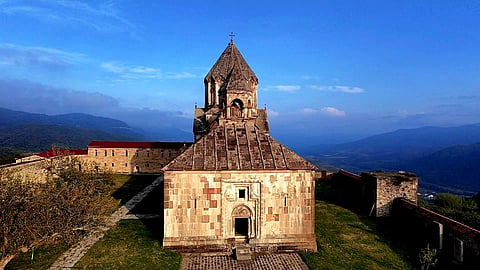
Our itinerary included visits to two historic mountain monasteries: Khudavank and Gandzasar. Both hold profound religious and historical importance for Armenians, who point to centuries of continuous worship and distinct monastic architecture as proof of their cultural legacy. To an amateur observer like myself, the stone carving and dome styles closely mirror classical Armenian ecclesiastical architecture I had seen before.
Conversely, Azerbaijani authorities present a different historical framework. Drawing on theories popularized by mid-20th-century Azerbaijani historians, officials maintain that these structures belong to the heritage of Caucasian Albania—an ancient Christian kingdom that existed in the Caucasus until the Middle Ages. Azerbaijan considers itself a cultural successor to Caucasian Albania, alongside minority groups like the Udis, arguing that these monuments represent national Azerbaijani heritage rather than Armenian history.
At both sites, officials highlighted architectural alterations and inscriptions added during the post-1990 period, characterizing them as unauthorized modifications to the original structures. They also noted the removal of historic church bells from Khudavank as a loss of cultural property.
Continuing onward, we reached the town of Lachin by evening. Nestled among lush, green mountains, it offered some of the most striking scenery of the journey.
Geographically, Lachin and Kalbajar lay outside the boundary of the former Soviet Nagorno-Karabakh Autonomous Oblast. When Armenian forces took control in the early 1990s, they occupied these surrounding Azerbaijani districts to create a land bridge to Armenia, forming a continuous territorial belt. Today, Azerbaijan has reorganized these lands into two administrative districts: Garabagh and East Zangezur.
The following morning, we traveled into East Zangezur toward the border zone. Regional transit plans, often discussed in connection with broader regional peace initiatives and transport corridors, aim to establish direct rail and highway links connecting mainland Azerbaijan across southern Armenia to its exclave of Nakhchivan. Standing near the border, we reached a viewpoint where the frontiers of Azerbaijan, Iran, and Armenia converge.
In nearby Jabrayil, we addressed one of the most persistent dangers in the region: landmines. The area remains heavily mined from decades of conflict. Because many devices were manufactured with plastic casings rather than metal, detection is notoriously difficult, and civilian casualties continue to occur. Experts provided a safety briefing on various ordnance types before conducting a controlled detonation of cleared mines, which one of our group members, Nolan from the Philippines, was invited to trigger.
As our intensive three-day journey drew to a close, we reflected on passing through places long known to us only through news headlines. While it was encouraging to see civilian life and infrastructure returning, the human cost remains heavy, marked by the recent displacement of over 100,000 ethnic Armenians who felt unable to remain under the new administration.
With diplomatic negotiations ongoing, there is hope that the long conflict between Armenia and Azerbaijan may finally give way to lasting stability.
-----
***Raiiq Ridwan is an UK-based doctor and traveller. The Garabagh leg of this trip was sponsored by Mehraj Mahmudov; all opinions expressed are the author’s own.