
Two years after Arakan Army massacre, Rohingyas still suffer
When Omar Ahmod returned to his home at Hoyyar Siri in Rakhine in July 2024, the village was already desolate.
“I saw heaps of skeletons and skulls scattered everywhere, clothes still intact though the flesh had decayed”, Omar recounted his memory to Human Rights Watch (HRW) as he visited the nearby paddy field where dozens of Rohingya villagers were massacred in May, 2024.
HRW on Tuesday published a 56 page report on the massacre of the Rohingya Muslims in Hoyyar Siri village by the Arakan Army (AA) in May, 2024.
On May 2 that year, the rebel group in Myanmar fired openly on unarmed villagers who were seeking safety following the fighting between AA and Myanmar’s military forces.
The report, titled “‘Skeletons and Skulls Scattered Everywhere’: Arakan Army Massacre of Rohingya Muslims in Hoyyar Siri, Myanmar,” documented the harrowing accounts of the survivors of the attack, corroborating them by satellite imagery, and verified photographs and videos.
The New York based rights group compiled a list of more than 170 Rohingya Muslims, including about 90 children, who were killed or still are missing after the incident.
“The toll is likely much higher”, the statement said.
“Today, the massacre’s survivors are effectively detained by the Arakan Army, which has neither provided redress nor held those responsible to account”, said Meenakshi Ganguly, deputy Asia director at Human Rights Watch.
“The Arakan Army’s murder of hundreds of Rohingya civilians and the burning of their village in Rakhine State in 2024 took the armed conflict with Myanmar’s junta to a new level of depravity,” she said.
Hostilities between Myanmar junta forces and the Arakan Army in Rakhine State resumed in November 2023. Both sides have been accused of serious abuses by the rights groups, especially for targeted attacks on civilians, arson and unlawful conscription.
“First, my son was hit by a bullet. Then my wife and baby daughter were shot, followed by my other daughter”, one survivor told HRW.
The fighters continued to fire on the villagers as they turned back and attempted to flee, the survivors said.
They have now been relocated to a makeshift camp near the village by the Arakan Army, from where many fled to Bangladesh as they were denied freedom of movement, subjected to forced labor and faced shortages of food and medical care.
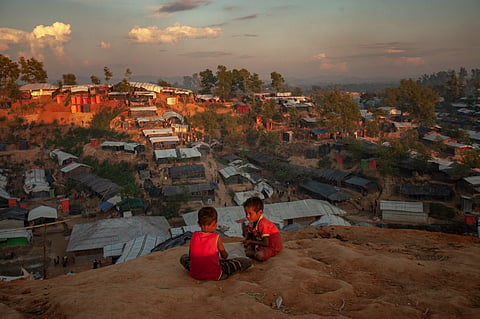
Bangladesh currently hosts more than one million Rohingya refugees in the sprawling camps in the southern district of Cox’s Bazar, bordering the Rakhine state of Myanmar.
More than 7,50,000 of them fled Myanmar following the military crackdown on the Muslim ethnic group in 2017.