
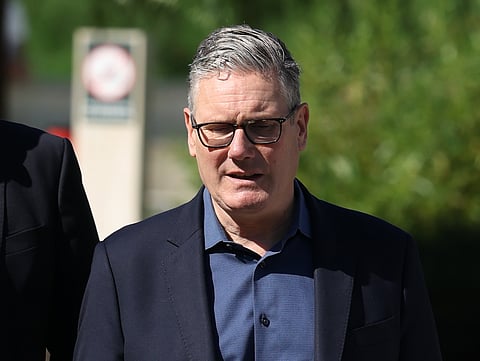
Starmer resigns but will stay on until successor is chosen
British Prime Minister Keir Starmer announced on Monday that he is stepping down as leader of the governing Labour Party after mounting pressure from within his party, saying he will remain as caretaker prime minister until a new leader is elected in the coming weeks.
Starmer said his decision was aimed at allowing Labour to renew itself after a sharp decline in the party's popularity since its landslide general election victory in July 2024.
"I believe this is the right decision for the country and for the Labour Party," Starmer said outside 10 Downing Street. "I will continue to serve as caretaker prime minister until my successor is chosen."
His resignation comes after weeks of speculation and follows the victory of intraparty rival Andy Burnham in a special parliamentary election last week. Burnham, the former mayor of Greater Manchester, had planned to challenge Starmer for the Labour leadership and is due to be sworn in as an MP on Monday.
Starmer's departure makes him the sixth British prime minister in a decade to leave office before completing a full term, underscoring a prolonged period of political instability since the Brexit referendum in 2016.
Although Burnham is widely viewed as the frontrunner to succeed Starmer, it remains unclear whether he will face a contested leadership race. Former health secretary Wes Streeting, who resigned from the Cabinet last month in protest at Starmer's leadership, has already said he will stand if a contest is held.
Discontent within Labour has been growing for months as lawmakers sought a change in direction following the government's declining popularity. Despite winning a commanding majority in the 2024 general election, Starmer struggled to deliver the economic growth he had promised, improve strained public services and ease the cost-of-living crisis.
His premiership was also overshadowed by a series of political setbacks, including criticism over the appointment of Peter Mandelson, a long-time associate of Jeffrey Epstein, as Britain's ambassador to the United States.
Labour has also lost support to the Green Party while facing increasing pressure from Reform UK, Nigel Farage's anti-immigration party, which has consistently led recent opinion polls.
Even before Starmer's announcement, U.S. President Donald Trump weighed in, attributing the British leader's political troubles to immigration and energy policies.
"Keir Starmer will resign as Prime Minister of The United Kingdom. He failed badly on two very important subjects – IMMIGRATION AND ENERGY (OPEN NORTH SEA OIL!). I wish him well!" Trump wrote on social media.
Relations between Starmer and Trump, initially cordial, have deteriorated in recent months, particularly over the Iran conflict, which Britain declined to join.
Despite his domestic difficulties, Starmer received broad praise for his foreign policy, especially for rallying European support for Ukraine following Russia's invasion and helping manage the diplomatic and economic fallout from the Iran conflict.
While many Labour MPs have thrown their support behind Burnham, others argue Starmer has been treated unfairly. Labour MP Neil Coyle criticised what he described as "the prospect of an utter stitch-up and the media circus being rewarded," warning that any successor would face the same political pressures.