
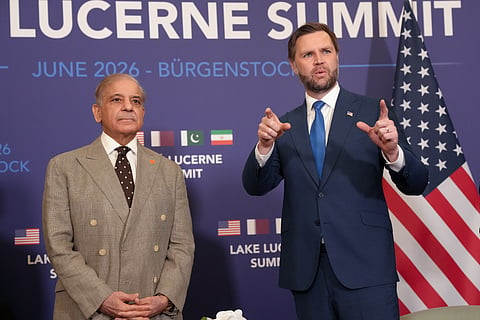
US-Iran talks end, technical negotiations to continue
Here is the text with all hyperlinks and embedded links removed:
High-level negotiations in Switzerland seeking a permanent end to the Iran war concluded early Monday, with lower-level talks planned for the rest of the week as Iran and the United States agreed to create a "de-confliction cell" to address the fighting in Lebanon.
A statement from mediators Pakistan and Qatar said the cell would include the Lebanese government and would "ensure the adherence of the termination of military operations in Lebanon." But it remains unclear whether that will be enough to stop fighting between the Iranian-backed militia Hezbollah and Israel, which occupies Lebanon and insists it must maintain a free hand to attack militants launching attacks into northern Israel.
The U.S. offered no immediate comment, while Iran praised the mediators' work.
The talks marked the start of a 60-day diplomatic process aimed at reaching a permanent agreement to end the Iran war. But the fighting in Lebanon remains one of the key sticking points.
Meanwhile, Iran insisted it had again shut the Strait of Hormuz over the weekend, the narrow mouth of the Persian Gulf crucial to global energy shipments, while the U.S. said maritime traffic continued.
Tense start to talks
The negotiations had a tense start Sunday in Switzerland, when Tehran took offense at U.S. President Donald Trump's threat to attack and his warning that Iran's president should watch what he says.
"Iran must immediately stop their highly paid PROXIES in Lebanon from causing trouble," Trump said on social media. "If they don't, we'll hit Iran very hard again, just like we did last week, only harder!!!"
The comments complicated efforts by Vice President JD Vance and mediators Pakistan and Qatar to keep Iran engaged in discussions.
"They would do better to be careful about their statements," Iran's lead negotiator, Mohammad Bagher Qalibaf, said on X after Trump's comments. "Our armed forces are prepared to respond to them in a different manner. They may keep talking, it is we who act."
Later, Iranian Foreign Minister Abbas Araghchi wrote on X that "tireless Pakistani and Qatari mediation has delivered major progress to end Lebanon War." He said the first "real test" of the negotiations would be whether the de-confliction cell succeeded in halting the fighting in Lebanon.
Vance and U.S. negotiators, including Steve Witkoff and Jared Kushner, Trump's son-in-law, met with Qalibaf and Araghchi for what Iranian state media said was about 80 minutes. One released photo showed Vance on a laptop working with Qatar's prime minister, while Kushner stood behind him.
Pakistan and Qatar said after the meeting that lower-level technical talks would continue in Switzerland throughout the week. The talks aim to produce the breakthroughs needed for senior officials to return and finalize an agreement.
A senior U.S. diplomat involved in the negotiations, speaking on condition of anonymity, said Sunday's discussions included clarifying Iran's recent statements about the Strait of Hormuz. Negotiators also discussed mechanisms to ensure the waterway remains open, enforcement of a ceasefire in southern Lebanon and the nuclear issue.
Iran wants to focus first on Lebanon
Negotiators are in a 60-day push to reach an agreement on technical issues with major implications for global security and the world economy.
"The question before us now is how much more can we accomplish together? Can we turn over a new leaf?" Vance said as the talks began, asking whether they could "change relations in the Middle East permanently."
The Iranian delegation did not address Western journalists before the talks.
The U.S. wants Iran to remain engaged in negotiations over its nuclear programme amid concerns it could be used for military purposes, an allegation Tehran denies. Washington also wants Iran to commit to keeping the Strait of Hormuz open. Iran claimed on Saturday that it had closed the strategic waterway, but the U.S. disputed that, saying shipping traffic continued.
A renewed ceasefire in Lebanon, brokered on Saturday, appeared to be holding. Israel's military said it would lift movement restrictions for residents near the Lebanese border on Monday, another sign of relative calm.
However, neither Israel nor Hezbollah is a signatory to the U.S.-Iran agreement. Israeli Prime Minister Benjamin Netanyahu has vowed to keep Israeli forces in southern Lebanon until any threat to Israel is eliminated, while Hezbollah has refused to halt attacks unless Israel commits to withdrawing.
Dispute over Iran's nuclear programme
The agreement signed by Trump and Iranian President Masoud Pezeshkian immediately allows Tehran to sell its oil freely and paves the way for Iran to access billions of dollars in previously frozen assets. A member of Iran's negotiating team told state television that draft language had been agreed on "temporary sanctions waivers for oil and petroleum derivatives."
The agreement also calls for Iran to dilute its stockpile of highly enriched uranium, believed to be stored at nuclear sites targeted in U.S. strikes a year ago.
Pezeshkian, however, declared Sunday that "we will never back down from the right to enrich uranium, and the other side is also forced to accept it," according to Iranian state media.
In a telephone interview with Fox News, Trump later warned that the Iranian president should watch what he says and threatened further action against Iran.
Iran approached the talks cautiously after previous rounds of nuclear negotiations with the United States were twice interrupted by military strikes over the past year.
Deal sparks political backlash
Trump and Vance have faced sharp criticism from some Republicans, who have compared the agreement to the Obama-era nuclear deal that Trump and many Republicans argued failed to end Iran's nuclear programme.
The new agreement allows commercial vessels to pass through the Strait of Hormuz for 60 days without charge but does not rule out future fees imposed by Iran. Trump also warned Saturday that the United States could impose its own tolls if no permanent agreement is reached within 60 days, saying the money would pay for services provided as the "Guardian Angel" of Middle Eastern countries.
The Trump administration has sought to reassure global markets that the conflict would have only a limited impact on oil prices, as Americans continue to complain about high gasoline prices ahead of the peak summer travel season. Oil futures fell nearly 8% after the agreement was announced.