
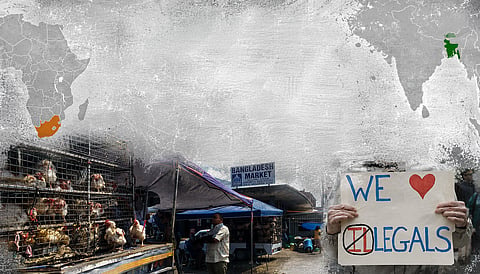
Bangladeshis in South Africa fear June 30 may trigger fresh wave of xenophobic unrest
The last time armed robbers stormed Nurul Huda's grocery shop near Johannesburg, they tied him up, locked him inside a freezer and left him for dead.
As they looted the store, the attackers sat on top of the freezer drinking cold drinks, convinced he would suffocate.
“I managed to push one corner of the door open just enough to breathe,” Huda told Daily Waadaa. A local woman later found him and rescued him.
Nearly a decade later, that fear has returned.
Across South Africa, Bangladeshi migrants are anxiously counting down to June 30, when anti-immigration groups plan nationwide protests demanding undocumented foreigners leave the country.
The movement behind the demonstrations, March & March, has threatened a national shutdown if its demands are ignored, prompting fears of renewed xenophobic violence.
The anxiety comes amid a broader anti-migrant backlash that has swept parts of South Africa in recent weeks. Thousands of foreign nationals from countries including Malawi, Mozambique, Ghana and Nigeria have fled their homes or sought repatriation after attacks and intimidation campaigns.
At least two people have been reported killed in the unrest, while several governments have begun evacuating their citizens.
South African President Cyril Ramaphosa has urged citizens not to scapegoat migrants for the country's economic woes, warning that unemployment, crime and inequality cannot be solved through vigilantism.
Labour unions representing millions of workers have also urged members to stay away from the planned demonstrations.
For Bangladeshis, the fears are deeply personal.
South Africa has witnessed repeated outbreaks of xenophobic violence since the end of apartheid, including the deadly 2008 attacks that killed more than 60 people and displaced over 100,000 migrants.
Community leaders estimate that around 300,000 Bangladeshis live in South Africa, many running small shops in townships and semi-urban areas. Between 2015 and 2020, roughly 400 Bangladeshis were reportedly killed in robberies and xenophobic attacks, while hundreds of migrant-owned businesses were looted or destroyed.
The memories are now resurfacing in Bangladeshi community groups on social media.
One Bangladeshi resident, Mohammad Rakib, recently warned fellow migrants on Facebook that after watching tensions escalate around nearby businesses, he believed there was a “90 percent chance” of looting on June 30.
Huda, who has lived in South Africa for 12 years, now operates a biscuit factory in Gauteng province with a South African business partner. The factory supplies around 1,000 buckets of biscuits daily, mostly to migrant-owned grocery stores.
Many of those customers have already stopped placing orders.
“If the grocery shops are attacked, my business will suffer too,” he said.
The uncertainty is compounded by immigration concerns. Bangladeshi diaspora members say thousands remain on asylum permits, many of which have not been renewed since the Covid-19 pandemic, leaving them in legal limbo.
Police document inspections and road checkpoints in some areas have further heightened anxiety among migrants.
Not all regions are equally tense. In Cape Town, Bangladeshi businessman Shanto Sikder said the atmosphere remains relatively calm.
“Cape Town is comparatively peaceful,” he said. “The fear is much stronger around Johannesburg and surrounding areas.”
As June 30 approaches, many Bangladeshi migrants are limiting travel, reducing business activity and monitoring developments closely.
For Huda, the memories of that freezer have become impossible to ignore.
“We survived before,” he said. “Now we are just hoping nothing happens again.”
—