
Ukraine's drone campaign forces Russia to reinforce Moscow: Zelenskyy
Russia is redeploying a significant portion of its air defences to protect a handful of strategic targets, including Moscow, as Ukraine's long-range drones continue to strike deep inside Russian territory, Ukrainian President Volodymyr Zelenskyy said.
Ukraine has intensified its aerial campaign against Russian military installations and energy infrastructure in recent months. The strikes have caused fuel shortages, disrupted military supply lines and contributed to slowing Russia's invasion more than four years into the war, while also unsettling Russian officials.
In his nightly video address on Wednesday, Zelenskyy said Russia was moving additional air defence systems to Moscow, as well as to Valdai — a town around 500 kilometres northwest of the capital where Russian President Vladimir Putin maintains a residence — and to the Kerch Bridge, the vital link connecting Crimea to mainland Russia.
"In the Moscow region alone, they have amassed hundreds of launchers" for air defence missiles, Zelenskyy said. "Nearly 90 launchers have been redeployed to Valdai from other regions of Russia."
Ukrainian drones have recently targeted both Moscow and St Petersburg, Russia's second-largest city and Putin's hometown. Kyiv has also sought to isolate Crimea, the Black Sea peninsula that Russia illegally annexed in 2014.
Zelenskyy suggested the redeployment would leave other areas of Russia more exposed to Ukraine's increasingly sophisticated long-range drones, which are now capable of travelling more than 1,500 kilometres.
"There are many difficulties for Russia, all because Putin refuses to end his war and refuses to hear our proposals for a meeting, genuine negotiations and a dignified peace," he said.
Zelenskyy has accepted an unconditional ceasefire proposed by US President Donald Trump, but Putin has rejected it. More than a year of US-led peace efforts has yielded little progress.
Trump's tone towards Zelenskyy softens
Ukraine's outlook has improved as its domestic production of advanced drones has helped offset Russia's battlefield advantages in a grinding war of attrition.
Speaking at the White House on Wednesday, Trump, who has previously criticised Zelenskyy, described the Ukrainian leader as "courageous" and said he was "doing pretty well" in the war.
Zelenskyy said he secured assurances of continued international support during a recent summit of G7 leaders, which Trump attended. He suggested that promised military assistance would help sustain Ukraine's increasingly aggressive campaign.
"Our operation, including the one concerning Crimea, has been carefully planned, and the way it is unfolding clearly demonstrates that if Ukraine receives exactly what we discussed with our partners at the G7 — and that depends on our partners' decisions — we will quickly create conditions in which Russia will be forced to choose peace," he said.
"We very much hope for a positive response from our partners. They know exactly what we are talking about."
Ukraine keeps watch on Belarus
Belarus, whose industrial sector has helped support Moscow's war effort, appears to have switched off signal repeaters on its territory that Kyiv says were used to guide Russian drone attacks against Ukraine.
Last week, Zelenskyy demanded that Belarus remove the relay equipment, which he said enabled Russian drones to strike targets in western Ukraine. He warned that Kyiv could take action against the installations, apparently raising the possibility of military strikes that could bring the two countries into direct confrontation.
In an audio message distributed to journalists, Zelenskyy said Ukrainian intelligence had determined that the repeaters were now inactive.
However, he added: "There are many questions regarding Belarus."
Belarus shares borders with both Ukraine and Russia, and Moscow used Belarusian territory as a staging ground during the initial invasion of Ukraine.
Ukrainian military authorities on Wednesday ordered the mandatory evacuation of communities in the Chernihiv region bordering Belarus from 1 July.
The Washington-based Institute for the Study of War said Belarusian President Alexander Lukashenko continues to tread a careful line.
"Lukashenko continues to stall and deflect the Kremlin's intensified attempts to drag Belarus into the war in Ukraine while maintaining relatively neutral rhetoric towards Ukraine," the think tank said.
Ukraine's armed forces commander, General Oleksandr Syrskyi, said last week that the country was strengthening defences along its northern frontier, including establishing new army drone units.
Russia targets civilian fuel infrastructure
Russia launched one ballistic missile and 90 long-range strike drones against Ukraine overnight, according to the Ukrainian Air Force.
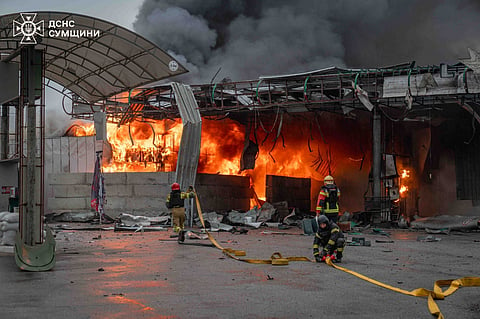
A Russian drone struck a petrol station in Ukraine's north-eastern Sumy region on Thursday morning, injuring four people, including two employees, regional administration head Oleh Hryhorov said.
Russian forces have attacked petrol stations in the region 13 times in June alone, he added.
In the southern city of Zaporizhzhia, an overnight Russian strike injured a woman and damaged another petrol station, according to regional governor Ivan Fedorov.
Meanwhile, Russia's Defence Ministry said its air defences had intercepted 269 Ukrainian drones between late Wednesday and early Thursday.
Several Russian airports temporarily restricted flights overnight amid the latest wave of drone attacks.