
Turkey summit offers chance to boost defence spending, reaffirm unity: NATO Deputy Commander
NATO's deputy commander has told that he hopes next month's summit in Turkey will encourage member states to increase defence spending, reaffirm support for Ukraine and demonstrate the alliance's unity.
Air Chief Marshal John Stringer, NATO's Deputy Supreme Allied Commander Europe, spoke to AP in London less than two weeks before the crucial summit in Ankara on 7-8 July, which will test the cohesion of the 77-year-old alliance.
US President Donald Trump has sent mixed signals about America's military presence in Europe and has repeatedly threatened to withdraw from NATO. He has also unsettled European leaders with his proposal to annex Greenland and his warm rhetoric towards Russian President Vladimir Putin. Last week, US Defence Secretary Pete Hegseth criticised NATO allies for not allowing the use of their military bases in attacks on Iran as he announced a surprise six-month review of US forces stationed in Europe.
Meanwhile, in the UK — the country that holds the post of NATO Deputy Supreme Allied Commander Europe — senior government ministers recently resigned over what they described as military spending plans that fail to keep Britain adequately protected.
"Summits are highly political events and they are a demonstration of any organisation's unity," said Stringer, a senior Royal Air Force officer. He added that it would be unusual if NATO had not experienced periods of turbulence during decades of expansion.
"Are we in one of those moments at the moment? Yes, we are," Stringer said during a military conference in London, where AP also interviewed several senior European military officials about their hopes — and concerns — ahead of the summit.
European allies step up defence spending
Trump has long pressed European allies to take greater responsibility for their own defence. With the notable exception of Spain, NATO's European members have largely responded by committing unprecedented levels of investment in their armed forces.
Russia poses an increasing threat to Europe, meaning allies must strengthen their militaries while continuing to help Ukraine weaken Russia's military capabilities, said Maj. Gen. Indrek Sirel of Estonia's armed forces.
"Europe as a whole has a lot to do in order to be credible against Russia," said Brig. Gen. Jyri Raitasalo of Finland, which shares NATO's longest border with Russia.
Stringer said European nations are investing to build "a really credible force", pointing to countries that are quadrupling production of 155mm artillery shells. He said the summit would focus on expanding defence production at a scale NATO has not required for decades.
European commanders await clarity on US plans
The outcome of Hegseth's six-month review will determine how quickly European nations need to assume greater responsibility for their own security. Earlier this month, the US military in Europe said Washington planned to withdraw certain capabilities from the continent while expecting allies to fill the resulting gaps.
Although the Trump administration insists that any troop reductions have been planned and coordinated with allies, Sirel said uncertainty remains over the future deployment of US forces in the Baltic states, including their role in deterring Russia along NATO's eastern flank.
Sirel said he remained "confident" that Estonia could continue to rely on an American military presence, although the country's armed forces were preparing contingency plans in case circumstances changed suddenly.
Stringer acknowledged that replacing US long-range strike and surveillance capabilities would be difficult, but said allies could bridge the gap through a combination of complementary systems.
Only the United States operates B-1 and B-52 bomber aircraft, but Stringer said that, in theory, their capabilities could be offset by combining missile systems launched from land, sea and smaller aircraft.
Sudden policy shifts complicate defence planning
NATO allies were left bewildered in May when Trump announced he would send 5,000 US troops to Poland just weeks after ordering the same number withdrawn from Europe.
Such abrupt policy changes complicate military planning, which depends on long-term strategies, said Raitasalo, the Finnish military's logistics chief.
"If you change your mind, or change your plan, every week or every month or even every year, you will not get very good results," he said.
Raitasalo added that NATO members must commit to delivering concrete military capabilities rather than simply promising higher defence spending.
Sweden's army chief, Maj. Gen. Jonny Lindfors, said a successful summit would produce "a common picture of how to realign when it comes to deterrence and defence".
Lindfors said he hoped to see at least an outline — if not "a clear vision" — of how defence responsibilities would be redistributed so that he could understand what "NATO 3.0 is starting to look like".
Britain under pressure to match its commitments
Britain's Defence Secretary John Healey resigned earlier this month, along with another government minister, arguing that the government was unwilling to commit the resources required to "defend the country at this time of rising threats".
At last year's NATO summit, member states agreed to spend 3.5% of gross domestic product on core defence. The UK pledged to meet that target by 2035, but Healey argued that the government's proposed defence investment plan would increase spending to only 2.68% of GDP by 2030.
The new Defence Secretary, Dan Jarvis, has said Britain will honour its commitments, while the government has pledged to publish its long-term defence spending plan.
By the time of the summit, NATO expects member states to present a "credible path" towards spending 3.5% of GDP on defence, and the UK is "as beholden to that as anybody else", Stringer said.
He added that Britain could not rely solely on "thought leadership" within NATO and must instead match its influence with sufficient "forces and resources".
NATO's credibility hangs in the balance
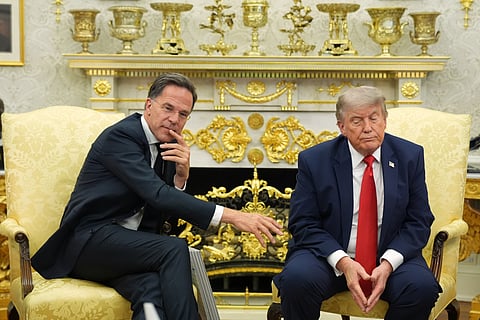
At last year's summit, NATO Secretary-General Mark Rutte persuaded Trump to remain committed to the alliance by arguing that he would achieve "BIG" success in convincing allies to increase defence spending.
"It's a tricky question," Lindfors said when asked whether one of the summit's main objectives was to avoid another public confrontation with the US president.
Stringer said this year's gathering must demonstrate both "cohesion and unity" among NATO's 32 members, while also allowing for "honest" discussions and the presentation of "credible" defence plans.
Raitasalo said the meeting must move beyond traditional "communiques, roadmaps and action plans" and instead demonstrate deterrence through concrete action.
If NATO members fail to translate promises into meaningful military capabilities, he warned, the alliance's "credibility" will be at risk.