
NASA races to save ageing Swift telescope with pioneering robotic rescue mission
NASA is preparing a daring mission to save one of its ageing space telescopes from falling back to Earth, with a robotic spacecraft set to attempt the first US orbital rescue of its kind.
The $30 million salvage mission could begin as early as this week with the launch of a robotic spacecraft developed by US start-up Katalyst Space Technologies.
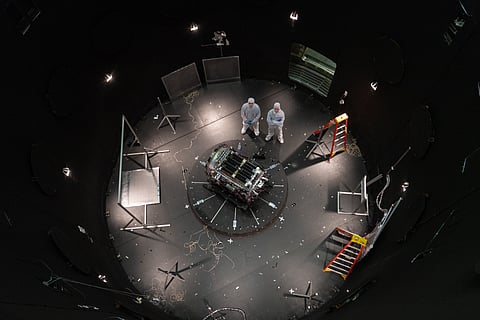
NASA has hired the company to raise the orbit of the Swift Observatory, enabling it to continue detecting some of the universe's most powerful explosions. Katalyst's three-armed spacecraft, named Link, will pursue Swift after launching aboard an air-launched Pegasus rocket from an atoll in the Marshall Islands in the Pacific. Liftoff could take place as early as Tuesday.
Since its launch in 2004, Swift has steadily lost altitude as a result of increased atmospheric drag caused by heightened solar activity. NASA says the observatory must be moved into a higher, more stable orbit as soon as possible if it is to remain operational.
The agency's Hubble Space Telescope, which is also gradually losing altitude because of the current period of intense solar activity, could eventually require a similar rescue mission.
Katalyst Space chief executive Ghonhee Lee said the company's next-generation robotic spacecraft, now under development, could be capable of extending Hubble's operational life within the next few years.
Only China has previously attempted a comparable mission, successfully boosting a satellite into a higher "graveyard" orbit four years ago.
"This is the first American space robot to go up and do anything like this," Lee told The Associated Press. "NASA has all these major observatories, and all of them can benefit from a service like this. What we're proving with this mission is that this is a new option available."
The autonomous Link spacecraft is expected to take around a month to rendezvous with Swift before using its three robotic arms to capture the observatory. It will then spend another two months lifting the 1.6-tonne gamma-ray telescope from its current orbit of 360 kilometres (224 miles) to around 600 kilometres (373 miles).
NASA estimates that the mission must begin before Swift descends below an altitude of 300 kilometres (185 miles), a threshold it is expected to reach in October.
Roughly the size of a small kitchen refrigerator, Swift has a 12-metre (40-foot) solar wingspan. Link is equipped with three robotic arms, each extending just over one metre (3 feet), ending in finger-like grippers designed to seize satellites that were never intended to be serviced in orbit.
If successful, Swift could resume scientific observations by September, according to Lee.
The mission remains highly challenging because Swift was never designed to be repaired or captured by a spacecraft. Company officials acknowledge there is no guarantee the rescue will succeed.
NASA awarded the contract to Katalyst last September with two clear objectives: complete the mission quickly and avoid causing further damage. Nine months later, the company says it is ready.
"I have to be honest. No one thought it was going to be possible. No one thought we would get as far as we've already gotten today," said Shawn Domagal-Goldman, NASA's director of astrophysics.
To slow Swift's descent and buy more time, NASA shut down all of the observatory's scientific instruments in February.
NASA's associate administrator for science, Nicky Fox, said the effort is worthwhile.
"If we let Swift re-enter, we would lose that telescope. We would lose a lot of capability," she said. "We don't currently have the budget to build another one to replace it."
Swift plays a unique role in astronomy. Designed to respond rapidly to transient cosmic events, it can quickly pivot to observe gamma-ray bursts, exploding stars and other short-lived phenomena. With discoveries expected from the James Webb Space Telescope and the upcoming Nancy Grace Roman Space Telescope, NASA believes Swift's ability to provide rapid follow-up observations will become even more valuable.
For Katalyst, the mission is also intended to demonstrate the commercial potential of in-orbit servicing. The company plans to launch a more advanced robotic spacecraft next year capable of servicing satellites as high as 35,800 kilometres (22,300 miles) above Earth.
Lee envisions fleets of robotic spacecraft one day repairing, refuelling and repositioning satellites, as well as helping construct orbital solar farms, data centres and other space infrastructure.
NASA says the 36-year-old Hubble Space Telescope, which was repeatedly serviced by astronauts during the Space Shuttle era, could become a candidate for a similar life-extension mission as early as 2028.
"It's a national treasure," Fox said. "People love Hubble."