
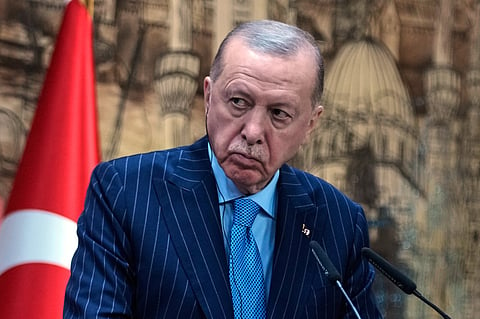
Erdogan rejects Israeli genocide proposal, accuses Israel over Gaza deaths
Turkish President Recep Tayyip Erdogan on Tuesday rejected an Israeli proposal to designate the mass killings of Armenians by the Ottoman Empire during World War I as genocide, accusing Israel instead of responsibility for the deaths of Palestinians in Gaza.
Erdogan was responding to a proposal approved by Israel's Cabinet on Sunday. The measure still requires approval by the Knesset and comes amid worsening relations between the two countries.
Turkey has long lobbied against international recognition of the mass deaths of Armenians around 1915 as genocide, while Armenia has campaigned for wider recognition.
Historians estimate that up to 1.5 million Armenians were killed by Ottoman Turks during and after World War I, in what is widely regarded by scholars as the first genocide of the 20th century. Turkey rejects the term "genocide", arguing that the death toll has been exaggerated and that those who died were victims of civil war and unrest.
"We pay absolutely no attention to the slanders against our country by this criminal network, which has the blood of 73,000 innocent people of Gaza, mostly children and women, on its hands," Erdogan said in a televised address after a Cabinet meeting.
"Our history is free from genocide, massacres, oppression and colonialism," he added.
Armenian Prime Minister Nikol Pashinyan, whose government has been working to normalise relations with neighbouring Turkey, declined to respond directly to the Israeli proposal on Monday, saying the issue should not be turned into a political weapon.
"We see no need to respond because we believe that refraining from entering into the issue of the weaponisation of the Armenian Genocide is in the interests of the Republic of Armenia," the state-run Armenpress news agency quoted Pashinyan as saying.
Turkey and Armenia have no formal diplomatic relations, and their shared border has remained closed since 1993. However, the two countries have held normalisation talks in recent years, with special envoys meeting to discuss reopening the border and restoring diplomatic ties.
Israel had for years avoided formally recognising the killings of Armenians as genocide for fear of damaging relations with Turkey. However, ties have steadily deteriorated over the past two decades, particularly amid the wars in Gaza, Lebanon and Iran.
Israeli Foreign Minister Gideon Saar, who introduced the proposal, said on Sunday that the "Armenian Genocide remains to this day the subject of an institutionalised campaign of denial and minimisation" by the Turkish government despite overwhelming historical evidence.
Saar noted that Israeli leaders, including Prime Minister Benjamin Netanyahu, had previously described the killings as genocide, although Israel's parliament has never formally recognised them through a vote.
He added that 32 countries, including the United States, Syria and Lebanon, have officially recognised the killings as genocide.
Israel and Turkey were once close allies, but relations deteriorated after Erdogan, whose ruling party has roots in Turkey's Islamist movement, came to power. Ties have continued to worsen over his strong criticism of Israeli policies towards the Palestinians.
On Sunday, Turkey's Foreign Ministry described Israel's move as "politically motivated", saying it was intended to divert attention from Israel's actions against Palestinians and proceedings before the International Court of Justice over allegations of genocide in Gaza. Turkey formally joined the case brought by South Africa in 2024.
Israel has repeatedly rejected accusations by the United Nations, Turkey and others that its military offensive in Gaza amounts to genocide. The country, founded in the aftermath of the Holocaust, denies the allegation.