
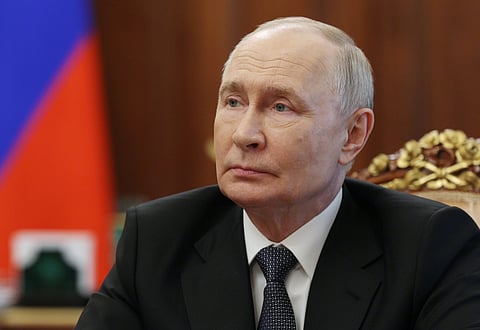
Putin shrugs off fuel shortages in Russia as he ramps up attacks on Ukraine
Russian President Vladimir Putin has played down worsening fuel shortages caused by repeated Ukrainian attacks on the country's oil infrastructure, insisting the situation is "not critical" and vowing to continue the war until Moscow achieves its objectives.
Despite mounting pressure on one of the world's largest oil producers, Putin has dismissed ceasefire proposals from Ukraine and its Western allies, portraying the attacks on Russia's energy sector as an attempt to distract from Kyiv's battlefield setbacks.
His remarks came as Russia launched one of its deadliest assaults on Ukraine's capital in recent months. An 11-hour overnight barrage on Kyiv into Thursday morning killed at least 21 people, with residential areas among the targets.
Fuel shortages deepen
Since March, Ukraine has carried out more than 50 reported strikes on oil refineries and other energy facilities in Russia and Russian-occupied Crimea, saying the attacks are intended to increase pressure on Moscow to end the war.
The campaign has brought the conflict closer to ordinary Russians, undermining the Kremlin's longstanding narrative that the war has little impact on daily life inside Russia.
According to Chris Weafer, chief executive of consultancy Macro-Advisory, about one-third of Russia's oil refining capacity has been knocked offline, with some facilities suffering damage that could take months to repair.
One of Moscow's largest refineries has been struck twice despite extensive air defence systems protecting the capital. A second attack on 18 June caused a major fire and damaged key equipment reportedly requiring repairs until the end of the year.
Government data show Russia's petrol production has fallen by around 17% to approximately 850,000 barrels per day. Fuel rationing has since been introduced in several regions, while motorists have faced long queues at petrol stations.
The situation has been particularly severe in Crimea, which Russia illegally annexed from Ukraine in 2014. Sales of petrol to private motorists have reportedly been suspended altogether.

Putin dismisses the impact
Chairing a government meeting last weekend, Putin acknowledged that Russia was experiencing a "difficult period" but insisted the shortages were temporary.
He said the government would speed up repairs to damaged energy infrastructure, consider importing petrol to ease supply shortages and expand production of air defence systems to counter future Ukrainian attacks.
Putin accused Ukraine of attempting to divide Russian society, disrupt Moscow's military campaign and force Russia into negotiations on terms favourable to Kyiv.
"We will not give them that chance," he said.
Although Putin maintained that the long-range strikes had "absolutely no effect on the situation at the front", Western military analysts say Ukrainian attacks on Russian logistics and supply lines have slowed Moscow's advance, contributing to a battlefield stalemate.
Putin nevertheless insisted Russian forces continued to make gains along the roughly 1,000-kilometre front line, citing the capture of villages and advances in eastern Ukraine.
Ceasefire proposals rejected
Putin also rejected renewed Ukrainian calls for a ceasefire.
He responded to Ukrainian President Volodymyr Zelenskyy's offer of direct talks by inviting him to Moscow—an option Kyiv has dismissed.
The Russian leader argued that any truce would simply allow Ukrainian forces to regroup.
He has made a ceasefire conditional on Ukraine withdrawing from the parts of the Donetsk region it still controls, a demand Kyiv has rejected.
Putin has also reiterated that any final peace agreement must require Ukraine to abandon its bid to join NATO, reduce the size of its armed forces and guarantee protections for the Russian language and culture.
In a televised interview last weekend, Putin claimed Ukraine had privately proposed limiting the fighting to the four regions Russia annexed—Donetsk, Luhansk, Kherson and Zaporizhzhia—but which Moscow does not fully control.
He said he rejected the proposal because it would allow Ukraine to redeploy forces from other parts of the front.
"Faced with a catastrophic shortage of personnel, the armed forces of Ukraine apparently believe this could be their salvation," Putin said. "Saving the Kyiv regime is not part of our plans."
The Kremlin said the proposal had been conveyed through confidential channels. Ukrainian officials have not publicly commented on the claim.
Putin also dismissed a Ukrainian proposal for both sides to halt long-range strikes deep inside each other's territory, arguing that Russia's attacks were "much more powerful, sensitive and, frankly speaking, destructive".
Thursday's missile and drone assault on Kyiv again struck residential neighbourhoods, despite Russian claims that it was targeting military facilities.
By contrast, most Ukrainian long-range attacks inside Russia have focused on oil refineries, defence factories and other military-related infrastructure.
According to the United Nations, more than 16,000 Ukrainian civilians have been killed since Russia launched its full-scale invasion in February 2022.